
When choosing stainless steel materials, 2205 duplex stainless steel and 316 stainless steel are often compared. They both have good corrosion resistance, but there are obvious differences in composition, pitting resistance, and use environment. Especially when facing high strength requirements or chlorine-containing environments, engineers and designers often need to make a trade-off between the two.
So, what is the difference between 2205 duplex stainless steel and 316 stainless steel? Which one is more suitable for your engineering application? Below we will conduct a comprehensive analysis from the aspects of chemical composition, corrosion resistance, cost, and application areas. Contact us
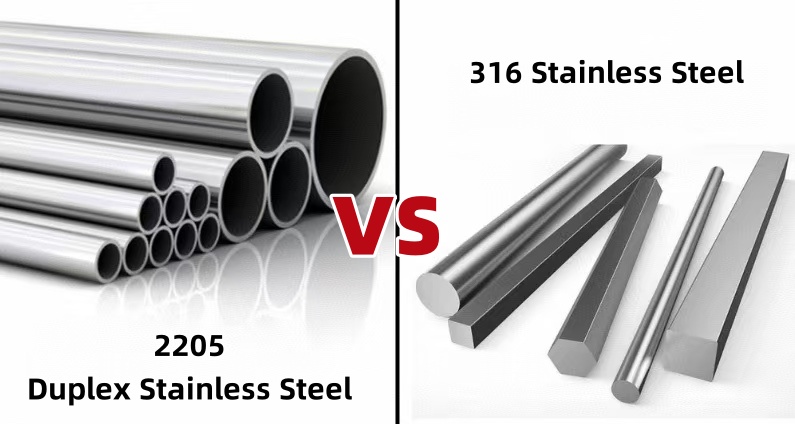
2205 Duplex Stainless Steel
2205 Duplex Stainless Steel refers to a super duplex stainless steel. It consists of a slightly higher content of chromium (22%) as well as nickel and molybdenum (5% and 3% respectively). It has a ferrite and martensitic duplex. Due to the ferrite, it is inherently magnetic. Alloy 2205 has very high corrosion resistance and is best suited for marine applications. Common uses include shipbuilding, offshore oil platforms and wind turbines. The high strength-to-weight ratio and low thermal expansion of duplex 2205 make it more demanding for low-temperature applications.
Advantages and Disadvantages of 2205 Duplex Stainless Steel
Advantages: The main advantage of alloy 2205 is its cost-effectiveness. It is less costly than other alloys with the same or lesser properties. It has high resistance to crevice corrosion, stress corrosion and acetic acid due to its high Ni and Mo content. Therefore, it is considered a marine stainless steel. Alloy 2205 has very high strength. This means that the thinner sections of the alloy have strength comparable to other steels with thicker sections.
Disadvantages: The limitation of Duplex Steel is that it has low toughness at low temperatures below 50°C. It has two phases which limits its operation at temperatures above 250°C. This is because it starts to form intermetallic phases which affect its weldability and other properties.
Advantages and limitations of 316 stainless steel
Advantages: The 316 grade has high corrosion resistance due to its high Cr and Mo content. This makes it highly resistant to acetic acid, crevice corrosion and stress corrosion. The non-magnetic properties of 316 steel make it suitable for the food processing industry. This is because it does not attract any dirt and is easy to clean. 316 also has higher formability and weldability than other austenitic steels used in piping systems and structural supports.
Disadvantages: 316 steel has high corrosion resistance due to its high Cr and Mo content, which limits its cost. In addition, due to its brittleness at low temperatures, it is not suitable for complex geometries and sharp bends.
316 Stainless Steel
316 stainless steel is an austenitic alloy. It contains up to 18% chromium, 14% nickel and 3% molybdenum. It is non-magnetic in nature. 316 alloy has high corrosion resistance and formability. It is mostly used in the food processing industry due to its corrosion resistance and high temperature resistance. Medical devices and tools are mostly made of 316 grade as they are less reactive with body fluids. High toughness makes it also highly demanded in the industrial sector.
2205 Duplex Stainless Steel vs 316 Stainless Steel
Chemical Composition
| Material | Key Alloy Composition (wt%) | Microstructural Characteristics |
| 2205 | – Chromium (Cr): 21-23% | Duplex structure (≈50% austenite + ≈50% ferrite), combining advantages of both phases |
| – Nickel (Ni): 4.5-6.5% | ||
| – Molybdenum (Mo): 2.5-3.5% | ||
| – Nitrogen (N): 0.08-0.20% | ||
| 316 | – Chromium (Cr): 16-18% | Single austenitic structure with high stability |
| – Nickel (Ni): 10-14% | ||
| – Molybdenum (Mo): 2-3% | ||
| – Carbon (C): ≤0.08% |
Core Differences:
2205 enhances strength and corrosion resistance through its duplex structure and higher Cr, Mo, and N content, particularly excelling in resistance to pitting and crevice corrosion.
316 relies on high Ni content to maintain austenitic stability, offering good corrosion resistance in non-chloride environments but with lower strength.
Welding and Processing Performance
| Process Type | Characteristics of 2205 Duplex Stainless Steel | Characteristics of 316 Stainless Steel |
| Welding | – Requires controlled heat input (to avoid excessive ferrite) | – Excellent weldability with conventional methods |
| – ER2209 filler metal recommended | – No special post-weld treatment required | |
| – Post-weld heat treatment (stress relief) needed | ||
| Cold Working | High work-hardening rate; intermediate annealing (e.g., 850-900°C) needed | Good cold-forming properties, suitable for complex shapes |
| Hot Working | Heating temperature restricted to 1000-1100°C to prevent brittle phase precipitation | Wide hot-working range (900 |
Corrosion Resistance
1. Resistance to Pitting and Crevice Corrosion
316 Stainless Steel: Contains molybdenum, making it more resistant to pitting and crevice corrosion than 304. It performs well in most mild chloride environments, but pitting and crevice corrosion can still occur in crevices with higher chloride concentrations, at high temperatures, or where there is an oxygen concentration cell. The critical pitting temperature (CPT) is relatively low.
2205 Duplex Stainless Steel: Due to its higher Cr and Mo content and the addition of nitrogen, 2205’s resistance to pitting and crevice corrosion far exceeds that of 316. Its critical pitting temperature (CPT) is significantly higher than that of 316, which means that it maintains excellent corrosion resistance in harsher chloride environments.
2. Stress Corrosion Cracking (SCC)
316 Stainless Steel: Austenitic stainless steels are generally at risk of stress corrosion cracking, particularly at high temperatures, in chloride-containing environments, and under tensile stress.
2205 Duplex Stainless Steel: Due to the presence of the ferrite phase in its duplex structure, 2205 has significantly better resistance to chloride stress corrosion cracking than 316 stainless steel. Because it can effectively avoid the sudden brittle fracture caused by the combined effect of stress and corrosion.
3. Resistance to Chloride Ion Stress Corrosion Cracking (SCC)
2205 Duplex Steel: Due to its high chromium and molybdenum content and duplex structure, 2205 exhibits extremely strong resistance to stress corrosion in chlorine-containing environments, which is far superior to 316 stainless steel.
316 stainless steel: although more than ordinary 304 stainless steel chloride corrosion resistance, but in the high temperature and high concentration of chloride ion environment may still occur stress corrosion cracking.
Cost
Due to its high alloying content (especially molybdenum and nitrogen) and the high manufacturing process requirements, 2205 typically has a higher raw material unit cost than 316. 2205 steel’s high strength makes it correspondingly more difficult to process (especially cold working, welding and machining). Its welding requires strict control of heat input to avoid the production of embrittled phases, cutting due to high hardness, high tool life and processing parameters. In contrast, 316 steel plasticity, easy to weld, easy to form, processing efficiency and tooling costs are relatively low.
Main Areas of Application
2205 Duplex Stainless Steel:
Marine and offshore platforms: Excellent seawater corrosion resistance for offshore oil and gas platforms and equipment.
Chemical, petrochemical and fertilizer industries: vessels, piping and heat exchangers handling highly chlorinated, acidic or alkaline, abrasive media.
Desalination plants: for critical equipment and piping.
Pulp and paper industry: resistance to chloride corrosion.
Structural components: Due to their high strength, they can be used in structures that are subjected to higher pressures.
316 Stainless Steel:
Food processing equipment: easy to clean and sterilize, resistant to acids in food.
Pharmaceutical and medical equipment: high hygiene requirements, resistance to disinfectant corrosion.
Ships and coastal buildings: can resist a certain degree of seawater corrosion, but not as good as 2205.
Chemical equipment: Suitable for a wide range of chemical handling, but still has limitations for high concentration chloride environments.
Architectural decoration, containers and piping.
Conclusion
The choice of 316 or 2205 depends critically on the specific requirements of the application environment:
– If your application environment has low chloride levels, moderate temperatures, and is more cost-sensitive, and you need good formability and machinability, then 316 stainless steel is a very economical and reliable choice.
– If your application environment involves high chlorides (e.g. seawater), high pressure, or risk of stress corrosion cracking, and you need higher strength and longer service life, then although 2205 duplex stainless steel is more costly and more complex to process, its superior performance will bring higher long-term value and reliability.
.