
347 stainless steel and 316 are both austenitic stainless steels, but they exhibit significant differences in performance and application. 316 stainless steel contains molybdenum, which provides superior resistance to pitting corrosion and crevice corrosion, making it widely used in the chemical, marine, and medical industries. In contrast, 347 stainless steel incorporates niobium (Nb) in its composition, significantly enhancing its resistance to intergranular corrosion and high-temperature creep, making it ideal for high-temperature, high-pressure environments such as boilers, heat exchangers, and the aerospace industry. This difference also raises an interesting question: how should one reasonably select between 316 and 347 stainless steel based on specific operating conditions in actual engineering applications?
Contact us for 347 stainless steel prices!
Contact us for 316 stainless steel prices!
What Is 316 Stainless Steel?
316 Stainless Steel is a widely used austenitic stainless steel known for its excellent corrosion resistance, high-temperature tolerance, and good mechanical properties. The addition of molybdenum gives 316 stainless steel superior corrosion resistance to the 304 series, making it particularly resistant to pitting and crevice corrosion in chloride environments. This grade is easily bent, roll-formed, welded, brazed, and cut by hot working and machining. The austenitic structure of 316 stainless steel provides excellent toughness, even at cryogenic temperatures.
What Is 347 Stainless Steel?
347 Stainless steel (SS347) is an austenitic stainless steel that intentionally adds tantalum (Ta) and niobium (Nb) to the base stainless steel 304 (SS304). The addition of Nb+Ta reduces the sensitivity to carbide precipitation during welding, thereby enhancing its resistance to intergranular corrosion. The operating temperature range for SS347 is 427°C to 899°C. SS347 is primarily used in high-temperature gaskets, expansion joints, exhaust manifolds, superheaters and heat exchangers, boilers, and chemical pipeline components.
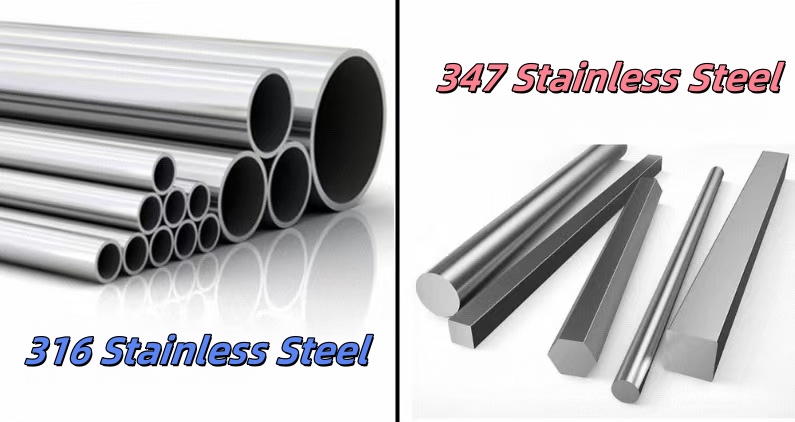
Difference Between Stainless Steel 347 and 316
Chemical Composition
| Grade | C | Cr | Ni | Mo | Mn | Si | N | P | S |
| 316 | 0.08 | 16-18 | 10-14 | 2-3 | 2 | 0.75 | 0.1 | 0.045 | 0.03 |
| Grade | Carbon | Chromium | Nickel | Manganese | Silicon | Phosphorus | Sulfur | Niobium |
| 347 | 0.08 | 17.0-19.0 | 9.0-13.0 | 2 | 0.75 | 0.045 | 0.03 | 10 x C min / 1.00 max |
316 Stainless Steel: on the other hand, uses molybdenum as the core element for performance enhancement. Its standard composition is: chromium (16.0%-18.0%), nickel (10.0%-14.0%), and molybdenum (2.0%-3.0%), carbon content ≤0.08%. The addition of molybdenum is the key distinction between 316 and ordinary austenitic stainless steel, directly conferring its excellent resistance to pitting and crevice corrosion.
347 stainless steel: 347 Stainless steel is based on a chromium-nickel composition system, with niobium (Nb) added as a key stabilizing element. Its typical composition includes: chromium (17.0%-19.0%), nickel (9.0%-13.0%), niobium (≥8×C%, typically 0.7%-1.0%), carbon content ≤0.08%. The addition of niobium is to form stable carbides with carbon, thereby preventing intergranular corrosion issues.
In comparison, 347 has a slightly higher chromium content than 316, while 316 has a wider nickel content range; the unique niobium element in 347 and the distinctive molybdenum element in 316 form the core driving force behind their performance differences.
Mechanical Properties
316 stainless steel:316 stainless steel has excellent toughness and ductility even at low temperatures, making it a versatile material suitable for a wide range of low- and high-temperature applications.
347 stainless steel: Due to the stabilizing effect of niobium, 347 stainless steel can withstand higher working temperatures (up to approximately 815°C or 1500°F). Its superior high-temperature strength makes it the material of choice for applications requiring heat resistance and high-temperature toughness.
| Property | 316 Stainless Steel | 347 Stainless Steel |
| Tensile Strength | 515 MPa | 515 MPa |
| Yield Strength | 205 MPa | 205 MPa |
| Max Service Temperature | 870°C (1600°F) | 815°C (1500°F) |
Weldability
316 Stainless Steel: Exhibits excellent weldability and is widely used in various manufacturing processes. After welding, it is important to control the cooling rate to prevent the formation of sensitized zones. Critical components should undergo solution treatment after welding.
347 Stainless Steel: Due to its niobium content, 347 does not require additional stabilization treatment during welding and exhibits excellent resistance to intergranular corrosion after welding. 347 stainless steel is softer in texture and easier to process. This characteristic gives it an advantage over 316 stainless steel, particularly in high-temperature welding projects.
Corrosion Resistance
316 Stainless Steel: 316 stainless steel exhibits enhanced resistance to pitting and crevice corrosion caused by chloride ions, particularly in marine and high-chloride environments, due to the presence of molybdenum. It is commonly used in chemical processing, desalination plants, and coastal construction.
347 stainless steel: Due to its niobium content, 347 stainless steel exhibits exceptional resistance to intergranular corrosion at high temperatures and during welding. This property makes it an ideal choice for high-temperature applications such as exhaust systems, heat exchangers, and boiler components.
High-temperature Performance
316 Stainless Steel: Performs well under general high-temperature conditions, but prolonged exposure to sensitization temperature ranges may reduce resistance to intergranular corrosion due to carbide precipitation. Therefore, the low-carbon 316L grade is commonly selected to address this issue.
347 stainless steel: Specifically designed for high-temperature applications. Its niobium content effectively prevents intergranular corrosion (also known as “weld corrosion”) that occurs at high temperatures after welding, so no post-weld heat treatment is required.
Application
316 Stainless Steel
Seawater Pipes, Heat Exchangers
Chemical Equipment, Pharmaceutical Equipment
Food Processing Industry, Pressure Vessels
347 Stainless Steel
High-Temperature Boiler Components, Heat Exchanger Pipes
Aerospace Engine Parts
Furnace Tubes, Heat Treatment Equipment
High-Temperature Chemical Equipment
Cost
316 stainless steel is more widely available, resulting in a relatively low and more stable overall price. 316 stainless steel is easily available and offers a high cost-effectiveness, making it particularly suitable for large-scale applications.
347 stainless steel, with the addition of niobium (Nb), offers excellent resistance to high-temperature intergranular corrosion. Due to limited supply, 347 stainless steel is generally priced higher than 316 stainless steel.
Conclusion
When selecting stainless steel materials, the choice between stainless steel 347 and 316 should be determined based on specific circumstances. If you require higher strength and superior resistance to intergranular corrosion, stainless steel 347 should be your first choice. However, if you need resistance to staining and corrosion and have lower strength requirements, stainless steel 316 should be considered. Additionally, factors such as the specific requirements of the product and the application scenario should also be taken into account.
In summary, both stainless steel 347 and 316 are commonly used materials, each with distinct characteristics and application ranges. When selecting the appropriate material, it is essential to make a choice based on specific circumstances to meet the requirements of the product and the application scenario.