
Why Bolt and Nut Pairing Matters for Industry
A critical flange connection in a processing plant failed—not due to a flawed bolt or defective nut, but because they were a mismatched pair. The high-strength bolt demanded more from its nut than the softer nut could withstand, leading to thread stripping under load. This scenario, along with vibration loosening and thread galling (cold welding), accounts for over 80% of preventable fastener failures in oil & gas, petrochemical, and structural applications.
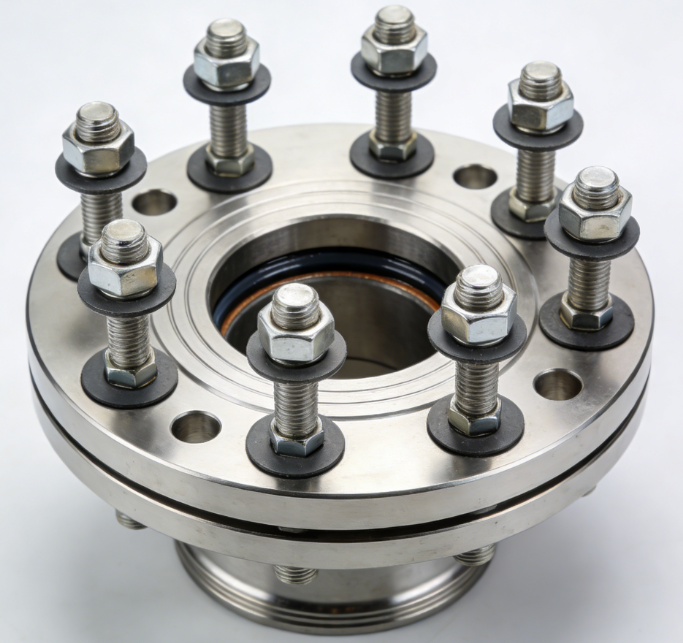
Treating bolts and nuts as an integrated system—from specification to installation—is the single most effective step to ensure connection integrity, operational safety, and long-term cost-effectiveness. For ASME B18.2.1 inch-series bolts (the industry standard for industrial fasteners), proper pairing isn’t just a best practice—it’s a compliance requirement for critical systems.
Strength Matching to Stop Bolt-Nut Thread Stripping
The golden rule of bolt-nut pairing is simple: the nut must be strong enough to handle the bolt’s full clamping force without thread failure. A mismatched strength grade creates a weak link—where the nut strips before the bolt reaches its designed tension—resulting in a false sense of a secure connection.
Critical ASME B18.2.1 Bolt and Nut Pairing on Strength
| Bolt Standard & Grade | Recommended Nut Standard & Grade | Core Industrial Applications | Key Failure Prevented |
| ASTM A193 B7 (High-strength alloy) | ASTM A194 2H (Quenched & tempered) | Pressure vessels, high-temp piping, boiler systems | Thread stripping: Nut withstands bolt’s high preload |
| ASTM A193 B7M (SSC-resistant alloy) | ASTM A194 2HM (Sulfide stress cracking resistant) | Sour oil & gas, acidic pipelines (NACE MR0175 compliant) | Stripping + corrosion: Matched for harsh acidic environments |
| ASTM A193 B16 (Ultra-high strength) | ASTM A194 7H (Ultra-high strength) | Heavy-duty pressure vessels, high-torque flanges | Extreme load stripping: Nut matches bolt’s 170ksi tensile strength |
| ASTM A320 L7M (Low-temperature alloy) | ASTM A194 4M (Low-temp treated) | Cryogenic/LNG systems, cold-region piping | Brittle fracture + stripping: Maintains ductility at -150°F |
| ASTM A193 B8 (304 Stainless Steel) | ASTM A194 8 (304 Stainless Steel) | Mild corrosive environments, food/pharmaceutical equipment | Corrosion + stripping: Material-matched for non-chloride settings |
| ASTM A193 B8M (316 Stainless Steel) | ASTM A194 8M (316 Stainless Steel) | Marine, chemical processing, coastal pipelines | Chloride corrosion + galling: Molybdenum-enhanced compatibility |
| ASTM A325 (Structural steel) | ASTM A563 DH (Heat-treated heavy hex) | Bridges, structural frames, building connections | Stripping + loosening: Optimized for shear & tension loads |
| ASTM A307 Grade B (General purpose) | ASTM A563 Grade A (Low carbon steel) | Light-duty brackets, non-critical assemblies | Cost-effective pairing for low-load scenarios |
The Hidden Danger of Under-Graded Nuts
Using a low-grade nut (e.g., ASTM A563 Grade A) with a high-strength bolt (e.g., ASTM A193 B7) is a catastrophic error. The nut will strip before the bolt achieves its intended tension, leaving joints vulnerable to leakage, fatigue failure, or sudden detachment under dynamic loads. Always verify nut grade markings (e.g., 2H, 7H, 8M) against the bolt’s grade to ensure a match.
Geometric Fit: Prevent Bolt and Nut Loosening
Proper physical fit between ASME B18.2.1 bolts and nuts is critical to maintaining preload and resisting vibrational loosening. This means aligning thread specifications, sizing, and wrench compatibility—all governed by ASME B18.2.1 (bolts) and ASME B18.2.2 (nuts).
Thread Engagement: The Foundation of Secure Connections
ASME B18.2.2 mandates full thread engagement for industrial nuts. As a best practice:
- Minimum Thread Engagement = 1 x Bolt Nominal Diameter (e.g., ¾” bolt = ¾” engagement)
- Critical Connections (high-pressure/high-vibration) = ≥ 1.5 x Bolt Nominal Diameter
Bolt Length Calculation (ASME B18.2.1 Compliant)
To ensure adequate thread engagement, use this formula for industrial applications:
Minimum Bolt Length = Clamped Material Thickness + Washer Thickness + Nut Height + (1.5 x Thread Pitch)
Wrench Compatibility: Don’t Compromise Torque
ASME B18.2.1 heavy hex bolts require heavy hex nuts (per ASME B18.2.2) for proper wrenching and load distribution. Using a smaller regular hex nut leads to inadequate bearing surface, rounded nut corners, and uneven torque application—all of which increase loosening risk.
| Nominal Bolt Size | ASME B18.2.2 Heavy Hex Nut (Across Flats) | Regular Hex Nut (Across Flats) | Key Implication |
| 3/4” | 1-1/8” | 1-1/16” | Wrong wrench size = slippage + uneven torque |
| 1-1/4” | 1-7/8” | 1-13/16” | Reduced contact = nut damage + preload loss |
Material Pairing: Fight Bolt and Nut Corrosion & Galling
Material incompatibility is a leading cause of long-term fastener failure. Mismatched materials can trigger galvanic corrosion or thread galling—especially in harsh industrial environments (wet, chemical, or high-temperature).
Galvanic Compatibility Chart for Industrial Bolt & Nut Pairs
| Bolt Material | Recommended Nut Material | Corrosion Risk Level | Mitigation Strategies |
| Hot-Dip Galvanized Carbon Steel | Hot-Dip Galvanized Carbon Steel | Low | Ensure uniform, thick coating; avoid scratching during installation |
| 304 Stainless Steel (ASTM A193 B8) | 304 Stainless Steel (ASTM A194 8) | Medium | Use same alloy group; apply anti-seize in high-friction scenarios |
| 316 Stainless Steel (ASTM A193 B8M) | 316 Stainless Steel (ASTM A194 8M) | Low | Molybdenum content resists chloride corrosion; ideal for marine use |
| Carbon Steel (ASTM A193 B7) | Carbon Steel (ASTM A194 2H) | Low | Avoid wet/corrosive environments; use zinc plating for added protection |
| Carbon Steel | Stainless Steel | High | Use insulating washers; limit to dry, non-corrosive settings |
| Aluminum | Aluminum | Medium | Restrict to mild environments; avoid high humidity |
Anti-Galling Strategies for Stainless Steel Pairings
Stainless steel bolts and nuts are prone to galling (cold welding) due to friction and pressure during installation. Follow these ASME-recommended practices to prevent damage:
- Use dissimilar hardness: Pair a harder Grade 8 nut with an ASTM F594 stainless bolt
- Apply anti-seize compound: Choose formulas with copper, nickel, or molybdenum disulfide
- Control installation speed: Tighten slowly to reduce heat buildup
- Ensure perfect alignment: Start threads by hand to avoid cross-threading
- Avoid dry installation: Never torque stainless pairs without lubrication
5-Minute Pre-Installation Checklist (ASME B18.2.1)
Before installing any critical fastener, verify these five points to ensure pairing compliance:
- Grade Match: Does the nut’s grade marking (e.g., 2H, 8M) align with the bolt’s grade (e.g., B7, B8M)?
- Size & Type: Is it a heavy hex nut for an ASME B18.2.1 heavy hex bolt? Do across-flats dimensions match your wrench?
- Thread Compatibility: Do the bolt and nut share the same nominal diameter and thread pitch (e.g., ½”-13 UNC)?
- Material/Coating Suitability: Are materials compatible with the service environment (temperature, chemicals, moisture)?
- Engagement & Length: Will the bolt provide at least 1x nominal diameter of thread engagement in the nut?
Diagnosing Bolt-Nut Failures
If a connection fails, use this chart to identify pairing-related root causes:
| Failure Mode | Visual/Symptom Clues | Likely Pairing Root Cause |
| Thread Stripping | Bolt threads intact; nut threads sheared/deformed; bolt removes by hand | Nut strength grade too low for the bolt |
| Thread Galling | Threads torn, smeared, or seized; components fused | Similar-hardness stainless steels installed dry/fast/misaligned |
| Vibration Loosening | Nut loose/fallen off; bolt fretting; preload lost | Insufficient thread engagement; thread pitch mismatch; wrong nut type |
| Galvanic Corrosion | Rust, pitting, or material degradation at the bolt-nut interface | Dissimilar metal pairing in corrosive environments |
Conclusion: Confident Bolt and Nut Pairing
For ASME B18.2.1 bolts—the backbone of industrial fasteners—proper pairing with compatible nuts isn’t optional. By adhering to three core rules—strength matching, geometric fit, and material pairing—you eliminate the most costly and dangerous failure modes: stripping, galling, and loosening.
Contact Us
As a professional engineering manufacturer, Zizi Engineering Co Ltd offers integrated one-stop solutions covering manufacturing, customization, and sales.
We welcome inquiries by call or drawing from project developers, contractors and enterprise clients. We will offer professional technical support and efficient manufacturing services.
Look forward to being your reliable partner.