
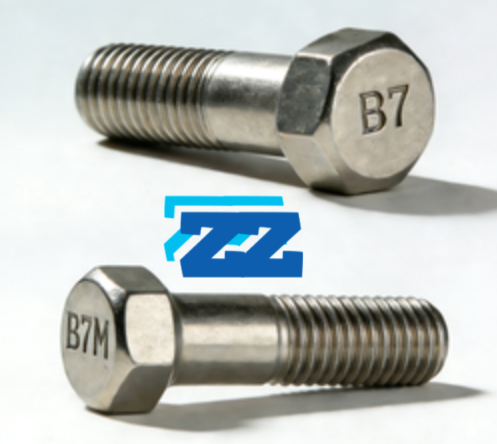
ASTM A193 B7 and B7M are two of the most used high-strength bolts in oil & gas, petrochemical, and power industries. They look the same, but choosing the wrong one can lead to sulfide stress cracking (SSC) or system failure—especially in acidic “sour” environments. This guide cuts through the jargon to help you pick the right one fast.
ASTM A193 Bolts
ASTM A193 bolts are industrial-grade fasteners compliant with ASTM standards, designed for high-temperature, high-pressure critical applications (oil and gas, petrochemical, power generation). Crafted from alloy steel, stainless steel, or nickel-based alloys, they deliver exceptional strength, corrosion resistance, and structural integrity.
Main grades within the ASTM A193 bolts include B7, B7M, B16, and 8M—each tailored to specific environmental and performance requirements. And strictly quality-controlled (quenching/tempering, ASME B1.1 thread compliance), ASTM A193 bolts pair with ASTM A194 nuts (e.g., 2H, 8M) for reliable assemblies. Ideal for piping flanges, pressure vessels, and turbines, they meet industrial buyers’ demands for compliance and durability.
B7 and B7M: High Strength Bolts
High strength bolts refer to heavy-duty industrial fasteners with far superior tensile, shear and yield strength than standard carbon steel bolts. They are widely used in steel structures, heavy machinery, construction and aerospace field, ensuring stable, reliable connections under extreme stress, vibration and high pressure.
Consisted of high-grade alloy steels and precision heat-treated (quenched and tempered), common grades include ISO 8.8/10.9/12.9, ASTM A325/A490 and ASTM A193 B7/B7M. With precision threading and tight dimensional tolerances, they’re typically paired with high strength nuts and washers for assembly, preventing loosening and improving load distribution.
Key Differences: B7 vs B7M
The main split is in corrosion resistance and compliance. Here’s a clear breakdown:
| Feature | ASTM A193 B7 | ASTM A193 B7M |
| Core Purpose | Non-sour, high-pressure/high-temperature jobs | Sour service (environments with hydrogen sulfide, H₂S) |
| Sulfur Content | Max 0.040% | Max 0.040% |
| Tensile Strength | ≤2in: 125 ksi min; 2-4in: 115 ksi min; 4-7in: 100 ksi min | ≤4in: 100 ksi min; 4-7in: 100 ksi min |
| Hardness | 321 HBW max or 35 HRC max | 235 HBW max or 99 HRB max |
| Must-Follow Standards | ASME B18.2.1 (dimensional fit) | NACE MR0175/ISO 15156 (sour service rule) + ASME B18.2.1 |
| Required Docs | ASTM A193 test report (EN 10204 3.1) | NACE MR0175 certificate + SSC testing results |
When to Use B7
B7 is your go-to for non-sour environments where strength and heat resistance matter:
- High-pressure steam pipelines and boilers (works up to 1100°F)
- Flanges and pressure vessels with neutral media (water, oil, air)
- Structural connections in power plants and refineries (non-sour areas)
- General high-strength needs (hex bolts, stud bolts, etc.)
Pair B7 with ASTM A194 2H nuts for best performance—this combo is the industry standard for non-sour high-load jobs.
When to Use B7M
B7M is mandatory if your system has H₂S (sour service) or requires NACE MR0175 compliance:
- Sour gas/oil wells and pipelines (acidic media)
- Refineries processing sour crude oil
- Chemical reactors handling H₂S-containing fluids
- Any project where NACE MR0175 is a requirement
Critical tip: B7M can’t pair with regular nuts. Use ASTM A194 2HM nuts—they’re SSC-resistant, so the whole system stays compliant.
Mistakes to Avoid for ASTM A193 B7 and B7M Bolts
- Using B7 in sour service: H₂S will cause SSC and fastener failure → Switch to B7M.
- Picking B7M for high-strength jobs: Its lower tensile strength can’t handle heavy loads → Use B7 (only in non-sour environments).
- Mixing nuts: B7 + 2HM or B7M + 2H won’t work → Stick to the recommended pairs.
- Skipping certifications: Non-compliant bolts risk safety audits → Always ask for test reports (B7) or NACE docs (B7M).
B7 or B7M? 10-Second Choice
- Choose B7 if: No H₂S, need high strength (125 ksi), or operate at high temps.
- Choose B7M if: H₂S is present, or NACE MR0175 is required.
Conclusion
B7 and B7M aren’t “better” than each other—they’re built for different jobs. The key question is simple: Does your system have H₂S? If yes, B7M is a must. If not, B7 is the reliable choice.
Verify the right certifications and pair with the correct nuts, and you’ll keep your system safe, compliant, and free from costly downtime.
Choose Us
Zizi Engineering Co Ltd is committed to providing one-stop solutions from drawing design, manufacturing to finished product delivery.
We welcome inquiries by call or drawing from project developers, contractors and enterprise clients. We will offer professional technical support and efficient manufacturing services.
Look forward to your contact.