
2205 Duplex Stainless Steel Material Selection, Performance & Industrial Applications
2205 duplex stainless steel offers a balanced structure.
It contains roughly 50% austenite and 50% ferrite.
This dual-phase design delivers high strength and chloride resistance.
It is the most widely used duplex grade today.
It offers the best overall cost performance.
Two UNS standards cover this grade:
UNS S31803 – the original base specification
UNS S32205 – the upgraded commercial standard
Engineers and procurement teams frequently compare these two.
This guide helps you choose wisely.
Standard 304 and 316L steels often fail.
They suffer pitting, crevice corrosion, and stress cracking.
High chlorides, H₂S, or mixed acids accelerate damage.
These grades cannot meet strict production demands.
Choosing the right material cuts project costs and extends equipment life.
Corrosive conditions are common in chemical, marine, oil & gas, and FGD systems.
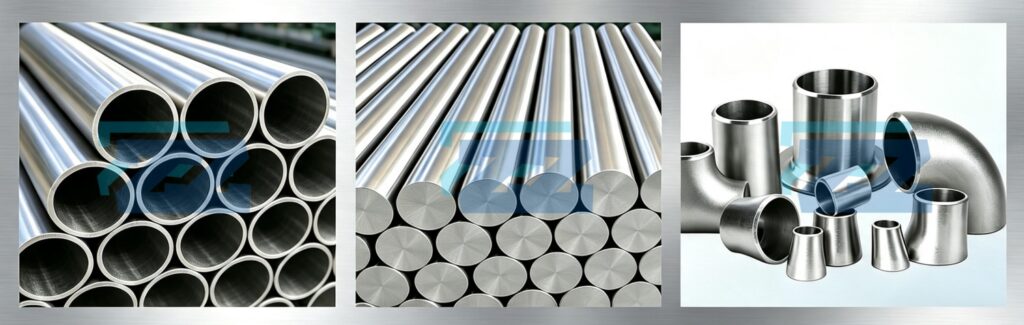
The Link Between UNS S31803 and UNS S32205 Duplex Stainless Steel
Both grades belong to the 2205 duplex stainless steel family.
Their dual-phase structure is the key to performance.
It boosts strength and corrosion resistance over standard steels.
Simple Relationship
UNS S31803 is the original grade.
It allows wider ranges for Cr, Mo, and N.
Field data later showed tighter control improves performance.
Tighter limits boost pitting resistance and processing stability.
Manufacturers then introduced UNS S32205.
This grade has stricter chemical boundaries.
It is now the standard commercial 2205 sold worldwide.
Key Rule
Any material meeting UNS S32205 also meets S31803.
Mills can issue test certificates with both UNS numbers.
Material that only meets S31803 cannot carry dual certification.
Today, major mills produce 2205 plates, pipes, and forgings to S32205.
Their certificates list both S31803 and S32205.
Performance Comparison
Chemical Composition
Chromium, molybdenum, and nitrogen block chloride attack.
UNS S32205 enforces higher minimums for these elements.
This gives it a superior Pitting Resistance Equivalent Number (PREN).
Table: ASTM Chemical Composition Ranges (mass %)
| Element | UNS S31803 | UNS S32205 | Core Function |
| Chromium (Cr) | 21.0–23.0 | 22.0–23.0 | Forms passive film; boosts oxidation and acid resistance |
| Molybdenum (Mo) | 2.5–3.5 | 3.0–3.5 | Improves pitting and crevice resistance; ideal for seawater |
| Nickel (Ni) | 4.5–6.5 | 4.5–6.5 | Stabilizes austenite; maintains phase balance |
| Nitrogen (N) | 0.08–0.20 | 0.14–0.20 | Raises yield strength; increases PREN |
| Carbon (C) | ≤0.030 | ≤0.030 | Low-carbon design; prevents carbide precipitation |
Thanks to higher Mo and N, S32205 holds PREN ≥35.
By comparison, 316L reaches only ~25.
304 hits just ~19.
The corrosion gap is huge in seawater, brine, and FGD wastewater.
Mechanical Properties
UNS S32205 delivers higher minimum mechanical limits.
It offers more consistent strength and toughness.
Table: Room-Temperature Mechanical Values
| Property | S31803 Min. | S32205 Min. | Notes |
| Yield Strength | 450 MPa | 450 MPa | Supports heavier loads; allows thinner walls |
| Tensile Strength | 620 MPa | 655 MPa | Larger safety margin for high-pressure equipment |
| Elongation | 20% | 30% | Better ductility for cold forming |
| Brinell Hardness | ≤290 | ≤290 | Easier cutting and grinding |
Overall, S32205 outperforms S31803 in strength and ductility.
Thinner walls reduce raw material costs.
Structural stability also improves.
2205 Duplex Stainless Steel vs 304 / 316L – Full Comparison
2205 directly replaces 304 and 316L in most conditions.
Its high strength and SCC resistance allow lighter designs.
Equipment life extends significantly.
| Parameter | 2205 Duplex | SS 304 | SS 316L |
| Min. Yield Strength | 450 MPa | 205 MPa | 170 MPa |
| Min. Tensile Strength | 655 MPa | 515 MPa | 485 MPa |
| PREN | ≥35 | ~19 | ~25 |
| Chloride SCC Resistance | Excellent | Very poor | Moderate |
| Thermal Expansion (20–200°C) | ~13.5×10⁻⁶/°C | ~17.2×10⁻⁶/°C | ~16.0×10⁻⁶/°C |
| Wall Thickness for Equal Pressure | 30–50% thinner | Thick walls | Thick walls |
Three Unmatched Advantages of 2205 Stainelss Steel
Ultra-high yield strength cuts costs
2205 is over twice as strong as 304.
It is 2.6x stronger than 316L.
Designers use thinner plates and pipes.
Equipment weighs less.
Lifting and transport are easier.
Total material spending drops.
Industry-leading chloride SCC resistance
This is 2205’s biggest benefit.
304 cracks rapidly in salt and stress.
316L only works in mild environments.
2205 performs reliably in seawater, brine, and desulfurization wastewater.
It is the top choice for high-chloride conditions.
Thermal properties suit heat cycles
2205 expands like carbon steel.
It conducts heat better than 304/316L.
Welds to carbon steel carry lower residual stress.
Units avoid deformation and cracking during thermal cycles.
Heat exchangers and storage tanks last longer.
Standards of Duplex Stainless Steel – Plates, Pipes, Forgings & Fasteners
UNS S31803 and S32205 follow ASTM/ASME and EN standards.
Each product form has dedicated specifications.
Forging codes F51 (S31803) and F60 (S32205) are widely used.
| Product Form | ASTM / ASME Standard | UNS / Forging Code | EN Standard |
| Plate, Sheet, Strip | ASTM A240 / ASME SA-240 | S31803, S32205 | EN 10088-2 |
| Bar & Structural Shapes | ASTM A276, A479 | S31803, S32205 | EN 10088-3 |
| Flanges, Fittings, Forgings | ASTM A182 | F51, F60 | EN 10022-5 |
| Seamless & Welded Pipe | ASTM A789, A790 | S31803, S32205 | EN 10216-5 / 10217-7 |
| Pressure Vessel Plate | ASME SA-240 | S31803, S32205 | EN 10028-7 |
| Bolts, Nuts, Fasteners | ASTM A1082 | S31803, S32205 | EN 10269 |
Specialized Industry Standards
Offshore platforms: NORSOK M-DS-47 – for S32205 in marine environments
Sour gas service: NACE MR0175 / ISO 15156 – for H₂S and CO₂ media
Practical Purchasing Advice
Always specify UNS S32205 (ASTM A182 F60) on orders.
S32205 offers tighter alloy control and higher performance.
It is the mainstream grade in global projects.
Stock is abundant.
Suppliers can provide dual-certified MTCs.
These list both S31803 and S32205.
Choosing only S31803 raises corrosion risks in harsh conditions.
Top Industrial Applications
2205 replaces 304 and 316L across many sectors.
It offers high strength, chloride resistance, and H₂S protection.
Key industries include:
| Industry | Typical Equipment | Core Selection Reasons |
| Oil & Gas | Pipelines, heat exchangers, separators, valves | Resists H₂S, CO₂, and high-chloride produced water; high strength for high pressure |
| Marine & Shipbuilding | Desalination units, pumps, cargo holds, platform frames | Handles full seawater immersion; stops pitting, crevice corrosion, and salt spray |
| Fine Chemicals | Reactors, scrubbers, storage tanks, impellers | Withstands acetic acid, formic acid, and mixed media; reduces maintenance |
| Pulp & Paper | Bleaching lines, separators, waste tanks | Resists strong oxidizing bleach; prevents perforation and leaks |
| Power & FGD | Flue ducts, absorber towers, nuclear pools, heat exchangers | Handles acidic wastewater with high chlorides; meets long-term safety standards |
| Heavy Structures | Bridge parts, high-pressure equipment, fasteners, shafts | High yield strength cuts dead weight; balances corrosion and wear resistance |
Operating Limits & Processing Guidelines
2205 has strong all-around performance.
But it also has inherent traits to manage.
Avoid these pitfalls to maintain corrosion resistance and toughness.
Safe Temperature Window
Continuous service: –50°C to 250°C
Below –50°C: toughness drops, brittle fracture risk rises
Above 250°C: sigma phase forms
This permanently reduces corrosion resistance and impact toughness.
Cold Forming Is Harder
Yield strength far exceeds 304 and 316L.
Stamping, bending, and rolling need higher-tonnage equipment.
Optimize processes to avoid concentrated stress.
Hidden corrosion risks can follow.
Strict Welding Controls
Keep heat input low
Maintain interpass temperature below 100°C
Use ER2209 filler metal
These steps preserve the austenite-ferrite balance.
They stop brittle intermetallic phases.
Weld corrosion resistance matches the base metal.
Practical Buying Tips of 2205 Duplex Stainless Steel
UNS S31803 and UNS S32205 offer high strength and SCC resistance.
They perform well in most corrosive media.
They are the premium alternative to 304 and 316L.
They are also the highest-volume duplex grade globally.
When ordering plates, pipes, flanges, or fasteners:
Require original MTCs with dual UNS markings (S31803 + S32205)
Confirm compliance with ASTM A240, A182, A790, etc.
For offshore or sour service, request NORSOK and NACE test reports
Professional distributors stock domestic and ASTM-grade 2205.
They offer ready delivery.
They provide dual-certified test reports.
On-site spectral inspection is available.
Custom cutting and machining services are offered.
Contact us for current pricing and expert selection support.
We help you choose the right 2205 plate, pipe, or forging for your project.