
In petrochemical, marine engineering, nuclear power, oil & gas transmission, environmental desulfurization, and pulp & paper industries, duplex stainless steel forged flanges serve as critical components for pipe connections, sealing, pressure containment, and removable joints.
Material selection, forging quality, and heat treatment directly impact system reliability, service life, and maintenance costs.
With the rapid growth of deep-sea oil & gas, seawater desalination, FGD upgrades, and high-end chemical equipment, traditional 304 and 316L austenitic stainless steel flanges show increasing limitations. They frequently suffer from pitting, crevice corrosion, and stress corrosion cracking (SCC) under medium-to-high pressure, high chloride, and H₂S-containing acidic conditions.
ASTM A182 duplex stainless steel forged flanges offer a clear advantage. Their austenite-ferrite dual-phase structure delivers high strength, excellent chloride corrosion resistance, and outstanding resistance to stress cracking – with cost-effectiveness between standard austenitic grades and high-end nickel alloys.
This guide provides a comprehensive breakdown of F51, F60, and F53 duplex forged flanges – covering grade differences, chemical composition, mechanical properties, forging techniques, heat treatment specifications, quality control standards, and engineering selection criteria. A practical, actionable technical reference for designers, procurement teams, site engineers, and project inspectors.
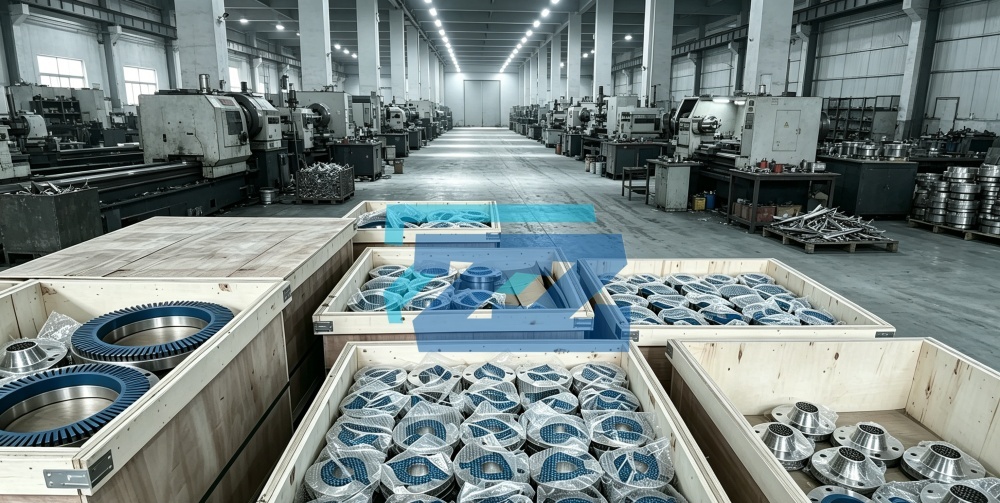
Process Advantages of Duplex Stainless Steel Forged Flanges
Industrial flanges are mainly produced via forging, casting, or plate machining. Among these, duplex stainless steel forged flanges deliver superior performance for high-pressure, highly corrosive, and long-cycle operations. The advantage comes from precision forging that optimizes the microstructure.
Multi-pass, high-deformation plastic forging – through repeated upsetting, drawing, and shaping – refines grain structure and densifies the material. This eliminates casting defects like porosity, gas holes, segregation, and uneven structure. The result: a stable, reliable finished component.
Mechanical performance: Forged duplex flanges offer significantly higher strength and toughness than cast equivalents. Tensile and yield strength improve by 30%–50%, with typical tensile values of 700–900 MPa. This enables long-term resistance to high pressure, cyclic loads, and thermal stress – without deformation, cracking, or sealing failure. Suitable for a wide range of medium-to-high pressure piping systems.
Microstructure: Properly processed F51, F60, and F53 duplex forged flanges exhibit a balanced microstructure – approximately 50% ferrite and 50% austenite. Ferrite enhances resistance to SCC and corrosion fatigue; austenite ensures good low-temperature impact toughness and weldability. This intertwined dual-phase structure effectively blocks chloride, H₂S, and CO₂ penetration, delivering far superior pitting, crevice, and SCC resistance compared to 304 and 316L flanges.
Grade Overview: F51, F60, F53 – Material & Performance Comparison
All duplex stainless steel forged flanges for industrial piping comply with ASTM A182/SA182 – the international standard for wrought fittings. Common grades include F51 (UNS S31803), F60 (UNS S32205), and F53 (UNS S32750). Each offers a distinct performance level for specific service conditions.
F60 duplex flanges are based on 2205 duplex steel composition. They feature tighter minimum limits for chromium, molybdenum, and nitrogen – the three key alloying elements for corrosion resistance. This solves the batch-to-batch variability and instability issues seen with F51. Today, F60 is the preferred specified grade for new marine, oil & gas, and FGD projects.
The industry-standard PREN (Pitting Resistance Equivalent Number) is the key technical indicator for chloride corrosion resistance. Formula: PREN = %Cr + 3.3×%Mo + 16×%N. Higher PREN values indicate better resistance to pitting, crevice, and localized corrosion – enabling use in more aggressive environments. Essential for engineering selection and material verification.
Chemical Composition – F51 / F60 / F53 Duplex Flanges
| Element | UNS S31803 (F51) | UNS S32205 (F60) | UNS S32750 (F53) |
| Carbon C | ≤0.030 | ≤0.030 | ≤0.030 |
| Chromium Cr | 21.0–23.0 | 22.0–23.0 | 24.0–26.0 |
| Nickel Ni | 4.5–6.5 | 4.5–6.5 | 6.0–8.0 |
| Molybdenum Mo | 2.5–3.5 | 3.0–3.5 | 3.0–5.0 |
| Nitrogen N | 0.08–0.20 | 0.14–0.20 | 0.24–0.32 |
| Manganese Mn | ≤2.00 | ≤2.00 | ≤1.20 |
| Silicon Si | ≤1.00 | ≤1.00 | ≤0.80 |
| Phosphorus P | ≤0.030 | ≤0.030 | ≤0.035 |
| Sulfur S | ≤0.020 | ≤0.020 | ≤0.020 |
From the composition table, F60 (S32205) shows three critical upgrades over F51:
Chromium minimum: 21.0% → 22.0%
Molybdenum minimum: 2.5% → 3.0%
Nitrogen minimum: 0.08% → 0.14%
These tighter controls raise the guaranteed PREN from 30.5 to 34.1, with typical values of 35–36 in practice. This eliminates the weak-corrosion-risk often seen with F51 when composition drifts to the lower limits. It also promotes a more uniform heat-affected zone (HAZ) after welding – significantly reducing corrosion failure risks in seawater and acidic media.
F53 (S32750) super duplex flanges represent a premium upgrade. With higher Cr, Mo, and N content, PREN reaches 40+. Enhanced corrosion resistance, high-temperature stability, and pressure capacity suit extreme conditions – high chloride concentrations, seawater above 60°C, and sour oil/gas environments. Commonly used in deep-sea platforms and high-pressure wellhead equipment.
Mechanical Properties
| Property | F51 (S31803) | F60 (S32205) | F53 (S32750) |
| Tensile Strength (MPa) | ≥620 | ≥655 | ≥800 |
| Yield Strength (MPa) | ≥450 | ≥450 | ≥550 |
| Elongation (%) | ≥25 | ≥25 | ≥25 |
| Reduction of Area (%) | ≥45 | ≥45 | / |
| Hardness (HB) | / | / | ≤310 |
Mechanically, F51 and F60 show similar performance. Yield strength is roughly 2.5 times that of 316L stainless steel – a major advantage. This high strength allows pipe wall thickness reduction of 30%–40% at the same pressure and diameter, cutting overall equipment weight and project costs.
The real difference between F51 and F60 lies in corrosion stability and batch consistency. F60’s strict composition control makes it the top choice for new marine, oil & gas, and high-end chemical projects. F51 offers good cost performance – often used for retrofit work and mild-to-moderate corrosive conditions.
Manufacturing Process & Core Quality Control Points
Final performance of duplex stainless steel forged flanges depends entirely on process control across forging, heat treatment, welding, and finishing. Duplex steels have a narrow hot-working temperature window. Forging temperature, cooling rate, and welding heat input must be precisely managed. Any deviation can upset the austenite-ferrite balance – reducing corrosion resistance and toughness, compromising long-term safety.
Forging Temperature & Forming Control
Duplex flange forging requires strict temperature control: heating to 1100°C–1180°C, with finishing temperature not below 950°C. This prevents reduced plasticity, grain coarsening, and property inconsistency at low temperatures.
The process follows a “light blow, fast strike, step-by-step” approach. Multiple upsetting, drawing, piercing, and expanding operations produce flanges from DN15 to DN2000, covering Class 150 to Class 2500.
For large-diameter (DN300+) and high-pressure (Class 900+) forged flanges, we apply segmented temperature-controlled precision forging. Deformation is distributed per step, ensuring metal flow lines follow the flange’s stress direction. The neck, sealing face, and bolt holes achieve uniform, balanced structure – eliminating stress concentration points and enhancing high-pressure sealing reliability.
Solution Heat Treatment – The Critical Step
Solution annealing is the core process determining duplex flange quality. It controls phase balance, eliminates internal defects, and restores material properties. Standard practice: heat forged blanks to 1020°C–1100°C – holding time based on wall thickness to fully dissolve carbides and intermetallic phases. Then rapid water quench to below 260°C – suppressing harmful brittle phase precipitation and stabilizing the two-phase structure.
Critical: avoid the 600°C–950°C sensitive temperature range. Prolonged exposure here promotes σ-phase precipitation – causing toughness loss, pitting resistance drop, and cracking susceptibility. Therefore, post-forging or post-welding stress-relief annealing in this range is strictly prohibited. If temperature deviation or abnormal structure occurs, re-solution annealing and water quenching are mandatory to restore standard properties.
Welding & Machining Requirements
Welding duplex flanges demands strict procedures. Oxy-acetylene welding is prohibited. Use matching ER2209 / E2209 duplex filler metal – never substitute with 308 or 316L austenitic wires. Control heat input (0.5–2.5 kJ/mm), with interpass temperature ≤150°C. Apply back-purging with argon (adding 2%–3% nitrogen to maintain nitrogen content). Ensure weld ferrite content stays within 30%–65% – avoiding embrittlement and corrosion leakage. Post-weld heat treatment is not normally required; for thick-wall or critical pressure components, solution re-treatment may be specified.
Machining F51/F60/F53 duplex grades is challenging due to high work-hardening rates and cutting resistance – far above standard stainless steels. Use coated carbide tools with low speed, heavy feed, and ample coolant. Precise control ensures sealing face flatness, dimensional accuracy, and geometric tolerances – meeting high-pressure assembly requirements.
Pressure Ratings, Flange Types & Application Matching
Our duplex stainless steel forged flanges are manufactured to ASME B16.5, EN 1092-1, GB/T 9119, and other major standards. Available in multiple pressure classes, structural types, and sealing faces. Full coverage for chemical, marine, oil & gas, power, and environmental piping applications. Standard sizes in stock; custom options available.
Pressure Ratings & Typical Applications
| Pressure Class | Standard | Typical Applications |
| Class 150–300 | ASME B16.5 | General chemical lines, seawater cooling, FGD auxiliary piping, municipal corrosion-resistant networks |
| Class 600–900 | ASME B16.5 | High-pressure oil/gas transmission, offshore platform process lines, chemical reactor connections |
| Class 1500–2500 | ASME B16.5 | Ultra-high-pressure wellhead equipment, subsea Christmas trees, high-end pressure vessels |
ASME B16.5 Duplex Forged Flange Types – Overview
ASME B16.5 Pipe Flanges and Flanged Fittings is the most widely used international standard. Covers NPS 1/2″ to 24″, with pressure classes from 150 to 2500. The standard explicitly requires forged construction for Class 600 and above – ensuring structural integrity and reliability under high pressure. Below is a systematic breakdown of six main types per ASME B16.5.
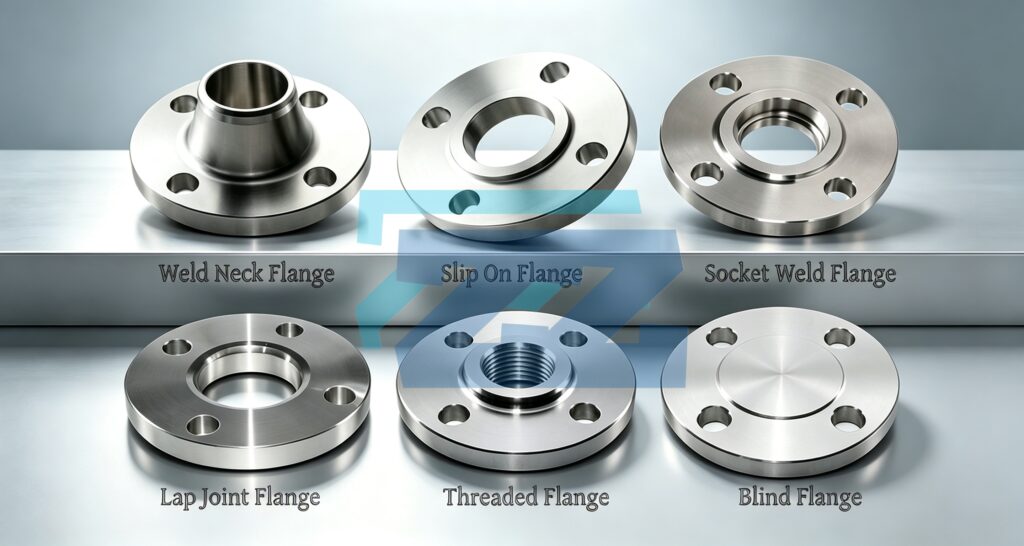
| Flange Type | Connection Method | Features | Typical Service | Common Grades |
| Weld Neck (WN) | Butt-weld (single full-penetration V-groove) | Long tapered hub; bore matches pipe ID – smooth flow, no turbulence | High pressure, high/low temperature, cyclic loading; critical process lines in oil/gas, chemical, power | F51/F60/F53 |
| Lap Joint (LJ) | Used with stub end (lap joint stub) | Flange rotates freely for easy bolt alignment; flange and stub can be different materials | Frequent disassembly for cleaning; large-diameter, non-critical services | F51/F60 (flange body can use carbon steel for cost saving) |
| Slip-On (SO) | Fillet weld (inside and outside) | Flange slides over pipe end; compact; easy alignment | Low pressure, non-critical services; water, air, general utility lines | F51/F60 |
| Socket Weld (SW) | Fillet weld (outside only) | Pipe inserts into socket; 1.6mm expansion gap required | Small-bore (NPS 1/2″–3″), high pressure; not for highly corrosive media (crevice risk) | F51/F60 |
| Threaded (TH) | NPT threaded connection | Internal threads; pipe screws in – no welding needed | Low pressure, non-critical; areas where hot work is prohibited (flammable/explosive environments) | F51/F60 |
| Blind (BL) | — | No center bore; closes pipe ends or equipment openings | Pipe end closure, pressure vessel manways, test caps | — |
Common Facing Types
Standard facing types: Flat Face (FF), Raised Face (RF), Male-Female (MFM), and Tongue & Groove (TG). RF (Raised Face) is the most widely used – offering broad applicability, easy assembly, stable sealing, and excellent cost-performance. The preferred choice for chemical, marine, and oil & gas projects.
Key Applications & Selection Guide
Duplex stainless steel forged flanges precisely fill the material gap – ideal where “316L lacks sufficient corrosion resistance, but 904L / nickel alloys are too expensive.” With excellent corrosion resistance, high strength, cost-effectiveness, and proven reliability, market adoption in 2026 continues to grow across marine, FGD, and desalination projects.
Primary Application Areas
Marine Engineering & Shipbuilding: F51 and F60 duplex forged flanges are widely used in seawater desalination pre-treatment and high-pressure systems, platform firewater and ballast lines, FPSO topside modules, and subsea manifolds. They withstand chloride levels up to 20,000 ppm and seawater temperatures below 60°C – significantly reducing equipment failures and maintenance costs.
Petrochemical & Oil/Gas Fields: Products comply with NACE MR0175 / ISO 15156 for sour service. Suitable for H₂S, CO₂, and chloride-containing media. Used in oil/gas gathering pipelines, wellhead valves, and refinery corrosive media lines. Excellent resistance to chloride SCC – reliable for long-term, severe oilfield conditions.
Power Generation, Environmental & Pulp/Paper: Widely used in power plant FGD scrubber spray lines, absorber tower inlet/outlet flanges, and nuclear cooling system corrosion-resistant connections. Also suitable for pulp/paper ClO₂ bleaching and washing equipment – stable performance in medium-temperature, chlorine-containing, mildly acidic environments.
Flange Selection – Key Points
Select grade by service media:
Chloride 1,000–3,000 ppm, temperature ≤60°C: choose F60 duplex flanges – cost-neutral, better corrosion stability than F51.
Chloride <1,000 ppm, ambient, non-acidic: 316L stainless steel may suffice.
Chloride >5,000 ppm, temperature above 60°C, hot seawater, sour gas: upgrade to F53 super duplex flanges.
For concentrated hydrochloric acid, hydrofluoric acid, or hot concentrated nitric acid: duplex grades are unsuitable – consider nickel alloys or titanium.
Match material standard to project specification:
Retrofits and mild/moderate conditions: F51 (S31803) remains acceptable.
New marine, sour oil/gas, high-end chemical projects: industry practice specifies F60 (S32205) duplex flanges. Dual-certified F51/F60 material offers both flexibility and compliance.
Respect temperature limits:
Long-term safe service temperature for duplex flanges: up to 280°C–300°C. Continuous operation above 300°C risks embrittlement and corrosion resistance degradation. Avoid exceeding these limits.
Procurement & inspection – mitigate risks:
For high-pressure, marine, and sour-service flanges, must verify:
Positive Material Identification (PMI) reports
Solution annealing heat treatment records
Non-destructive examination (NDE) reports
For critical projects, add ASTM A923 phase ratio testing and NACE hardness re-inspection. This prevents composition non-conformance, improper heat treatment, and batch-to-batch performance variations.
Product Supply & Customization Services
We professionally supply ASTM A182 F51, F60, and F53 duplex stainless steel forged flanges – Class 150 through Class 2500. Available in ASME B16.5 / B16.47A / B, EN 1092-1, and custom drawings.
Product range includes: weld neck, slip-on, lap joint, threaded, socket weld, blind, and orifice flanges. Also available: matching duplex stainless steel pipes and fittings – supporting one-stop procurement for all industrial projects.