
UNS S32750 (2507) and UNS S32760 (F55 or ZERON 100) are two common super duplex stainless steel grades. Both deliver a pitting resistance equivalent number (PREN) above 40 and a yield strength above 550 MPa. Their base performance is close. Engineers often compare them for selection. One key difference appears in the chemical composition. S32760 adds copper (Cu) and tungsten (W). This difference affects performance in sulfuric acid, crevice corrosion conditions, and cold forming. This guide covers composition, mechanical properties, heat treatment, and industrial applications.
S32750 vs S32760 Composition: The Copper and Tungsten Divide
Both grades use about 25% chromium (Cr) as the base. Molybdenum (Mo), nickel (Ni), and nitrogen (N) build the duplex structure and corrosion resistance. The main differences are listed below.
| Element | UNS S32750 | UNS S32760 | Effect |
| Cu | ≤ 0.50% | 0.50 – 1.00% | Improves resistance to reducing acids such as sulfuric acid. |
| W | — | 0.50 – 1.00% | Enhances pitting and crevice corrosion resistance. |
| Cr | 24.0 – 26.0% | 24.0 – 26.0% | Forms the passive film. |
| Mo | 3.0 – 5.0% | 3.0 – 4.0% | Core pitting resistance element. |
| N | 0.24 – 0.32% | 0.20 – 0.30% | Solid-solution strengthening and pitting resistance. |
Data source:
ASTM A182 / A240.
Quick summary:
S32750 builds its corrosion resistance on Cr, Mo, and N.
S32760 uses Cu against reducing acids and W to reinforce local corrosion defense.
Mechanical Properties: Strength vs Ductility
The minimum yield strength is the same. Minimum tensile strength and elongation differ. This affects wall thickness margins and cold forming difficulty.
| Property | UNS S32750 (min) | UNS S32760 (min) |
| Yield strength Rp0.2 | ≥ 550 MPa | ≥ 550 MPa |
| Tensile strength Rm | ≥ 800 MPa | 750-895 MPa |
| Elongation A | ≥ 15% | ≥ 25% |
| Hardness | ≤ 310 HBW | — |
Data source:
ASTM A182 for F53 (S32750) and F55 (S32760).
Interpretation:
S32750 has a higher minimum tensile strength. It offers a slight data advantage in weight-reduction design based on standard minimums.
S32760 requires elongation 10 % higher. This means a wider process window and lower cracking risk in bending, flaring, and cold forming.
Actual product typical values usually exceed the minimums. The standard difference still reflects different design orientations.
Corrosion Resistance: Chlorides vs Reducing Acids
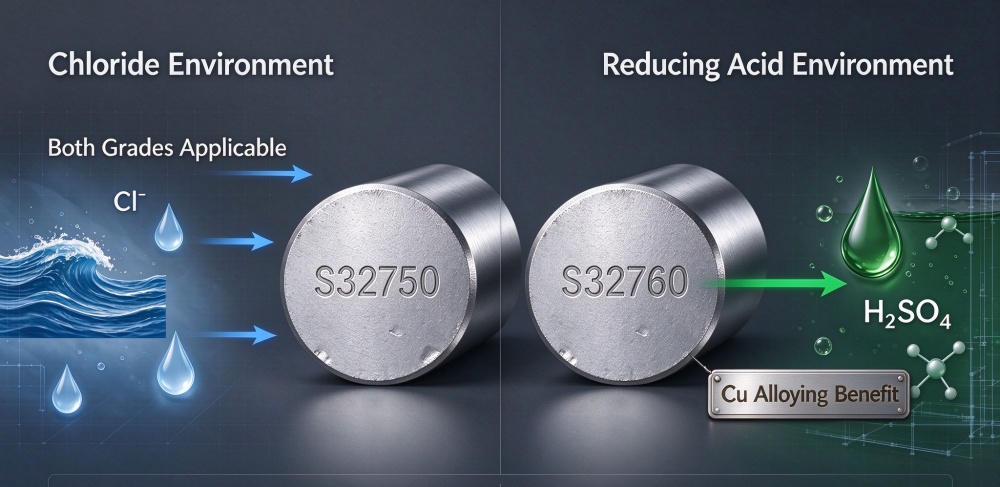
Both grades have a PREN above 40. Their pitting and crevice corrosion resistance in seawater and high-chloride environments is in the same tier. Performance is comparable in most marine conditions. The difference appears in the following scenarios.
Where S32750 fits: Neutral or oxidizing chloride environments, such as seawater cooling systems, offshore platform firefighting lines, and deep-sea manifolds. When chloride is the main threat, the Cr-Mo-N combination of S32750 handles it without the cost increase from Cu and W.
Where S32760 adds value: When sulfuric acid or phosphoric acid is present, copper improves resistance to general corrosion. Tungsten acts like molybdenum and provides an extra barrier against pitting and crevice corrosion in hot chloride environments. Flue gas desulfurization (FGD) systems, where acidic condensate and chlorides coexist, are a typical application for S32760.
S32750 vs S32760 Heat Treatment: Same Core, Different Window
Both grades require solution annealing. The goal is a balanced austenite-ferrite structure of about 50/50 and dissolution of harmful phases formed during processing.
S32750 heat treatment points
Recommended solution annealing temperature is usually 1040°C–1120°C. Research data shows σ phase (a Cr-Mo-rich brittle phase) starts to precipitate below 1040°C. This can reduce toughness and corrosion resistance. Between 1040°C and 1100°C, the two-phase ratio is stable, and mechanical properties and corrosion resistance match well. Rapid cooling (water quenching) is required after treatment to suppress σ phase re-precipitation during cooling.
S32760 heat treatment points
The solution annealing window is narrower and more sensitive due to tungsten addition. Recommended range is usually 1060°C–1120°C. Tungsten increases the σ phase precipitation tendency. The risk of heat treatment below 1040°C is higher than for S32750. Besides σ phase, S32760 also requires attention to chromium nitride (Cr₂N) precipitation. With high nitrogen content and insufficient cooling rate, chromium nitride may precipitate in situ in ferrite, affecting toughness and corrosion resistance. S32760 therefore has stricter cooling rate requirements after solution annealing.
Defects addressed by heat treatment: Both grades share the same core goal. Eliminate harmful precipitates such as σ phase and secondary austenite formed during processing or prior thermal cycles. Restore toughness and corrosion resistance. The difference is that S32760 requires additional control of chromium nitride.
Industrial Applications
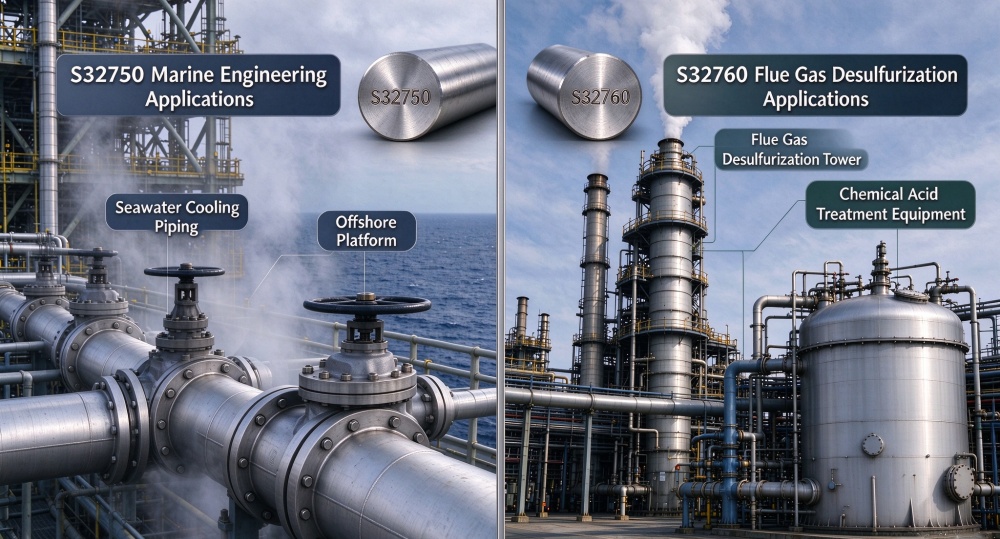
Where to prioritize S32750
Seawater and offshore structural components: Offshore platform seawater injection pumps, fire pumps, high-pressure seawater cooling lines. Valued for proven engineering experience, higher tensile strength, and better supply availability.
Deep-sea oil and gas manifolds and risers: Under high-pressure, low-temperature seawater, the strength and stress corrosion cracking resistance of S32750 are a common choice.
Cost-sensitive general super duplex projects: When the service condition does not involve strong reducing acids and the design code allows F53, S32750 usually offers better economics.
Where to prioritize S32760
Chemical processes involving sulfuric or phosphoric acid: Sulfuric acid production units, phosphoric acid concentration equipment, chemical tanker cargo holds with acidic media. The copper addition is targeted protection that S32750 does not provide.
Flue gas desulfurization (FGD) systems: Absorber inlets, scrubber piping, and similar locations where chlorides and acidic condensate coexist. The Cu + W combination of S32760 provides a more complete barrier.
Pipe fittings and connections requiring significant cold forming: Elbows, tees, or components requiring expansion. The higher minimum elongation of S32760 means relatively lower cracking risk during processing.
Selection Quick Reference Table
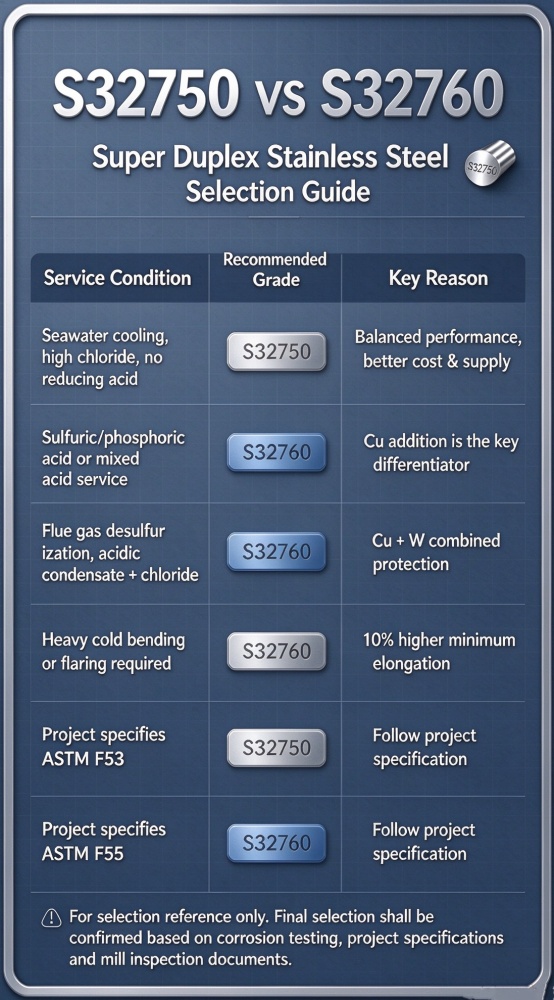
One-line summary: The two grades are interchangeable in chloride-dominated marine and oil-gas environments. S32750 features mature application, better economics, and higher minimum tensile strength. S32760 features targeted protection against reducing acids and better ductility reserve. Check first whether the medium contains sulfuric or phosphoric acid. Then check whether the forming process requires large deformation capacity. That usually settles the direction.
Compare both grades side by side. Contact us for a selection report.
FAQ: S32750 vs S32760 Super Duplex Steel
Q1: Can S32750 and S32760 replace each other?
A: In most chloride-dominated marine and oil-gas environments, yes. They are not interchangeable when reducing acids are present or when the project code specifies F53 or F55.
Q2: Which grade is better for sulfuric acid service?
A: S32760. Its copper addition improves resistance to reducing acids such as sulfuric and phosphoric acid. S32750 does not add copper.
Q3: Which grade is easier to cold form?
A: S32760. Its minimum elongation requirement is 25%, compared with 15% for S32750. This gives a wider process window for bending, flaring, and expansion.
Q4: What is the solution annealing temperature for each grade?
A: S32750: usually 1040°C–1120°C. S32760: usually 1060°C–1120°C. S32760 has a narrower window because tungsten increases σ phase precipitation tendency.
Q5: Which grade has higher tensile strength?
A: S32750. Its minimum tensile strength is ≥795 MPa, compared with ≥750 MPa for S32760. Both have the same minimum yield strength of ≥550 MPa.
Q6: What defects does heat treatment address?
A: Solution annealing dissolves harmful precipitates such as σ phase and secondary austenite. For S32760, chromium nitride (Cr₂N) control is also required.