
ASME B16.5 lap joint flange and ASME B16.9 stub end are widely used matching components in industrial piping systems. This guide covers their standards, dimensions, sealing faces, weights, materials, and applications to help engineers and purchasers make the right selection.
ASME B16.5 Flange General Introduction
ASME B16.5 is the most commonly used international standard for pipe flanges and flanged fittings. It defines dimensions, pressure ratings, materials, tolerances, and testing requirements for flanges used in pressure piping systems. ASME B16.5 flanges provide high compatibility and reliability for various industrial applications.
ASME B16.5 Lap Joint Flange
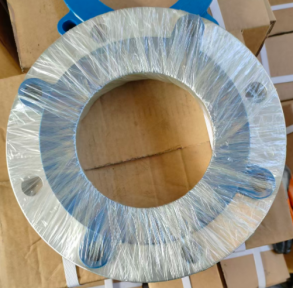
The ASME B16.5 lap joint flange is a loose-type flange that is not directly welded to the pipe. It can rotate freely, making bolt hole alignment much easier during installation. ASME B16.5 lap joint flange is usually used together with lap joint stub end to form a complete and practical flanged connection.
Class 150 Dimension of ASME B16.5 Lap Joint Flange
Class 150 is the most popular pressure class for ASME B16.5 lap joint flange. All Class 150 dimensions strictly comply with ASME B16.5 standard. Unified dimensions ensure good interchangeability between different manufacturers.
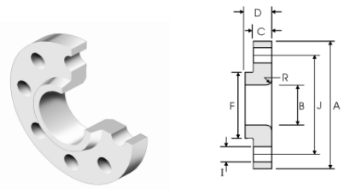
| Pipe | Flange Data | Lap | Hub | Drilling Data | ||||||
| Nominal Pipe Size | OD | A | B | C | D | R | F | H | I | J |
| mm | Overall Diameter | Inside Diameter | Flange Thickness min | Overall Lenth | Lap Radius | Hub Diameter | Number of Holes | Bolt Hole Diameter | Diameter of Circle of Holes | |
| 1/2 | 21.3 | 88.9 | 22.9 | 11.2 | 15.7 | 3 | 30.2 | 4 | 15.7 | 60.45 |
| 3/4 | 26.7 | 98.6 | 28.2 | 12.7 | 15.7 | 3 | 38.1 | 4 | 15.7 | 69.85 |
| 1 | 33.4 | 108 | 35.1 | 14.2 | 17.5 | 3 | 49.3 | 4 | 15.7 | 79.25 |
| 1 1/4 | 42.2 | 117.3 | 43.7 | 15.7 | 20.6 | 4.8 | 58.7 | 4 | 15.7 | 88.9 |
| 1 1/2 | 48.3 | 127 | 50 | 17.5 | 22.4 | 6.4 | 65 | 4 | 15.7 | 98.6 |
| 2 | 60.3 | 152.4 | 62.5 | 19.1 | 25.4 | 7.9 | 77.7 | 4 | 19.1 | 120.7 |
| 2 1/2 | 73 | 177.8 | 75.4 | 22.4 | 28.4 | 7.9 | 90.4 | 4 | 19.1 | 139.7 |
| 3 | 88.9 | 190.5 | 91.4 | 23.9 | 30.2 | 9.7 | 108 | 4 | 19.1 | 152.4 |
| 3 1/2 | 101.6 | 215.9 | 104.1 | 23.9 | 31.75 | 9.7 | 122.2 | 8 | 19.1 | 177.8 |
| 4 | 114.3 | 228.6 | 114.5 | 23.9 | 33.3 | 11.2 | 134.9 | 8 | 19.1 | 190.5 |
| 5 | 141.3 | 254 | 116.8 | 23.9 | 36.6 | 11.2 | 163.6 | 8 | 22.4 | 215.9 |
| 6 | 168.3 | 279.4 | 171.5 | 25.4 | 39.6 | 12.7 | 192 | 8 | 22.4 | 241.3 |
| 8 | 219.1 | 342.9 | 222.3 | 28.4 | 44.5 | 12.7 | 246.1 | 8 | 22.4 | 298.5 |
| 10 | 273 | 406.4 | 277.4 | 30.2 | 49.3 | 12.7 | 304.8 | 12 | 25.4 | 362 |
| 12 | 323.8 | 482.6 | 328.2 | 31.75 | 55.6 | 12.7 | 365.3 | 12 | 25.4 | 431.8 |
| 14 | 355.6 | 533.4 | 360.2 | 35.1 | 79.25 | 12.7 | 400.1 | 12 | 28.4 | 476.3 |
| 16 | 406.4 | 596.9 | 411.2 | 36.6 | 87.4 | 12.7 | 457.2 | 16 | 28.4 | 539.8 |
| 18 | 457.2 | 635 | 462.3 | 39.6 | 96.8 | 12.7 | 505 | 16 | 31.75 | 577.9 |
| 20 | 508 | 698.5 | 514.4 | 42.9 | 103.1 | 12.7 | 558.8 | 20 | 31.75 | 635 |
| 24 | 609.6 | 812.8 | 616 | 47.8 | 111.3 | 12.7 | 663.4 | 20 | 35.1 | 749.3 |
Sealing faces of Lap Joint Flange
Sealing faces directly affect the sealing performance of lap joint flanges. ASME B16.5 lap joint flanges provide three main types of sealing faces:
- Raised Face (RF)
- Flat Face (FF)
- Ring Type Joint (RTJ)
Raised Face (RF) is the most widely used for Class 150 and Class 300 lap joint flanges, providing strong and reliable sealing for most general industrial piping systems.
Flat Face (FF) is mainly used in low-pressure Class 150 systems, often matched with cast iron equipment or non-metallic flanges.
Ring Type Joint (RTJ) is designed for high-pressure classes Class 600 and higher, using metal ring gaskets for high-temperature and high-pressure service conditions.
ASME B16.5 LAPJ Flange Weight Reference
Weight information is important for transportation, installation, and structural design. The weight of ASME B16.5 lap joint flange changes with nominal pipe size, material, and pressure class. Accurate weight data helps users estimate logistics cost and project load.
| NPS | 150LB | 300LB | 400LB | 600LB | 900LB | 1500LB | 2500LB |
| 1/2 | 0.45 | 0.68 | 0.91 | 0.91 | 2.72 | 2.72 | 3.18 |
| 3/4 | 0.68 | 1.14 | 1.36 | 1.36 | 2.72 | 2.72 | 3.63 |
| 1 | 0.91 | 1.36 | 1.59 | 1.59 | 3.41 | 3.41 | 5.45 |
| 1 1/4 | 1.14 | 2.04 | 2.04 | 2.04 | 4.54 | 4.54 | 7.72 |
| 1 1/2 | 1.36 | 2.95 | 2.95 | 2.95 | 6.36 | 6.36 | 10.9 |
| 2 | 2.27 | 3.18 | 3.63 | 3.63 | 9.53 | 9.53 | 16.8 |
| 2 1/2 | 3.63 | 4.54 | 4.99 | 4.99 | 11.35 | 13.17 | 24.06 |
| 3 | 4.09 | 6.58 | 6.36 | 6.36 | 13.17 | 17.25 | 36.32 |
| 3 1/2 | 4.99 | 7.26 | 9.08 | 9.08 | / | / | / |
| 4 | 5.45 | 10.9 | 9.99 | 14.07 | 23.15 | 34.05 | 55.39 |
| 5 | 5.9 | 11.8 | 13.17 | 28.6 | 36.77 | 62.65 | 92.62 |
| 6 | 8.17 | 17.25 | 16.8 | 35.41 | 47.67 | 77.18 | 142.56 |
| 8 | 12.71 | 24.97 | 26.79 | 50.85 | 85.35 | 129.84 | 213.83 |
| 10 | 16.34 | 39.95 | 43.13 | 88.53 | 125.76 | 220.19 | 407.24 |
| 12 | 27.24 | 63.11 | 69.01 | 108.96 | 168.43 | 340.05 | 572.95 |
| 14 | 38.5 | 83.54 | 95.34 | 131.66 | 180.24 | / | / |
| 16 | 47.22 | 106.24 | 127.12 | 181.6 | 221.55 | / | / |
| 18 | 66.28 | 138.4 | 156.63 | 212.93 | 304.18 | / | / |
| 20 | 72.19 | 170.25 | 190.68 | 274.22 | 394.07 | / | / |
| 24 | 88.53 | 240.62 | 279.21 | 393.16 | 753.19 | / | / |
ASME B16.9 Standard
ASME B16.9 is the standard for factory-made wrought steel butt-welding fittings. It covers dimensions, manufacturing requirements, and inspection rules for butt-welding fittings such as elbows, tees, reducers, and lap joint stub ends. ASME B16.9 ensures stable fitting quality and good matching with pipes.
ASME B16.9 Lap Joint Stub End
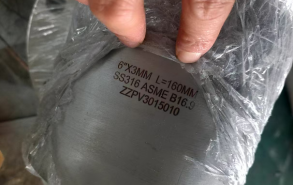
ASME B16.9 lap joint stub end is a special butt-welding fitting designed for lap joint flanges. It has a straight pipe body and a flared end that forms the sealing surface. The stub end is welded to the pipe, while the lap joint flange remains rotatable.
How Lap Joint Flange Works with Stub End?
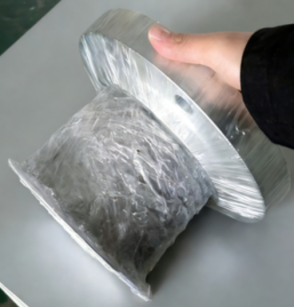
Understanding how lap joint flange works with stub end helps ensure correct installation.
The lap joint flange is first slipped onto the pipe. The stub end is then welded to the pipe end. The flange can rotate freely for easy bolt alignment. When tightened, the flange holds the stub end to create a strong and tight connection.
Material Selection for Lap Joint Flange and Stub End
Material is key to the service life and safety of lap joint flange and stub end. Common materials include:
- Carbon steel
- Stainless steel 304/304L
- Stainless steel 316/316L
- Alloy steel
Materials are chosen based on pressure, temperature, medium, and corrosion resistance needs. The stub end is often made of the same material as the pipeline.
Typical Applications
Lap joint flange and stub end connections are widely used in many industries due to easy installation and maintenance. Typical applications include:
- Chemical and petrochemical plants
- Water treatment systems
- Food and beverage processing
- Pharmaceutical equipment
- Marine and offshore piping
- Stainless steel piping systems
They are especially suitable for systems that require frequent disassembly and cleaning.