
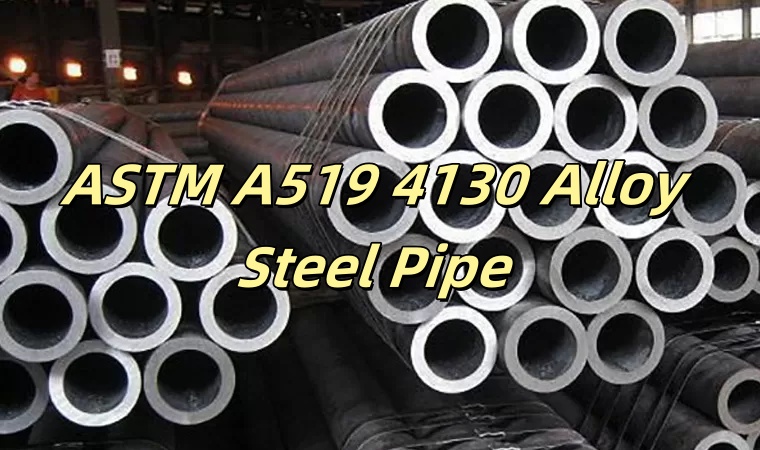
ASTM A519 4130 alloy steel pipe is a common low alloy steel pipe, an alloy containing chromium and molybdenum that has higher tensile strength and higher fatigue resistance. It is able to withstand tremendous pressure and strain, which makes 4130 Chrome Moly pipe suitable for a variety of critical applications that require extremely high performance. It is often called Chrome-Molybdenum Alloy Steel, or simply Chrome-Molybdenum Steel, because it contains chromium (Cr) and molybdenum (Mo) as strengthening agents. 4130 Alloy Steel is known for its responsiveness to mechanical and heat treatments and can be welded by most commercially common methods. It can be cold worked and is usually formed in the annealed condition. Contact us
4130 Alloy Steel Pipe Features
High strength and toughness: The addition of chromium and molybdenum significantly improves its strength and toughness.
Good weldability: The lower carbon content makes it easy to weld, but requires proper welding process.
Easy to process: In the annealed state, 4130 alloy steel pipe has good formability and machinability.
Corrosion resistance: It has certain corrosion resistance and oxidation resistance.
Lightweight: Compared with ordinary carbon steel, 4130 alloy pipe can use thinner wall thickness when achieving the same strength requirements, thus achieving lightweight.
Specification of AISI 4130 Alloy Steel Pipe
| Size Range | 2″ – 12” |
| Schedules | 20, 30, 40, Standard (STD), Extra Heavy (XH), 80, 100, 120, 140, 160, XXH & heavier |
| Standard | ASTM A519 |
| Grade | AISI 4130, L80, L110 |
| Type | Seamless / ERW / Welded / Fabricated |
| Form | Round, Hydraulic Etc |
| Length | Single Random, Double Random & Cut Length. |
| End | Plain End, Beveled End, Treaded |
ASTM A519 Standard Scope
This specification covers several grades of carbon and alloy steel seamless mechanical tubing. The grades are listed in Tables 1-3. When welding is used for joining the weldable mechanical tube grades, the welding procedure shall be suitable for the grade, the condition of the components, and the intended service.
This specification covers both seamless hot-finished mechanical tubing and seamless cold-finished mechanical tubing in sizes up to and including 12 3/4 in. [325 mm] outside diameter for round tubes with wall thicknesses as required.
Chemical composition % of ASTM A519 4130 Alloy Steel Pipe
| Chemical composition limits, % | ||||||||
| Grade Designation | Carbon | Manganese | Phosphorus,max | Sulfur, max | Silicon | Nickel | Chromium | Molybdenum |
| 4130 | 0.28-0.33 | 0.40-0.60 | 0.04 | 0.04 | 0.15-0.35 | – | 0.80-1.10 | 0.15-0.25 |
Mechanical Properties of ASTM A519 4130 Alloy Steel Pipe
| Grade Designation | Condition | Ultimate Strength | Yield Strength | Elongation in 2 in.or 50mm,% | Rockwell,Hardness B Scale | ||
| ksi | Mpa | ksi | Mpa | ||||
| 4130 | HR | 90 | 620 | 70 | 485 | 20 | 89 |
| SR | 105 | 725 | 85 | 585 | 10 | 95 | |
| A | 75 | 515 | 55 | 380 | 30 | 81 | |
| N | 90 | 620 | 60 | 415 | 20 | 89 | |
Physical Properties ASTM A519 4130 Alloy Steel Pipe
| Properties | Metric | Imperial |
| Density | 7.85 g/cm3 | 0.284 lb/in³ |
| Melting point | 1432°C | 2610°F |
Alloy 4130 Pipe Equivalent Grades
| EU | USA | Germany | Japan | France | England | Italy |
| EN | – | DIN,WNr | JIS | AFNOR | BS | UNI |
| 25CrMo4 | SAE4130 | 25CrMo4 | SCM420 | 25CD4 | 708A25 | 25CrMo4 |
AISI 4130 Alloy Steel Pipe Processing performance
·Cold working: 4130 alloy steel pipe has good cold working performance and can be formed by conventional cold working methods such as bending, stretching, hammering or pressing. In the annealed state, its plasticity is moderate and it is easy to cold deform.
·Hot working: 4130 alloy steel can be hot worked, such as forging, in the temperature range of 816∘C to 1093∘C (about 1500∘F to 2000∘F). The maximum forging temperature can reach 1230∘C (about 2250∘F), but it is recommended to stop forging when the forging temperature is lower than about 870∘C (about 1600∘F).
·Machinability: In the annealed state, 4130 alloy steel pipe has good machinability. However, as the hardness of the steel increases, the difficulty of machining will increase accordingly.
UNS G41300 Alloy Steel Pipe Heat Treatment Processes
Through heat treatment processes such as quenching and tempering, the strength, hardness and toughness of 4130 steel can be further improved to meet specific application requirements.
| Process | Parameters (Typical) | Purpose |
| Annealing | Heat to 870–900°C, slow cool | Soften the material and improve machinability |
| Normalizing | Heat to 870–950°C, air cool | Refine grain structure, improve uniformity |
| Quenching | Heat to 870–900°C, oil or water quench | Increase hardness and strength |
| Tempering | Heat to 400–650°C after quenching, air cool | Relieve internal stress, improve |
AISI 4130 Alloy Steel Pipe Packed
1. Inner packaging materials
Anti-rust paper, anti-rust film, vapor phase anti-rust bag, etc. can effectively isolate air and moisture and extend the anti-rust cycle.
2. Outer packaging materials
Hexagonal steel pipes are bundled and wrapped with strong steel belts, or packaged according to customer requirements. Waterproof canvas, plastic cloth, etc. are used to cover the steel pipe bundles to prevent the intrusion of rain, dust, etc.
3. Container packaging: The steel pipes are loaded into the container, supported by wooden pallets at the bottom, and filled with cushioning materials around to prevent shaking during transportation.
4. Wooden box packaging: The steel pipes are placed in a customized wooden box, the inner wall of the wooden box is lined with anti-rust paper and cushioning materials, and the outside of the box is tied with steel belts. Wooden box packaging is suitable for high-precision or easily damaged steel pipes.
5. End protection:
The ends of the pipes are usually sealed with plastic covers or other protective caps to prevent damage to the pipe mouth or internal contamination.
6. Marking & Labeling:
The outside of the package will be clearly labeled with the quantity, product model, batch number, specifications (trademark, brand, size, etc.) of the product for easy identification and tracking.
During the packaging process, our experienced warehouse staff will take the most stringent precautions to ensure that your AISI 4130 alloy steel pipe is optimally protected during transportation.
Outside Diameter Tolerances for Round Hot-Finished Pipe
| Outside Diameter Size Range, in.(mm) | Outside Diameter Tolerance, in. (mm) | |
| Over | Under | |
| 4.500-5.99 (114.30-152.37) | 0.031 (0.79) | 0.031 (0.79) |
| 6.000-7.499 (152.40-190.47) | 0.037 (0.94) | 0.037 (0.94) |
| 7.500-8.999 (190.50-228) | 0.045 (1.14) | 0.045 (1.14) |
| 9.000-10.750 (228.60-273.05) | 0.050 (1.27) | 0.050 (1.27) |
Outside and Inside Diameter Tolerances for Round Cold-Worked Pipe
| Outside and Inside Diameter Tolerances for Round Cold-Worked Tubing | |||||||||||||
| Outside Diameter Size Range, in. | Thermal Treatment after Final Cold Work Producing Size | ||||||||||||
| Wall Thickness as Percent of Outside Diameter | None, or not exceeding 1100°F Nominal Temperature | Heated Above 1100°F Nominal Temperature Without Accelerated Cooling | Quenched and Tempered | ||||||||||
| OD, in. | ID, in. | OD, in. | ID, in. | OD, in. | ID, in. | ||||||||
| Over | Under | Over | Under | Over | Under | Over | Under | Over | Under | Over | Under | ||
| Up to 0.499 | all | 0.004 | 0 | — | — | 0.005 | 0.002 | — | — | 0.01 | 0.01 | 0.01 | 0.01 |
| 0.500 – 1,699 | all | 0.005 | 0 | 0 | 0.005 | 0.007 | 0.002 | 0.002 | 0.007 | 0.015 | 0.015 | 0.015 | 0.015 |
| 1,700 – 2,099 | all | 0.006 | 0 | 0 | 0.006 | 0.006 | 0.005 | 0.005 | 0.006 | 0.02 | 0.02 | 0.02 | 0.02 |
| 2,100 – 2,499 | all | 0.007 | 0 | 0 | 0.007 | 0.008 | 0.005 | 0.005 | 0.008 | 0.023 | 0.023 | 0.023 | 0.023 |
| 2,500 – 2,899 | all | 0.008 | 0 | 0 | 0.008 | 0.009 | 0.005 | 0.005 | 0.009 | 0.025 | 0.025 | 0.025 | 0.025 |
| 2,900 – 3,299 | all | 0.009 | 0 | 0 | 0.009 | 0.011 | 0.005 | 0.005 | 0.011 | 0.028 | 0.028 | 0.028 | 0.028 |
| 3,300 – 3,699 | all | 0.01 | 0 | 0 | 0.01 | 0.013 | 0.005 | 0.005 | 0.013 | 0.03 | 0.03 | 0.03 | 0.03 |
| 3,700 – 4,099 | all | 0.011 | 0 | 0 | 0.011 | 0.013 | 0.007 | 0.01 | 0.01 | 0.033 | 0.033 | 0.033 | 0.033 |
| 4,100 – 4,499 | all | 0.012 | 0 | 0 | 0.012 | 0.014 | 0.007 | 0.011 | 0.011 | 0.036 | 0.036 | 0.036 | 0.036 |
| 4,500 – 4,899 | all | 0.013 | 0 | 0 | 0.013 | 0.016 | 0.007 | 0.012 | 0.012 | 0.038 | 0.038 | 0.038 | 0.038 |
| 4,900 – 5,299 | all | 0.014 | 0 | 0 | 0.014 | 0.018 | 0.007 | 0.013 | 0.013 | 0.041 | 0.041 | 0.041 | 0.041 |
| 5,300 – 5,549 | all | 0.015 | 0 | 0 | 0.015 | 0.02 | 0.007 | 0.014 | 0.014 | 0.044 | 0.044 | 0.044 | 0.044 |
ASTM A519 4130 Alloy Steel Pipe Common uses
Aerospace structural parts (such as fuselage frames, landing gear)
Racing chassis, frames, roll cages
Bicycle frames, motorcycle parts
High-pressure oil and gas pipelines
Industrial machinery structural pipes, tool brackets
You can get an offer for products in below material forms:
-Pipe and Tube (EN 10216-5, ASTM A213, ASTM A249, A312, A790,)
-Forged Fitting and Flange (ASTM A182 , ASTM A105,ASTM B564 )
-Butt Weld Fittings (ASTM A234, ASTM A403,ASTM A815)
-Round bar , Billet (ASTM A276, ASTM A479)
– Plate, Sheet, Strip(ASTM A240, EN 10028-7, A480)
-Bolting, Nuts(ASTM A193, A194, A320)
ASTM A519 4130 Alloy Steel Pipe Exported Countries
We Export ASTM A519 4130 Alloy Steel Pipe to Saudi Arabia, United Arab Emirates, Qatar, Bahrain, Oman, Kuwait, Turkey, Egypt, Yemen , Syria, Jordan, Cyprus, Singapore, Malaysia, Indonesia, Thailand, Vietnam, South Korea, Japan, Sri Lanka, Maldives, Bangladesh, Cambodia, Argentina, Bolivia, Brazil, Venezuela, Colombia, Ecuador, Guyana, Paraguay, Uruguay, United States Of America, Canada, Mexico, Panama, Jamaica, Bahamas, Denmark, Norway, Germany, France,Italy, United Kingdom, Spain, Belgium, Greece, Czech Republic, Portugal, Hungary, Albania, Austria, Finland, Ireland, Croatia, Malta, Nigeria, Algeria, Angola, South Africa, Libya, Egypt, Sudan, Europe, Africa, Asia, North America, South America, Middle East.etc
Frequently Asked Questions (FAQs)
1. What is 4130 steel good for?
4130 steel is a low-alloy, high-strength steel known for its excellent strength-to-weight ratio, weldability, and toughness. It is widely used in aerospace, motorsports, and industrial applications—such as aircraft structures, race car frames, roll cages, and high-performance tubing—where strong yet lightweight and easily weldable materials are essential.
2. How does 4130 chrome molybdenum tubing compare to stainless steel?
Both 4130 Chrome Moly and Stainless Steel have applications in various industries, but there are significant differences between the two. Chrome Moly 4130 has a good strength to density ratio, is easy to machine, and has fairly high weldability. However, stainless steel performs better in wet and corrosive environments, especially when it is not surface treated. On the other hand, stainless steel is heavier and more difficult to machine than Chrome Moly.