
What is Butt Weld Fittings?
Butt weld fittings are a type of pipe fittings that are directly connected to the pipe end face after the pipe end face is processed through bevel and connected by full penetration weld. This kind of pipe fittings are exquisitely designed to ensure the stability and sealing of the pipe connection. Butt-weld pipe fittings have high weld strength, low fluid resistance, and continuous and smooth inner surface.
Butt weld fittings are mainly suitable for high-pressure pipelines that require high pressure, equipment with precise dimensions, and other high-pressure fields such as petrochemical, medical and health, electric power, aerospace, military industry, fire protection, metallurgy, shipbuilding, gas, nuclear power, and environmental protection.
Features of Butt weld Fittings
1. High Strength and Reliability: Butt weld connections are achieved through full penetration welding, which allows the fittings and pipelines to form a continuous metal structure, which is usually as strong as or higher than the parent material. This enables butt-weld fittings to withstand extremely high pressures, temperatures, and mechanical stresses, ensuring long-term stable operation of the pipeline system.
2. Excellent sealing performance: Welded connections eliminate potential leakage paths that may exist in threaded or flanged connections, providing the highest level of sealing for fluid transportation, especially suitable for pipelines that transport dangerous, flammable, explosive, or precious media.
3. Smooth internal flow path: The internal surface of butt-weld fittings is usually smooth and continuous, without protruding edges or dead corners. This minimizes fluid turbulence, pressure drop, and accumulation of corrosive media, which is critical for systems with high-purity media or low flow resistance.
4. Wide range of applications: Applicable to almost all pipe sizes and wall thicknesses, from small instrumentation lines to large transmission pipelines.
5. Easy installation: Compared with other connection methods, the installation process of butt-welded pipe fittings is relatively simple, which can effectively shorten the construction period and improve engineering efficiency. At the same time, the stability of the welding connection also reduces the workload of later maintenance and overhaul.
Types for Butt Weld Fittings
Butt Weld Elbows:
One of the most commonly used pipe fittings in the pipeline system, mainly used to change the flow direction of the pipeline. They are permanently connected to the pipeline or other pipe fittings by butt welding to form a seamless, strong and leak-proof structure.
· 90-degree elbow: Used to achieve a 90-degree direction change, divided into long radius (LR) and short radius (SR). LR elbows (radius is 1.5 times the nominal diameter) have less flow resistance, and SR elbows (radius is 1 times the nominal diameter) are more space-saving.
· 45-degree elbows: Used to achieve a 45-degree direction change.
· 180-degree elbows (Return Bends): Used for complete reversal of flow direction, commonly found in heat exchangers.
Butt Weld Tee:
Butt weld tee is a common pipe connector. It is in the shape of a “T” and is used to lead a branch pipeline from the main pipeline to achieve fluid diversion or confluence. It is connected to the pipeline by butt welding to form a firm, sealed and continuous structure to ensure that there is no leakage during the transmission of high pressure, high temperature or corrosive media.
· Equal Tee: The diameter of the main pipe and the branch pipe is the same.
· Reducing Tee: The diameter of the branch pipe is smaller than the diameter of the main pipe.
Butt Weld Cross:
The butt weld cross is a special butt welding pipe fitting. It is shaped like a “cross” and is mainly used to connect four pipes at one point to achieve fluid diversion or convergence in four directions.
· Equal Cross: The diameter of all four ports is the same. Used to connect four pipes of the same diameter.
· Reducing Cross: The diameter of at least one port is different from that of the main pipe (usually the diameter of the branch pipe is smaller than the diameter of the main pipe). Used to change the pipe diameter while diverting or converging.
Butt Weld Reducers:
Butt-weld reducers, also often called butt-weld reducers, are an important butt-weld pipe fitting that is mainly used to connect two pipes of different diameters to achieve a smooth transition and flow adjustment of fluid media in a pipeline system. They are welded directly to the pipe through the beveled end to form a strong, leak-free connection that is flush with the inner wall of the pipe, minimizing fluid resistance.
· Concentric Reducer: It is tapered and used to keep the centerline of the pipe aligned.
· Eccentric Reducer: It is straight on one side and is often used in horizontal pipes to prevent fluid or gas accumulation.
Butt Weld Cap:
Butt weld caps, as an important pipe connector, are mainly used to close the end of the pipeline system. Its design features no internal threads or sockets, but is directly butt-welded to the pipe through a beveled bevel to form a permanent, seamless and highly sealed end. This connection ensures the structural integrity, high strength and excellent leakage resistance of the pipeline system, enabling it to withstand the transmission of high pressure, high temperature or corrosive media.
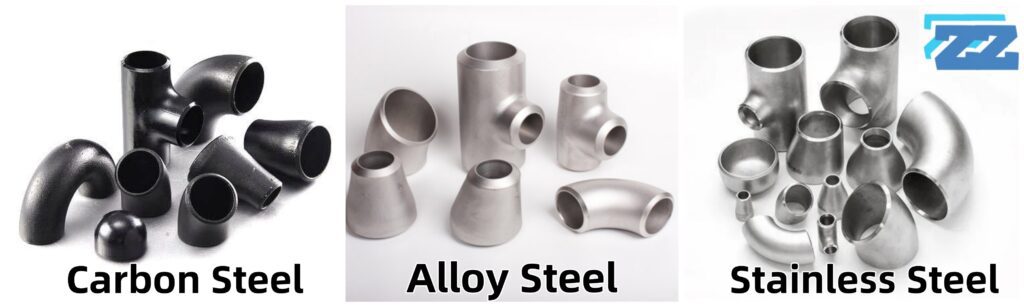
Materials of Carbon Steel Butt Weld Fittings
Carbon Steel: ASTM A234 WPB/WPC, ASTM 420 WPL 3 / 6 / 9, A860 WPHY 42 / 46 / 56 / 60 / 65
Carbon steel is the most common and largest-volume steel material. It is an alloy with iron as the main component and a small amount of carbon and other trace elements (such as manganese, silicon, sulfur, and phosphorus). The carbon content is the key factor in distinguishing the types of carbon steel and determining its performance.
Main features of carbon steel
1. Economical: Compared with other alloy steels or stainless steels, carbon steel has a lower production cost, which makes it the most cost-effective choice in many industrial applications.
2. Strong versatility: Carbon steel butt weld fittings can obtain various mechanical properties from soft to hard, from tough to brittle by adjusting the heat treatment process according to the different carbon content to meet different application requirements.
3. Good processability: Most carbon steels have good plasticity, are easy to weld and cut, and are convenient for various forming.
4. Adjustable strength and hardness: As the carbon content increases, the strength, hardness and wear resistance of carbon steel will increase, but the plasticity and toughness will decrease accordingly.
Materials of Alloy Steel Butt Weld Fittings
Alloy Steel : A234 WP5 / WP9 / WP11 / WP12 / WP22 /WP 91 / WP92
Alloy Steel refers to the intentional addition of one or more alloying elements to carbon steel to improve the mechanical, physical and chemical properties of steel, so that it has special properties that carbon steel does not have.
Main features of alloy steel
High strength and hardness: Able to withstand greater loads and impacts.
Excellent toughness: Enhanced ability to resist fracture and not easy to break brittlely.
Good wear resistance: Extend service life and reduce wear.
Corrosion resistance: Ability to resist chemical erosion in harsh environments.
Materials of Stainless Steel Butt weld Fittings
Stainless Steel : A403 WP304/304L/304H – WP316/316L – WP317 – WP310S – WP321 – WP347 – WP904L
Stainless Steel is a special iron alloy known for its excellent corrosion resistance because it contains at least 10.5% chromium. Chromium forms an extremely thin but dense passivation film (chromium oxide) on the surface of steel, which can self-repair and protect the steel from further oxidation and corrosion.
Main features of stainless steel
1. Strong corrosion resistance: Chromium forms a dense oxide film on the surface to block the invasion of corrosive media, and performs well in the atmosphere, water and acid-base environments.
2. Good strength and toughness: By adjusting the composition and heat treatment, the strength range is wide, and it has good toughness and can withstand impact and deformation.
3. Good processing performance: It can be formed by cold and hot processing through a variety of processes, has good weldability, and is easy to manufacture complex parts and structural parts.
4. High temperature and oxidation resistance: Some stainless steels can still maintain stable performance at high temperatures, have strong oxidation resistance, and are suitable for high temperature industrial environments.
Application of Butt Weld Fittings
Oil and Gas Industry: Upstream Exploration, Midstream Transportation (Pipeline) and Downstream Refining.
Chemical and Petrochemical Industry: Handling of Corrosive Media, High-pressure Reactors and Tank Connections.
Power Industry: Steam and Water Circulation Systems in Thermal Power Generation and Nuclear Power Plants.
Food and Beverage Industry: Production Lines with High Hygiene Requirements to Ensure No Contamination.
Pharmaceutical Industry: Transportation of High-purity Media.
Shipbuilding and Marine Engineering: Seawater Pipelines and Hull Structures.