
Butt Weld pipe fittings are pipeline connection components manufactured from welded pipes, which are directly welded to the pipeline using the butt welding method. They are suitable for high-temperature, high-pressure, and media-sensitive applications. Production standards comply with international standards such as ASME B16.9, with materials including stainless steel (304/316 series) and carbon steel. The applicable media include gas, liquid, and steam. Product types include butt-welded 90° elbows, tees, crosses, and reducers, among others. They are classified by bending radius into long radius (R=1.5D) and short radius (R=1D).
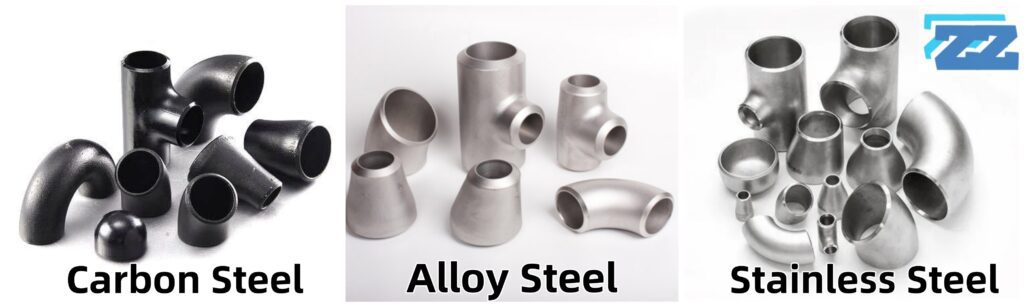
Butt Weld Pipe Fitting Types
Butt Weld Elbows:
One of the most commonly used fittings in piping systems, they are primarily used to change the direction of flow. They are permanently connected to pipes or other fittings via butt welding, creating a seamless, strong, and leak-proof structure.
90-degree elbows: Used to achieve a 90-degree change in direction and are available in long radius (LR) and short radius (SR) versions.
45-degree elbows: Used to achieve a 45-degree change in direction.
180-degree elbows (return elbows): Used to completely reverse flow direction and are commonly found in heat exchangers.
Butt Weld Tees:
Butt Weld Tees are a common pipe connector. They are T-shaped and used to branch off from a main pipeline, diverting or merging fluids. They are connected to the pipeline via butt welding, creating a secure, sealed, and continuous structure that ensures leak-free operation even when conveying high-pressure, high-temperature, or corrosive media. Tees are available in equal-diameter and reducing-diameter tees.
Butt Weld Crosses:
Butt-Weld Crosses are a specialized butt-weld pipe fitting. Shaped like a cross, it’s primarily used to connect four pipes at a point, diverting or merging fluids in four directions.
Butt weld Reducer:
Butt-weld reducers, also commonly known as butt-weld reducers, are an important butt-weld pipe fitting used to connect two pipes of different diameters, ensuring a smooth transition and regulating flow within a piping system. They are welded directly to the pipe using a beveled end, creating a secure, leak-proof connection. They also sit flush with the pipe’s interior wall, minimizing fluid resistance. Reducers are categorized as concentric and eccentric reducers.
Butt weld Cap:
Butt weld caps are essential pipe connectors used to seal the ends of piping systems. They lack internal threads or sockets, but are instead welded directly to the pipe using a beveled groove, creating a permanent, seamless, and highly sealed end.
Benefits of ANSI B16.9 Compliance
Enhanced Safety: Components manufactured to precise dimensions and strict tolerances reduce the likelihood of leaks or failures.
Standardization: Consistent part dimensions eliminate guesswork, simplifying installation and maintenance.
Regulatory Acceptance: Components that comply with recognized rules clear the approval path in regulated environments.
Cost-Effectiveness: Reliably manufactured parts reduce scrap, minimize failures, and lower maintenance costs.
Global compatibility: International specifications allow components to fit systems built anywhere, simplifying logistics.
Manufacturing Process
Material selection:
Choosing the appropriate raw materials is the first step. Commonly used materials include carbon steel, stainless steel, etc. The raw materials are cut into the required length and shape.
Hot pushing:
For elbow-type ASTM A234 butt-welded pipe fittings, hot pushing is a common forming method. The blank is heated to a certain temperature and then placed into a die for pushing.
Stamping:
The blank is placed in a die, and a press is used to apply significant pressure, causing the blank to deform into the desired pipe fitting shape.
Cold pressing:
Cold pressing is a processing method that applies pressure to the material at room temperature, causing it to undergo plastic deformation to achieve the desired shape and dimensions.
Hot pressing
Hot pressing is a processing method that involves heating the material to a certain temperature and then applying pressure. Heating increases the atomic mobility of the material, reducing its yield strength and making it easier to undergo plastic deformation.
Heat treatment :
After forming, the pipe fittings undergo heat treatment processes (such as normalizing, annealing, or quenching + tempering) to eliminate stress and improve mechanical properties and corrosion resistance.
Blank shaping:
Blank shaping is a critical step in the mechanical manufacturing process, aimed at correcting and optimizing the shape and dimensions of the blank obtained from preliminary processing.
Beveling:
Before butt welding, the welding area of the pipe fitting must undergo beveling. There are various beveling forms, such as V-type beveling and U-type beveling, selected based on the wall thickness of the pipe fitting and welding requirements.
Circularity correction:
Circularity correction is an operation that corrects the shape of circular workpieces or blanks to make them as close as possible to an ideal circle.
Surface Treatment:
Methods such as sandblasting, acid washing, or passivation are used to remove scale, rust, and impurities, thereby improving the surface quality of the pipe fittings. Sandblasting effectively removes rust, scale, oil stains, and other impurities from the metal surface. Painting pipe fittings is a surface protection process. After applying anti-rust paint, it can effectively resist atmospheric corrosion and prevent rusting of the pipe fittings.
Marking:
Marking on pipe fittings refers to the process of engraving text, numbers, or symbols on the surface of the fittings.
Inspection:
Quality inspection is an indispensable part of the stainless steel butt-welded pipe fitting manufacturing process. This step typically includes dimensional inspection, visual inspection, weld inspection, and other aspects to ensure product quality and reliability.
Packaging:
During transportation and storage, pipe fittings may be subjected to external forces such as collisions, friction, and compression. Proper packaging can minimize damage caused by these external forces. For stainless steel butt-welded pipe fittings, protective caps are added to both ends to prevent damage during transportation and storage. The choice of packaging materials depends on the surface requirements of the product, with common options including plastic bags, foam, bubble wrap, and woven bags.
Advantages of the Butt Weld Pipe Fitting
High strength and excellent pressure resistance: The integral forming process ensures that the pipe fittings are consistent with the base material, resulting in high connection strength after welding.
Reliable sealing performance: Welded connections eliminate the risk of leaks, making them suitable for high-temperature and high-pressure pipeline systems.
Wide range of applications: Suitable for various industrial fields such as petroleum, chemicals, power, shipping, and metallurgy.
Complete range of specifications: We can produce a variety of butt-welded pipe fittings from small to large diameters to meet different engineering requirements.
Conclusion
The manufacturing process for butt-welded pipe fittings is a complex and precise procedure involving multiple stages, including raw material preparation, welding and forming, pipe processing, welding edge finishing, quality inspection, and packaging and storage. Through these series of manufacturing steps, the high quality and reliability of stainless steel butt-welded pipe fittings are ensured, enabling their widespread application across various industrial sectors. With the continuous advancement of technology, the manufacturing processes for butt-welded pipe fittings are also undergoing constant innovation and improvement to meet the market’s demand for high-quality products.