
On May 20, 2025, our company received an inquiry from a new customer for carbon steel pipes and fittings. The customer listed the specifications, materials, quantity and related technical requirements of the flanges in detail in the email. After completing the quotation, the customer communicated with us about the specific details and placed an order with us.
ZIZI is a company specializing in the production and processing of pipes and fittings. The pipes and pipe fittings we produce are mainly used in chemical, petroleum, natural gas, water conservancy, electric power, marine engineering and other fields. The products mainly include seamless pipes, welded pipes, butt-welded pipe fittings, high-pressure forged pipe fittings and flanges of various sizes. The materials include carbon steel, stainless steel, alloy steel, low-temperature steel, duplex steel, base alloy, etc.
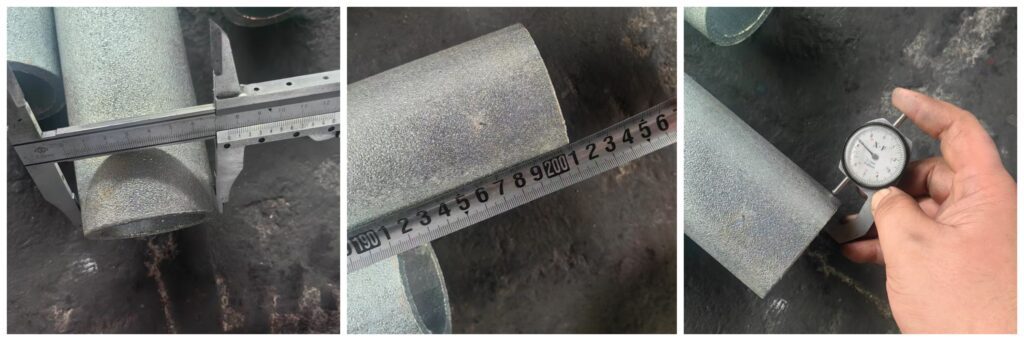
Inspection of Carbon Steel pipes
Outer diameter inspection:
Usually, an outside diameter micrometer or caliper is used to measure the steel pipe in different cross-sections and circumferential directions to check whether it is within the allowable tolerance range. For large-diameter steel pipes, ovality may also be checked.
Wall Thickness (WT) Inspection:
Measurement is carried out at different points of the steel pipe to ensure that the wall thickness is uniform and meets the minimum wall thickness requirements specified in the standard. The standard usually specifies the negative deviation of wall thickness (that is, the minimum allowable wall thickness) and the unevenness of wall thickness
Length (Length) Inspection:
According to the order requirements, verify whether the fixed length, multiple length or irregular length of the steel pipe meets the requirements.
Inspection of Butt Weld pipe fittings
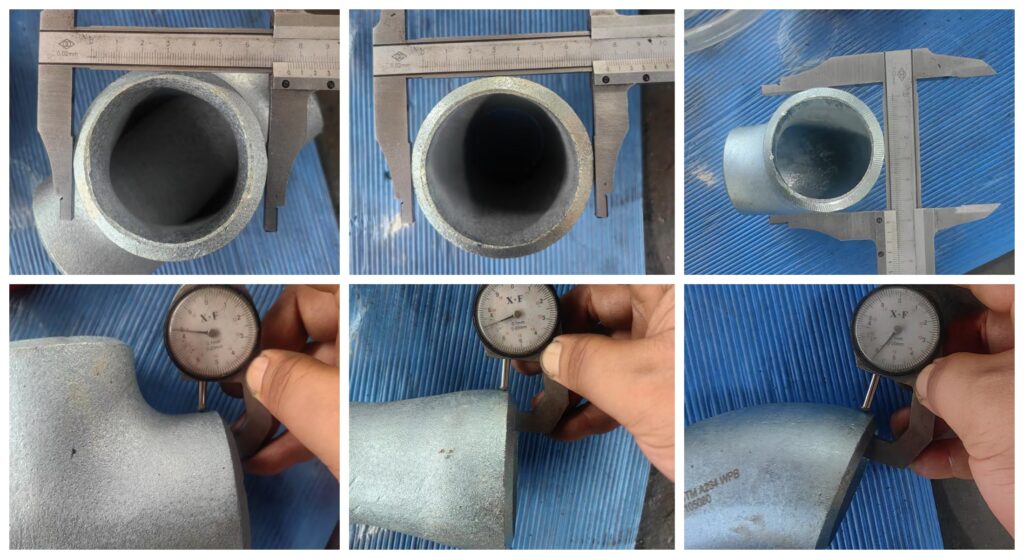
Nominal diameter (DN) inspection
This is the key dimension for the connection between the pipe fittings and the pipeline. And it is necessary to check whether it is consistent with the order and design drawings. Center distance and height (applicable to elbows, tees, reducers, etc.):
Elbows: Check the center distance of the elbow, the bending radius and the angle (such as 45°, 90°, 180°).
Tee: Check the center distance between the main pipe and the branch pipe, as well as the size and angle of the branch pipe.
Reducers: Check the diameter and wall thickness of the large and small ends, as well as the length and taper of the reducing part.
ASTM A106B Pipe Specification
| Processing Method | Seamless and Welded |
| Size Range | 1/8″- 48″ / DN6 – 1200 |
| Thickness Schedule | SCH 10, SCH 20, SCH 40, STD, XS, SCH 100, SCH 120, SCH 160, XXS |
| Length | 6m or 12 m or Random |
| Standard | ASME B36.10M |
| Surface Treatment | Blasting and Painting , Epoxy Powder FBE, 2PE, 3PE Coating |
| Material Grade | ASTM A106B / A53, API 5L B |
ASTM A106 B Carbon Steel Pipes Chemical Composition
| CHEMICAL | LIMITS | C | Mn | P | S | Cu | Ni | Cr | Mo | V | Si |
| ASTM A106B | MIN | 0.29 | 0.10 | ||||||||
| MAX | 0.30 | 1.06 | 0.035 | 0.04 | 0.40 | 0.400 | 0.40 | 0.15 | 0.080 |
ASTM A106 B Carbon Steel Pipes Mechanical Property
| MATERIAL | T.S (MPA) | Y.S (MPA) | EL % |
| ASTM A106 GR B | 415 min | 240 min | 22 min |
Key Features and Advantages
Strength and toughness: Carbon steels have good tensile and yield strengths and are capable of withstanding high stresses and external loads.
Economy: Carbon steel is less costly than alloy steels such as stainless steel, and therefore offers significant economic advantages in large-scale applications.
Ease of Processing: Carbon steel is easy to cut, weld, bend and machine, facilitating on-site construction and installation.
Wide range of applications: Suitable for a wide range of fluid and gas transportation, as well as structural support.
Carbon steel pipes Main Applications
Petroleum and natural gas industry: used to transport crude oil, natural gas and refined oil.
Water treatment and water supply and drainage: urban water supply, drainage, fire protection system, etc.
Architectural and structural engineering: as structural support, scaffolding, bridge components, etc.
Machinery manufacturing: used to manufacture various mechanical equipment and components.
Electric power and chemical industry: used for boiler pipes, heat exchangers, pressure vessels, etc.
ASTM A234 WPB Carton Steel Fittings Specification
| Size Range | 1/2″ – 80″ / DN15 – 2000 |
| Thickness Schedule | SCH 10, 20, 40, STD, XS, 80, 100, 120, 140, 160, XXS |
| Standard | ANSI / ASME B16.9, MSS SP 43, JIS B2311/2312/2313, EN10253 |
| Carbon Steel Grades | ASTM A234 WPB/WPC, A420 WPL6, A860 WPHY 42 / 46 / 56 / 60 / 65 |
ASTM A234 WPB Chemical Composition
| CHEMICAL | LIMITS | C | Mn | P | S | Si | Cr | Mo | Ni | Cu | Cb | V |
| ASTM A234 WPB | MIN | 0.29 | 0.10 | |||||||||
| MAX | 0.30 | 1.06 | 0.050 | 0.058 | 0.40 | 0.15 | 0.40 | 0.40 | / | 0.08 |
ASTM A234 WPB Mechanical Property
| MATERIAL | T.S (MPA) | Y.S (MPA) | EL % | R/A % | HARDNESS |
| ASTM A234 WPB | 415 min | 240 min | 22 min | 30 min | 197 max |
Features of Carbon Steel Pipe Fittings
High Strength and Durability:
Carbon steel has excellent mechanical properties, including high tensile strength and yield strength, and can withstand large pressures and external loads.
High Cost-Effectiveness:
Carbon steel has a low production cost compared to stainless steel or other alloy materials, which makes carbon steel pipe fittings an economical choice for large-scale industrial and infrastructure projects.
Good Machinability:
Carbon steel is easy to cut, weld, bend and machine, which provides great convenience in pipeline installation and on-site construction.
Wide Availability:
Carbon steel is one of the most produced metal materials, so carbon steel pipe fittings are in sufficient supply and easy to obtain in various sizes and types.
Good Weldability:
Most carbon steel grades have good welding properties and can achieve strong and sealed connections through standard welding processes.
Applications of Carbon Steel Pipe Fittings
Oil and Gas Industry
Water Treatment and Water Supply and Drainage Systems
Chemical Industry
Power Industry
Building and Structural Engineering
Machinery Manufacturing
Mining Industry