
A double flanged bend is a prefabricated assembly consisting of a bend pipe with flanges at both ends. It is used to alter the direction of piping while providing a detachable connection interface. Not only does it change the pipeline’s orientation, but it also enables flexible pipe connections through flange interfaces.
If you want to know more about flange customization, please click

How Does a Double Flanged Bend Work?
Bends, as the name suggests, are pipe fittings used to alter the direction of piping. They guide pipelines to specific routes according to actual engineering requirements, enabling fluids to smoothly change direction during transmission. Flanges, meanwhile, are crucial components connecting pipes to pipes or pipes to equipment. Mounted at pipe ends, they feature holes through which bolts tightly join two flanges together. Sealing is achieved by gaskets placed between the flanges. A flanged bend represents the organic integration of these two components, permanently bonding an bend to a flange to form a reliable connection structure. This design simultaneously achieves pipeline directional changes while ensuring sealing integrity and stability at the joint. Though seemingly simple in construction, it embodies sophisticated engineering design. Different bend types (such as common 45-degree and 90-degree bends) paired with diverse flange configurations can meet complex and varied pipeline installation requirements.
Pipe Bend Specification
| Item | Bend |
| Standard | DL/T 515 Pipe Bends for Power Station,SY/T 5257 Steel Bend for Oil and Gas Transmission,ASME B16.49 Factory-Made Wrought Steel Induction Bends for Transportation and Distribution Systems and or purchasing specification |
| Material | Carbon Steel、Alloy Steel、Stainless Steel |
| Bend Radius | R≥3OD(OD is outside diameter of pipe)(R= 3D, 4D, 5D, 6D, 7D, 8D, 9D, 10D) |
| Size Range | 1/2″ – 48″ / DN15 – 1200 |
| Thickness Schedule | SCH 10 – SCH 160, XXS |
| Straight Length | Per standard or specified length in the design documentation,or both straight lengths are 500mm. |
| Outside Diameter | OD≤1220mm |
Carbon Steel Flanged Bend:
Offering excellent strength and toughness at a relatively affordable price, these flanges are widely used in general industrial piping systems, such as common water and gas transmission pipelines. In building plumbing and drainage projects, carbon steel double flanged bends are extensively employed to connect pipes, ensuring smooth water flow and secure connections.
Stainless Steel Flanged Bend:
Leveraging stainless steel’s exceptional corrosion resistance, these double flanged bend excel in demanding environments like chemical processing, food production, pharmaceuticals, and marine engineering. In chemical manufacturing, they withstand corrosive media for long-term stable operation, safeguarding continuous and secure production processes.
Alloy Steel Flanged Bend:
Combining the properties of multiple alloy elements, these flanges offer high strength, resistance to high temperatures, and high pressure. They are commonly used in high-pressure, high-temperature piping systems within energy industries like petroleum and natural gas. For instance, in the high-temperature, high-pressure piping connections of petroleum refining units, alloy steel elbow flanges effectively ensure safe pipeline operation through their superior performance.
Dimensions of Double Flanged 3D Bend
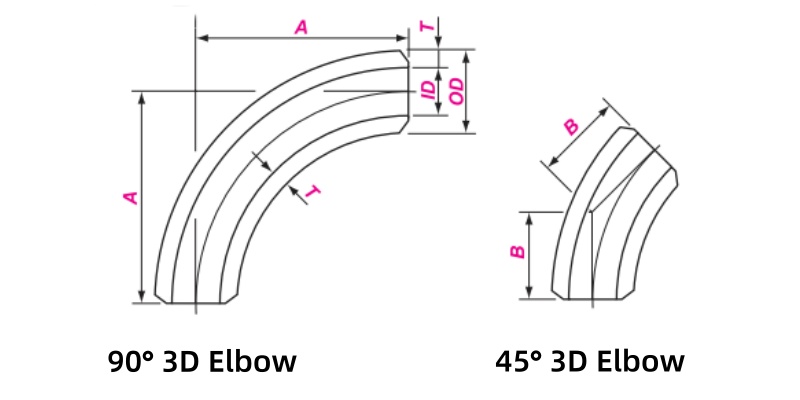
| Nominal size | Outside Diameter at Bevel | Center to Center | ||
| 90°Bend | 45°Bend | |||
| DN | NPS | OD | A | B |
| 3D | 3D | |||
| 15 | 1/2 | 21.3 | – | – |
| 20 | 3/4 | 26.7 | 57 | 24 |
| 25 | 1 | 33.4 | 76 | 31 |
| 32 | 1 1/4 | 42.2 | 95 | 39 |
| 40 | 1 1/2 | 48.3 | 114 | 47 |
| 50 | 2 | 60.3 | 152 | 63 |
| 65 | 2 1/2 | 73.0 | 190 | 79 |
| 80 | 3 | 88.9 | 229 | 95 |
| 90 | 3 1/2 | 101.6 | 267 | 111 |
| 100 | 4 | 114.3 | 305 | 127 |
| 125 | 5 | 141.3 | 381 | 157 |
| 150 | 6 | 168.3 | 457 | 189 |
| 200 | 8 | 219.1 | 610 | 252 |
| 250 | 10 | 273.0 | 762 | 316 |
| 300 | 12 | 323.8 | 914 | 378 |
| 350 | 14 | 355.6 | 1067 | 441 |
| 400 | 16 | 406.4 | 1219 | 505 |
| 450 | 18 | 457.0 | 1372 | 568 |
| 500 | 20 | 508.0 | 1524 | 632 |
| 550 | 22 | 559.0 | 1676 | 694 |
| 600 | 24 | 610.0 | 1829 | 757 |
| 650 | 26 | 660.0 | 1981 | 821 |
| 700 | 28 | 711.0 | 2134 | 883 |
| 750 | 30 | 762.0 | 2286 | 964 |
| 800 | 32 | 813.0 | 2438 | 1010 |
| 850 | 34 | 864.0 | 2591 | 1073 |
| 900 | 36 | 914.0 | 2743 | 1135 |
| 950 | 38 | 965.0 | 2896 | 1200 |
| 1000 | 40 | 1016.0 | 3048 | 1264 |
| 1050 | 42 | 1067.0 | 3200 | 1326 |
| 1100 | 44 | 1118.0 | 3353 | 1389 |
| 1150 | 46 | 1168.0 | 3505 | 1453 |
| 1200 | 48 | 1219.0 | 3658 | 1516 |
Double Flanged Bend Types
As an bend with flanges on both ends, the primary advantage of double flanged bend lies in their ease of installation and removal. Different flange and elbow combinations can be selected based on specific requirements under various operating conditions:
Slip-On Flanged Bend
Features a simple structure and convenient installation, suitable for medium-to-low pressure piping systems. Commonly used in water supply and drainage, HVAC, and general industrial piping.
Weld Neck Flanged Bend
Offers high strength and excellent sealing performance, suitable for high-temperature and high-pressure applications such as petroleum, natural gas, chemical, and power industries. This is the most common type of flanged elbow.
Socket Weld Flanged Bend
Commonly used in small-diameter, high-pressure piping systems to ensure tight connections. Suitable for petrochemical and instrumentation piping.
Threaded Flanged Bend
Requires no welding, facilitating easy installation and removal. Primarily used in low-pressure, small-diameter pipelines such as fire protection and temporary piping systems.
Blind Flanged Bend
Though less common, one end of the elbow may feature a blind flange for sealing or standby pipelines in specific applications.
Forged Flange Specifications
Standards
ASME B16.5 – American Standard Small Diameter Flanges
ASME B16.47 – American Standard Large Diameter Flanges
EN 1092-1 – European Standard Flanges
JIS B2220 – Japanese Standard Flanges
GB/T Flange Standard – Chinese National Standard
Pressure Ratings
Nominal Pressure (PN): PN6, PN10, PN16, PN25, PN40, PN64, PN100, PN160
American Pressure Class (Class): Class 150, 300, 600, 900, 1500, 2500
Sealing Surface Types
RF (Raised Face) – Most common, highly versatile
FF (Flat Face) – Used for cast iron or low-pressure systems
MFM (Male & Female Face) – Precise positioning, excellent sealing performance
RTJ (Ring Type Joint) – Suitable for high-temperature, high-pressure environments
Applications
Oil and Gas Pipelines: High-pressure transmission systems
Chemical Industry: Process pipelines requiring high corrosion resistance
Power and Nuclear Power: High-temperature, high-pressure steam pipelines
Shipbuilding: Corrosion-resistant piping for marine environments
Water Treatment and Fire Protection Systems: Large-diameter low-to-medium pressure pipelines
Selection and Use
When selecting elbow flanges, multiple factors must be comprehensively considered. First, operating pressure and temperature: based on the pressure rating and maximum/minimum operating temperatures of the fluid within the pipeline, choose elbow flange types and materials capable of withstanding the corresponding parameters. Second, medium characteristics: such as the medium’s corrosiveness and whether it is flammable or explosive. For corrosive media, elbow flanges made of corrosion-resistant materials must be selected. Additionally, factors like installation space, construction conditions, and budget constraints must be considered to determine the most suitable connection method and product specifications.
As a core component in pipeline connections, elbow flanges play an irreplaceable role across numerous fields—including industrial production, construction, and municipal engineering—due to their diverse types and significant advantages. Understanding elbow flange knowledge and correctly selecting, installing, and maintaining them is key to ensuring efficient, safe, and stable pipeline system operation. With continuous advancements in industrial technology and growing engineering demands, elbow flanges will continue to innovate and evolve, providing superior solutions for diverse pipeline projects.