
In pipeline engineering, tees serve as critical branching fittings whose weight directly impacts transportation costs, installation load-bearing designs, and material budgets. Whether project estimators are calculating costs, procurement personnel are comparing supplier quotes, or installers are planning construction schemes, accurately determining tee weights is essential. However, many struggle with tee weight calculation methods. This article provides a free tee weight calculation chart to help you efficiently solve weight estimation challenges.
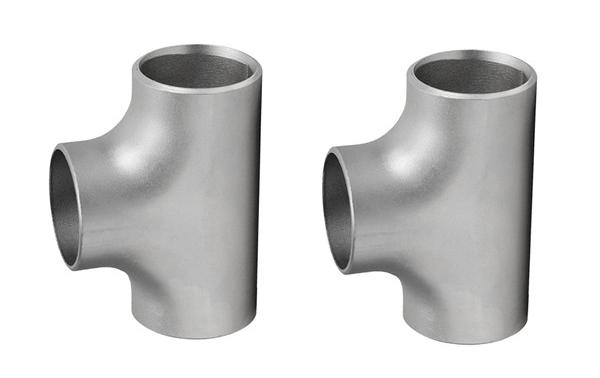
What is a Pipe Tee?
A Pipe Tee is a butt weld pipe fitting that connects three pipes together, typically featuring one main port and two branch ports arranged in a “T” shape.
The two common types are:
Equal Tee: All three ports have the same diameter.
Reducing Tee: The branch port diameter is smaller than the main port diameter.
Why is it necessary to calculate the weight of a Tee?
Accurate calculation of tee weights is fundamental to professional piping engineering, primarily for the following reasons:
Cost Estimation: Steel is typically priced by weight. Precise weight calculations are essential for controlling procurement costs.
Transportation and Logistics: Determining total weight enables selection of appropriate shipping methods and calculation of freight costs.
Structural Design: In high-rise or complex pipe rack designs, the weight of fittings directly impacts the load-bearing capacity of supports and the overall structure.
Inventory Management: Accurate weight records for different tee specifications facilitate efficient inventory tracking and management.
Weight Calculation Formula for ASME B16.9 Tee
The weight of a tee fitting can be approximated using the following formula:
if the branch size is reducing one size, it will be 0.94 times of equal tee weight.
if the branch size is reducing two size, it will be 0.91 times of straight tee weight.
if the branch size is reducing three size, it will be 0.89 times of equal tee weight.
Calculation formula: 0.02466 * (S + 1.5) * [D – (S + 1.5)] * (3C – D/2) / 1000. Where: S = wall thickness (mm), D = outer diameter (mm), and C = center-to-end dimension.
Example:
Calculating the Weight of a 6″ Equal Tee (ASME B16.9)
Suppose we need to calculate the theoretical weight of a 6″ Sch 40 equal tee.
According to the standard table (ASME B16.9):
Outer Diameter D = 168.3 mm
Wall Thickness S = 7.11 mm
Center-to-Face Dimension C = 143 mm
The formula is as follows:
Weight (kg) = 0.02466 × (S + 1.5) × [D − (S + 1.5)] × (3C − D/2) / 1000
Substituting values:
=0.02466×(7.11+1.5)×[168.3−(7.11+1.5)]×(3×143−168.3/2)/1000
=0.02466×8.61×159.69×348.85/1000
≈11.7 kg
Free Download! Automatic Tee Weight Calculation Chart
To help you quickly and accurately calculate the weight of various tee specifications, we’ve compiled a professional theoretical weight chart for seamless tees.
Click the link below to download it for free:
>> Free Download: Pipe Tee Weight Chart (PDF) <<
Free Download: Tee Volume Chart
To help engineers and procurement personnel streamline design and weight calculations, we’ve compiled a dedicated Tee Volume Chart.
This chart covers equal-diameter tees in various sizes (½“ to 60”) and lists volume data for each model, enabling quick theoretical weight estimates or material inventory tracking.
Click the button below to download for free:
>> Free Download: Pipe Tee volume Chart (PDF) <<
| Nominal Size | SCH20 | SCH30 | STD | SCH40 | SCH60 | XS | SCH80 | SCH100 | SCH120 | SCH140 | SCH160 | XXS | |
| DN | NPS | ||||||||||||
| 15 | 1/2 | – | 0.15 | 0.16 | 0.16 | – | 0.20 | 0.20 | – | – | – | 0.25 | 0.35 |
| 20 | 3/4 | – | 0.18 | 0.20 | 0.20 | – | 0.30 | 0.30 | – | – | – | 0.35 | 0.45 |
| 25 | 1 | – | 0.27 | 0.28 | 0.28 | – | 0.45 | 0.45 | – | – | – | 0.54 | 0.77 |
| 32 | 1 1/4 | – | 0.46 | 0.55 | 0.55 | – | 0.70 | 0.70 | – | – | – | 0.91 | 1.26 |
| 40 | 1 1/2 | – | 0.68 | 0.78 | 0.78 | – | 1.25 | 1.25 | – | – | – | 1.39 | 1.83 |
| 50 | 2 | – | 0.96 | 1.17 | 1.17 | – | 1.61 | 1.61 | – | – | – | 2.39 | 2.89 |
| 65 | 2 1/2 | – | 2.06 | 2.21 | 2.21 | – | 2.92 | 2.92 | – | – | – | 3.81 | 5.21 |
| 80 | 3 | – | 2.87 | 3.23 | 3.23 | – | 4.42 | 4.42 | – | – | – | 6.17 | 8.01 |
| 90 | 3 1/2 | – | 3.65 | 4.33 | 4.33 | – | 5.95 | 5.95 | – | – | – | – | – |
| 100 | 4 | – | 4.56 | 5.68 | 5.68 | – | 7.88 | 7.88 | – | 10.0 | – | 11.8 | 14.5 |
| 125 | 5 | – | – | 9.08 | 9.08 | – | 12.9 | 12.9 | – | 16.8 | – | 20.5 | 24.0 |
| 150 | 6 | – | – | 13.6 | 13.6 | – | 20.5 | 20.5 | – | 26.1 | – | 32.5 | 38.1 |
| 200 | 8 | 17.5 | 22.0 | 25.5 | 25.5 | 31.8 | 38.7 | 38.7 | 45.4 | 54.1 | 60.4 | 66.6 | 64.6 |
| 250 | 10 | 28.0 | 37.1 | 44.8 | 44.8 | 59.2 | 59.2 | 69.7 | 83.3 | 96.6 | 113 | 125 | 113 |
| 300 | 12 | 42.6 | 55.7 | 63.1 | 68.1 | 93.0 | 83.2 | 112 | 137 | 160 | 178 | 204 | 160 |
| 350 | 14 | 64.5 | 76.3 | 76.3 | 88.7 | 119 | 101 | 148 | 183 | 211 | 238 | 264 | – |
| 400 | 16 | 78.2 | 95.7 | 95.7 | 126 | 164 | 126 | 191 | 252 | 294 | 342 | 375 | – |
| 450 | 18 | 102 | 141 | 121 | 179 | 237 | 160 | 269 | 357 | 419 | 471 | 529 | – |
| 500 | 20 | 168 | 198 | 150 | 235 | 317 | 190 | 365 | 489 | 566 | 651 | 724 | – |
| 550 | 22 | 185 | 241 | 182 | – | 414 | 241 | 482 | 636 | 743 | 846 | 947 | – |
| 600 | 24 | 222 | 305 | 205 | 340 | 516 | 272 | 589 | 796 | 930 | 1046 | 1174 | – |
| 650 | 26 | 340 | – | 254 | – | – | 337 | – | – | – | – | – | – |
| 700 | 28 | 390 | 478 | 289 | – | – | 383 | – | – | – | – | – | – |
| 750 | 30 | 420 | 549 | 332 | – | – | 441 | – | – | – | – | – | – |
| 800 | 32 | 480 | 627 | 379 | 631 | – | 503 | – | – | – | – | – | – |
| 850 | 34 | 540 | 709 | 429 | 714 | – | 569 | – | – | – | – | – | – |
| 900 | 36 | 610 | 796 | 481 | 872 | – | 639 | – | – | – | – | – | – |
| 950 | 38 | – | – | 537 | – | – | 713 | – | – | – | – | – | – |
| 1000 | 40 | – | – | 598 | – | – | 791 | – | – | – | – | – | – |
| 1050 | 42 | – | – | 636 | – | – | 846 | – | – | – | – | – | – |
| 1100 | 44 | – | – | 712 | – | – | 946 | – | – | – | – | – | – |
| 1150 | 46 | – | – | 779 | – | – | 995 | – | – | – | – | – | – |
| 1200 | 48 | – | – | 850 | – | – | 1080 | – | – | – | – | – | – |
| 1300 | 52 | – | – | 917 | – | – | – | – | – | – | – | – | – |
| 1400 | 56 | – | – | 1065 | – | – | – | – | – | – | – | – | – |
| 1500 | 60 | – | – | 1226 | – | – | – | – | – | – | – | – | – |
| 1600 | 64 | – | – | 1398 | – | – | – | – | – | – | – | – | – |
| 1700 | 68 | – | – | 1580 | – | – | – | – | – | – | – | – | – |
| 1800 | 72 | – | – | 1740 | – | – | – | – | – | – | – | – | – |
| 1900 | 76 | – | – | 1980 | – | – | – | – | – | – | – | – | – |
| 2000 | 80 | – | – | 2290 | – | – | – | – | – | – | – | – | – |
Summary
Mastering the weight calculation method for tees not only enhances design accuracy but also facilitates cost control, transportation, and installation.
Whether you require carbon steel, stainless steel, or alloy steel tees, accurate weight data helps optimize your piping system solutions.
Contact us for detailed dimension tables or project-specific customization support.