
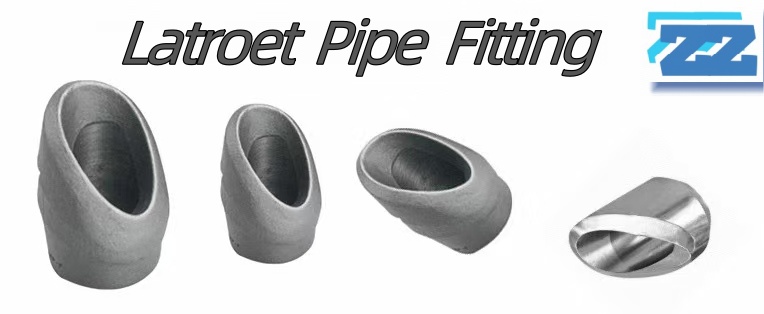
Latrolet is a pipe fitting used for pipe connections. Its shape resembles a saddle, with one side featuring a curved concave surface designed to tightly adhere to the surface of the main pipe, while the other side has a 45-degree angle socket or outlet for connecting branch pipes. Its design allows pipes to turn 45 degrees at the branch fitting, enabling connections for branch pipes to be made by drilling holes in the main pipe. In various pipeline systems, the Latrolet plays a crucial role when it is necessary to connect a branch pipeline from the side of the main pipeline without altering the direction of the main pipeline. For example, in a building’s drainage system, it enables the branch pipeline to extend along the side of the original pipeline.
ZIZI specialize in selling all kinds of pipe fittings, tubes, plates, flanges, bolts and nuts. Our products are widely used in many fields, from precision machinery manufacturing to warm home decoration and even high-end aerospace industry. We have become a trusted choice for many industries due to our superior product quality and wide range of applications. Not only do we offer a wide range of products, but we can also provide customized processing services according to the specific needs of our customers. With advanced production equipment and strict quality management system, we are committed to providing high-quality piping solutions to customers worldwide. Welcome to contact us.
Specification of Latroet Pipe Fitting
| End Type | BW, SW, THD |
| Size Range | 1/2″ – 12″ / DN15 – DN300 |
| Thickness Schedule | STD, XS, SCH 160 |
| SW & THD Size | 1/2″ – 2″ / DN15 – DN50 |
| Pressure Rating | 3000lbs, 6000lbs |
| Welding Size Range | 1/2″- 12″ / DN15 – DN300 |
| Weld Pressure Level | STD, XS, SCH 160 |
| Insertion Thread Size | 1/2″- 2″ / DN15 – DN50. |
| Insertion Thread Pressure | 3000LBS, 6000LBS |
| Standard | MSS SP-97 |
Latrolet Types
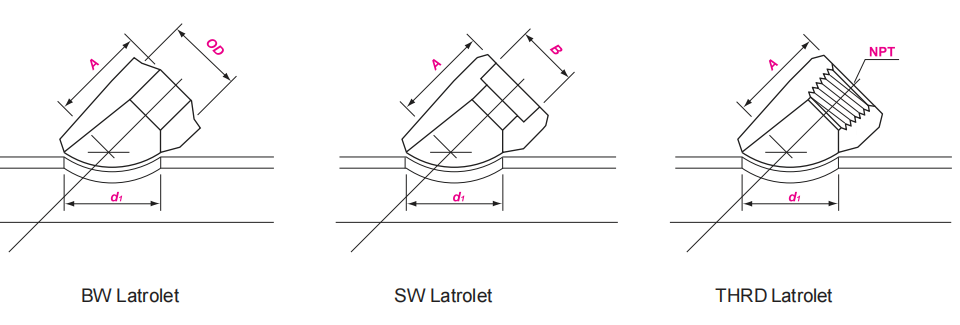
Socket Weld Latrolet :
This type of Latrolet is typically used for smaller pipes. It features a socket into which the branch pipe is inserted and then welded using a fillet weld. This connection is strong and reliable, suitable for high-pressure and high-vibration environments.
Threaded Latrolet :
The outlet of a threaded Latrolet is internally threaded and connected to the branch pipe via a threaded connection. This connection offers the advantage of easy installation and removal, but its sealing performance is weaker than that of a butt weld. It is typically used for medium- and low-pressure, small-sized piping systems.
Butt Weld Latrolet :
The outlet of a butt weld Latrolet is beveled, allowing for direct butt welding to the branch pipe. This connection offers the highest strength and best sealing performance, making it suitable for critical piping systems of various sizes, high pressures, and high temperatures.
Material & Grades of Latroet Forged Fitting
Carbon Steel Threaded Flanges :
Carcon Steel: ASTM A105 / A105N,ASTM A350 LF2 / LF3, A694 F42 / 46 / 52 / 56 / 65 / 70
Alloy Steel Threaded / Screwed Flanges :
ASTM / ASME A/SA 182 & A 387 F1, F5, F9, F11, F12, F22, F91
Stainless Steel Threaded Flanges :
ASTM A 182, A 240 F 304, 304L, 304H, 316, 316L, 316Ti, 310, 310S, 321, 321H, 317, 347, 347H, 904L
Duplex & Super Duplex Steel Threaded Flanges :
ASTM / ASME A/SA 182 F 44, F 45, F51, F 53, F 55, F 60, F 61
Copper Alloy Steel Threaded Flanges :
ASTM SB 61 , SB62 , SB151 , SB152 UNS No. C 70600 (Cu-Ni 90/10), C 71500 (Cu-Ni 70/30), UNS No. C 10100, 10200, 10300, 10800, 12000, 12200
Nickel Alloy Threaded Flanges :
ASTM SB564, SB160, SB472, SB162 Nickel 200 (UNS No. N02200), Nickel 201 (UNS No. N02201), Monel 400 (UNS No. N04400), Monel 500 (UNS No. N05500), Inconel 800 (UNS No. N08800), Inconel 825 (UNS No. N08825), Inconel 600 (UNS No. N06600), Inconel 625 (UNS No. N06625), Inconel 601 (UNS No. N06601), Hastelloy C 276 (UNS No.N10276), Alloy 20 (UNS No. N08020)
Latrolet Dimensions
| DN | NPS | DN | NPS | A | d1 | ||||||
| BW | SW and THRD | BW | SW and THRD | ||||||||
| STD/XS | SCH160 | 3000 | 6000 | STD/XS | SCH160 | 3000 | 6000 | ||||
| 20~900 | 3/4~36 | 15 | 1/2 | 45 | 50 | 45 | 50 | 31 | 30 | 31 | 30 |
| 25~900 | 1~36 | 20 | 3/4 | 50 | 58 | 50 | 58 | 42 | 40 | 42 | 40 |
| 32~900 | 11/4~36 | 25 | 1 | 60 | 70 | 60 | 70 | 54 | 50 | 54 | 50 |
| 40~900 | 11/2~36 | 32 | 11/4 | 68 | 76 | 68 | 76 | 61 | 58 | 61 | 58 |
| 50 | 2~36 | 40 | 11/2 | 75 | 83 | 75 | 83 | 76 | 66 | 76 | 66 |
| 65~900 | 21/2~36 | 50 | 2 | 90 | 98 | 90 | 98 | 90 | 83 | 90 | 83 |
| 80~900 | 3~36 | 65 | 21/2 | 95 | 105 | – | – | 100 | 95 | – | |
| 90~900 | 31/2~36 | 80 | 3 | 120 | 130 | – | – | 132 | 115 | – | – |
| 125~900 | 5~36 | 100 | 4 | 140 | 150 | – | – | 168 | 150 | – | – |
| 200~900 | 8~36 | 150 | 6 | 195 | 310 | – | – | 238 | 225 | – | – |
| 250~900 | 10~36 | 200 | 8 | 220 | – | – | – | 338 | – | – | – |
| 300~900 | 12~36 | 250 | 10 | 270 | – | – | – | 431 | – | – | – |
| 350~900 | 14~36 | 300 | 12 | 290 | – | – | – | 498 | – | – | – |
Latrolet Weight Chart in KG
| Branch Nominal Size | BW Latrolet | SW/THRD Latrolet | ||||
| DN | NPS | STD | XS | Sch160 | 3000 | 6000 |
| 15 | 1/2 | 0.25 | 0.28 | 0.38 | 0.32 | 0.48 |
| 20 | 3/4 | 0.40 | 0.42 | 0.61 | 0.54 | 0.81 |
| 25 | 1 | 0.73 | 0.77 | 1.10 | 0.93 | 1.20 |
| 32 | 11/4 | 1.10 | 1.15 | 1.41 | 1.32 | 2.23 |
| 40 | 11/2 | 1.47 | 1.60 | 2.35 | 1.59 | 3.12 |
| 50 | 2 | 2.50 | 2.60 | 3.35 | 3.06 | 4.95 |
| 65 | 21/2 | 3.20 | 3.40 | 3.70 | – | |
| 80 | 3 | 6.05 | 6.35 | 7.20 | ||
| 100 | 4 | 10.5 | 11.8 | 13.6 | – | – |
| 150 | 6 | 23.6 | 33.5 | 38.0 | – | – |
| 200 | 8 | 32.9 | 50.3 | – | – | |
| 250 | 10 | 58.5 | 76.5 | – | – – | |
| 300 | 12 | 86.0 | 112 | – | – | |
Installation Method
Positioning and Drilling: First, precisely mark the position where the branch pipe needs to be connected to the main pipe. Then, use a specialized drill bit to create a hole in the main pipe that matches the inner diameter of the branch pipe. The quality of the drilling directly affects the sealing and strength of the connection.
Branch pipe joint connection: Align the inner hole at the bottom of the 45-degree branch pipe joint with the hole on the main pipe for welding or other connection. If using butt welding, ensure the weld quality meets standard requirements. I +f using socket welding, pay attention to the socket depth and sealing performance.
Bolt tightening: Some branch pipe fittings are designed as two-piece structures, secured to the main pipe with bolts, and typically have rubber seals inside to ensure sealing. This method facilitates disassembly and maintenance.
Connecting the branch pipe: Insert the branch pipe into the socket of the branch pipe fitting and complete the subsequent connection.
Advantages:
Convenient and efficient construction: No need to cut the main pipeline, greatly reducing construction time and difficulty.
Cost-effective: Compared to purchasing and installing complete tee fittings, material and labor costs are typically lower.
Minimal disturbance to the main fluid flow: Compared to right-angle branches, the smooth 45-degree transition helps reduce fluid resistance, noise, and pressure drop.
High flexibility: Branches can be added flexibly at any position along the pipeline, offering high layout flexibility.
Disadvantages:
Connection strength issues: Compared to one-piece three-way fittings, the strength of connections at welded or fixed branch pipe seats may be a weak point, requiring higher construction standards.
Impact on main pipe structure: Drilling holes in the main pipe alters its original stress distribution. If the holes are improperly drilled or the main pipe wall thickness is insufficient, it may affect the structural strength of the main pipe.
Potential leakage risks: The sealing at connection points relies entirely on construction quality. Whether through welding or gaskets, improper handling may result in leakage points.
Cleaning and maintenance: The inner walls at connection points may not be as smooth as those of integral fittings, posing a risk of debris accumulation over time.
You can get an offer for products in below material forms:
-Pipe and Tube (EN 10216-5, ASTM A213, ASTM A249, A312, A790,)
-Forged Fitting and Flange (ASTM A182 , ASTM A105,ASTM B564 )
-Butt Weld Fittings (ASTM A234, ASTM A403,ASTM A815)
-Round bar , Billet (ASTM A276, ASTM A479)
– Plate, Sheet, Strip(ASTM A240, EN 10028-7, A480)
-Bolting, Nuts(ASTM A193, A194, A320)