
Niobium Alloy Tubes are high-performance steel pipe with niobium as one of the main microalloying elements. It is widely used in industries such as oil, natural gas, chemical industry, electric power and aerospace due to its excellent high-temperature strength, good weldability and corrosion resistance. The trace addition of niobium can effectively refine the grain structure of steel, improve the mechanical properties and comprehensive service life of steel. Compared with traditional carbon steel and low-alloy steel pipes, niobium alloy steel pipes perform better under high temperature and extreme conditions, can withstand greater stress and more complex service environments, and are suitable for high pressure, high temperature and corrosive media. Contact us
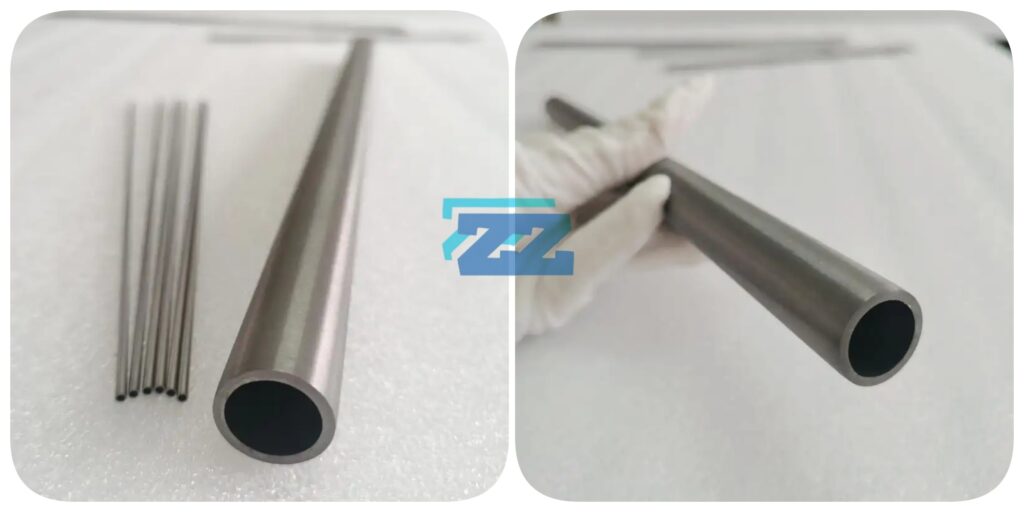
ASTM B394 Niobium Tube Specification
| Dimensions: | Out Diameter: 2-100 mm |
| Wall Thickness: 0.2-5.0 mm | |
| Length: 200-8000 mm, or customized | |
| Standard: | ASTM B394 |
| Shape: | Cylinder, Square, or Rectangle (according to the cross-section) |
| Purity: | 99.5%-99.99% |
| Density: | 8.57 g/cm3 |
| Melting point: | 2468 ℃ |
| Temper: | Annealed or Unannealed |
This specification covers wrought niobium and niobium alloy seamless and welded tubes as follows:
R04200-Type 1—Reactor grade unalloyed niobium,
R04210-Type 2—Commercial grade unalloyed niobium,
R04251-Type 3—Reactor grade niobium alloy containing 1 % zirconium, and
R04261-Type 4—Commercial grade niobium alloy containing 1 % zirconium.
Chemical Composition of Niobium Alloy Tubes
| Element | Type 1 | Type 2 | Type 3 | Type 4 |
| (Reactor Grade Unalloyed Nb) | (Commercial Grade Unalloyed Nb) | (Reactor Grade Nb- 1%Nb) | (Commercial Grade Nb-1%Nb) | |
| RO4200 | RO4210 | RO4251 | RO4261 | |
| Max Weight %(Except Where Otherwise Specified) | ||||
| C | 0.01 | 0.01 | 0.01 | 0.01 |
| N | 0.01 | 0.01 | 0.01 | 0.01 |
| 0 | 0.015 | 0.025 | 0.015 | 0.025 |
| H | 0.0015 | 0.0015 | 0.0015 | 0.0015 |
| Zr | 0.02 | 0.02 | 0.8-1.2 | 0.8-1.2 |
| Ta | 0.1 | 0.3 | 0.1 | 0.5 |
| Fe | 0.005 | 0.01 | 0.005 | 0.01 |
| Si | 0.005 | 0.005 | 0.005 | 0.005 |
| W | 0.03 | 0.05 | 0.03 | 0.05 |
| Ni | 0.005 | 0.005 | 0.005 | 0.005 |
| Mo | 0.01 | 0.02 | 0.01 | 0.05 |
| Hf | 0.02 | 0.02 | 0.02 | 0.02 |
| Ti | 0.02 | 0.03 | 0.02 | 0.03 |
Niobium Tube Mechanical Properties of Annealed Condition
| Grade | Ultimate tensile strength, | Yield strength, 0.2% Residual deformation, | Elongation in 1″ (25.4mm) Gage Length, min., % |
| min., psi (MPa) | min., psi (MPa) | ||
| RO4200-1 | 18000 (125) | 10500 (73) | 25 |
| Welded | |||
| RO4200-1 | 18000 (125) | 8500 (59) | 25 |
| Seamless | |||
| RO4210-2 | 18000 (125) | 10500 (73) | 25 |
| Welded | |||
| RO4210-2 | 18000 (125) | 8500 (59) | 25 |
| Seamless | |||
| RO4251-3 | 28000(195) | 18000(125) | 20 |
| RO4261-4 | 28000(195) | 18000(125) | 20 |
Performance Characteristics of Niobium Alloy Tubes
High strength and high toughness: The microalloying effect of niobium can significantly improve the yield strength and tensile strength of steel while maintaining good toughness, which enables the steel pipe to withstand greater pressure and stress.
Excellent welding performance: Despite the increased strength, niobium alloy steels generally maintain good welding performance, which is essential for pipeline connection and construction.
Good corrosion resistance: The presence of niobium can improve the corrosion resistance of steel, especially in some special media and environments.
Excellent low-temperature performance: Some niobium alloy steels can also maintain good toughness and strength in low-temperature environments, which are suitable for cold areas or low-temperature medium transportation.
Lightweight and reduction: Due to the increased strength, the amount of steel can be reduced while ensuring performance, thereby achieving lightweight pipelines and reducing costs and energy consumption.
Niobium Tube Dimensions and Tolerance
| Outer diameter, Inch (mm) | Outer diameter tolerance | Inner diameter tolerance | Thickness Deviation, %, +/- |
| 0.187-0.625 (4.7-15.9) | 0.004 (0.01) | 0.004 (0.01) | 10 |
| 0.625-1 (15.9-25.4) | 0.005 (0.13) | 0.005 (0.13) | 10 |
| 1-2 (25.4-50.8) | 0.0075 (0.19) | 0.0075 (0.19) | 10 |
| 2-3 (50.8-76.2) | 0.010 (0.25) | 0.010 (0.25) | 10 |
| 3-4 (76.2-101.6) | 0.0125 (0.32) | 0.0125 (0.32) | 10 |
Manufacturing process
Melting: Vacuum arc melting or electron beam melting methods are commonly used to melt niobium and alloying elements into alloy ingots in proportion to ensure the uniformity and purity of the alloy composition.
Thermal processing: The alloy ingot is subjected to thermal processing processes such as forging and extrusion to improve the organizational properties of the alloy, to make it more dense and uniform, and to obtain the initial shape of the pipe. For example, niobium ingot billets are processed into niobium alloy tube billets by hot piercing and extrusion processes.
Cold working: Cold working processes such as drawing and cold rolling are used to further improve the dimensional accuracy and surface quality of the tubes, as well as to enhance the strength and hardness of the alloy.
Heat treatment: Annealing, solution treatment and other heat treatment processes are carried out as required to eliminate processing stress, improve the microstructure and properties of the alloy, and improve the comprehensive performance of the tubes.
Application Areas for Niobium Alloy Tubes
Oil and Gas Transportation Pipelines
Building Structure
Automobile Manufacturing
Mechanical Manufacturing
Chemical Industry,
Shipping
Aerospace
You can get an offer for products in below material forms:
-Pipe and Tube (EN 10216-5, ASTM A213, ASTM A249, A312, A790,)
-Forged Fitting and Flange (ASTM A182 , ASTM A105,ASTM B564 )
–Butt Weld Fittings (ASTM A234, ASTM A403,ASTM A815)
-Round bar , Billet (ASTM A276, ASTM A479)
– Plate, Sheet, Strip(ASTM A240, EN 10028-7, A480)
-Bolting, Nuts(ASTM A193, A194, A320)
Niobium Alloy Tubes Exported Countries
We Export Niobium Alloy Tubes to Saudi Arabia, United Arab Emirates, Qatar, Bahrain, Oman, Kuwait, Turkey, Egypt, Yemen , Syria, Jordan, Cyprus, Singapore, Malaysia, Indonesia, Thailand, Vietnam, South Korea, Japan, Sri Lanka, Maldives, Bangladesh, Cambodia, Argentina, Bolivia, Brazil, Venezuela, Colombia, Ecuador, Guyana, Paraguay, Uruguay, United States Of America, Canada, Mexico, Panama, Jamaica, Bahamas, Denmark, Norway, Germany, France,Italy, United Kingdom, Spain, Belgium, Greece, Czech Republic, Portugal, Hungary, Albania, Austria, Finland, Ireland, Croatia, Malta, Nigeria, Algeria, Angola, South Africa, Libya, Egypt, Sudan, Europe, Africa, Asia, North America, South America, Middle East.etc
Frequently Asked Questions (FAQs)
1. What is a niobium tube?
Niobium tubes are tubular products made of niobium or niobium alloys. They are favored for their excellent resistance to heat, corrosion and chemicals. Niobium tubes are known for their strength, durability and ability to remain stable under extreme conditions. Niobium tubes are widely used in the aerospace, medical, nuclear and chemical processing industries where reliability and performance are critical.
2. Why is niobium so expensive?
Niobium is expensive because it is a rare and highly sought-after metal with unique properties such as high strength, excellent corrosion resistance, and a high melting point. Its extraction and refining process are complex and costly, and global supply is limited to a few mining locations, making it a critical material for industries like aerospace, medical, and electronics. This scarcity, combined with its specialized applications, contributes to its higher price.
3. What are the disadvantages of niobium?
While niobium has many valuable properties, it also has a few drawbacks. Its high cost and limited availability can make it impractical for some applications. Additionally, niobium can be challenging to machine and weld due to its unique material characteristics, requiring specialized equipment and expertise. In certain environments, especially at very high temperatures, it may also require protective coatings or alloys to prevent oxidation and maintain long term performance.