
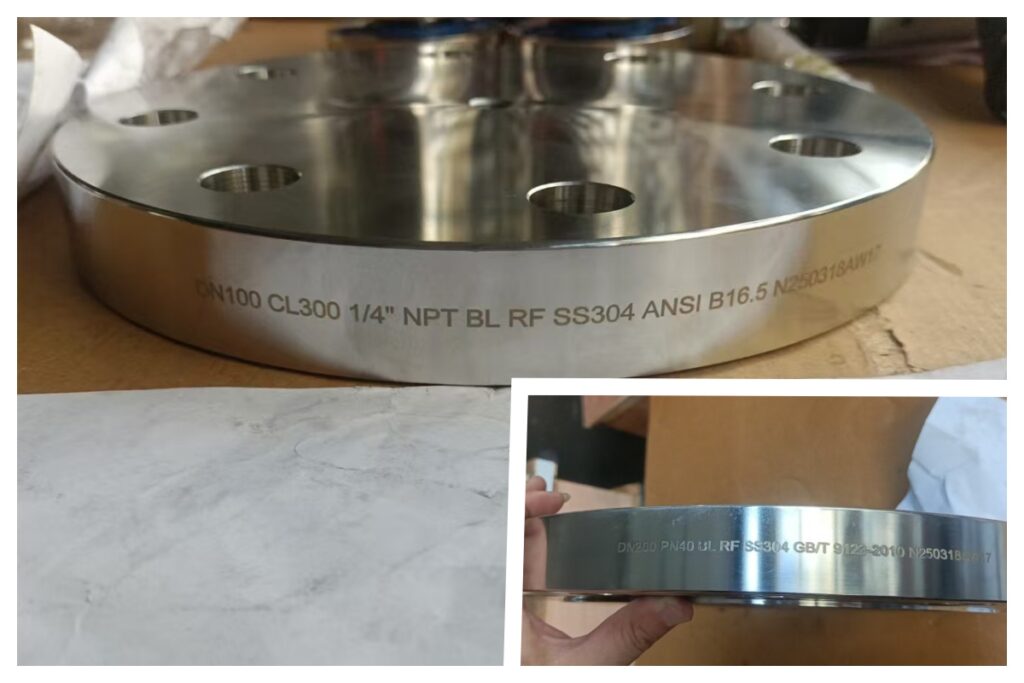
On August 12, 2025, our long-standing domestic client placed an order for SS304 blind flange. Having collaborated with us on multiple occasions, this customer consistently values our product quality and delivery efficiency. For this order, we strictly adhered to ASME/ASTM standards throughout production and inspection, ensuring each flange met project specifications in dimensions, performance, and surface treatment.
To facilitate the client’s project progress, we optimized our production schedule and ultimately delivered the order one week ahead of the contractual deadline, earning high praise from the client once again.
For more flange orders, please click
Product Inspection
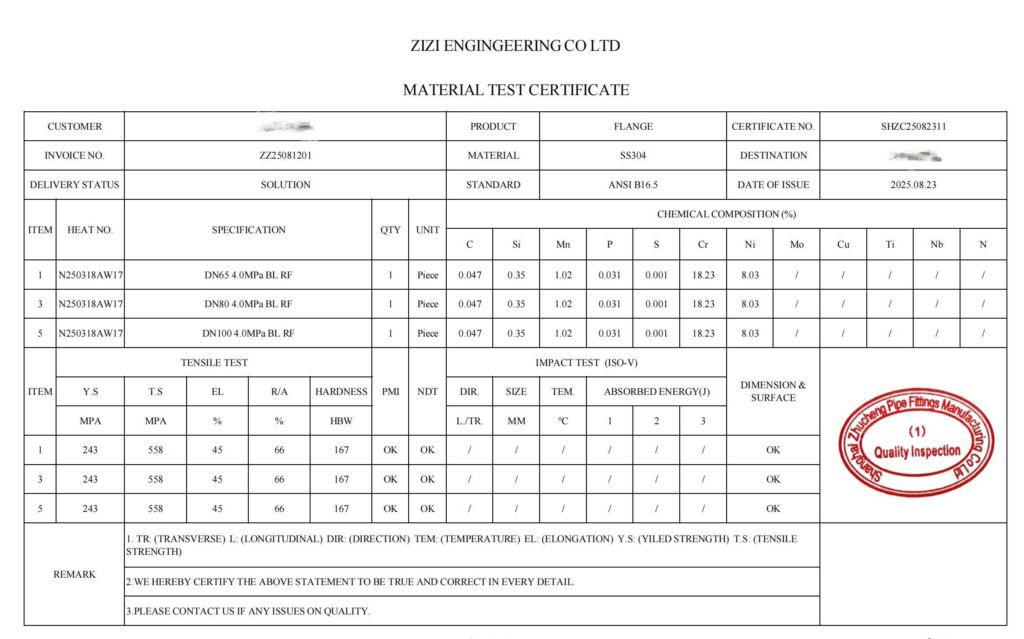
We provide customers with Mill Test Certificates (MTC) for flanges to ensure every product meets international standards and client specifications. The MTC details chemical composition, mechanical properties, heat treatment conditions, dimensional tolerances, and relevant inspection results. By delivering comprehensive certification documentation, customers gain clear insight into flange materials and performance while receiving robust support for project quality management and third-party audits. This exemplifies our unwavering commitment to quality-first, transparent, and traceable service.
Specification of Forged Blind Flanges
| Sealing Face | RF, FF, FTJ |
| Size Range | 1/2” – 48” / DN15 – DN1200 |
| Pressure Rating | Class 150, 300, 600, 900, 1500, 2500lb |
| Standard | ASME / ANSI B16.5, ASME B16.47 Series A/B |
| Carbon Steel | ASTM A105 / A105N |
| Low Temp Carbon Steel | ASTM A350 LF2/LF3 |
| Pipeline Steel | ASTM A694 F42 / 46 / 56 / 60 / 65 |
| Alloy Steel | ASTM A182 F11 / 12 / 5 / 9 / 91 / 92 |
| Stainless Steel | ASTM A182 F304/304L/304H, 316/316L, 310S, 317,347,904L |
| Duplex Stainless Steel | ASTM A182 F51, F53, F44 |
ASTM A182 F304 Flange Chemical Composition
| CHEMICAL | LIMITS | C | Mn | P | S | Si | Ni | Cr | Mo | N |
| ASTM A182 F304 | MIN | 8.0 | 18.0 | |||||||
| MAX | 0.08 | 2.00 | 0.045 | 0.030 | 1.00 | 11.0 | 20.0 | 0.10 | ||
| ASTM A182 F304H | MIN | 0.04 | 8.00 | 18.00 | ||||||
| MAX | 0.10 | 2.00 | 0.045 | 0.030 | 1.00 | 11.00 | 20.00 |
ASTM A182 F304 Flange Mechanical Property
| MATERIAL | T.S (MPA) | Y.S (MPA) | EL % | R/A % |
| ASTM A182 F304 | 515 min | 205 min | 30 min | 50 min |
| ASTM A182 F304L | 485 min | 170 min | 30 min | 50 min |
Class 300 SS Blind Flange Dimension
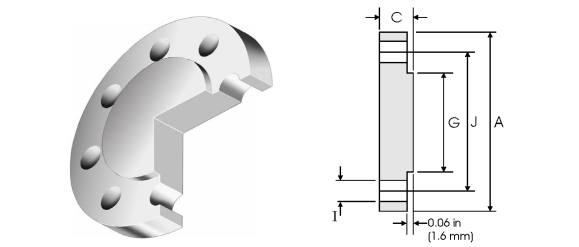
| Nominal Pipe Size | A | C | G | H | I | J | Weight | |
| inch | mm | mm | mm | mm | Holes | mm | mm | kg / piece |
| 1/2 | 21.3 | 95.2 | 14.2 | 35.1 | 4 | 15.7 | 66.55 | 0.64 |
| 3/4 | 26.7 | 117.3 | 15.7 | 42.9 | 4 | 19 | 82.5 | 1.11 |
| 1 | 33.4 | 123.9 | 17.5 | 50.8 | 4 | 19 | 88.9 | 1.39 |
| 11/4 | 42.2 | 133.3 | 19 | 63.5 | 4 | 19 | 98.5 | 1.79 |
| 11/2 | 48.3 | 155.4 | 20.6 | 73.15 | 4 | 22.3 | 114.3 | 2.66 |
| 2 | 60.3 | 165. 1 | 22.3 | 91.9 | 8 | 19. 10 | 127 | 3.18 |
| 21/2 | 73.0 | 190.5 | 25.4 | 104.6 | 8 | 22.3 | 1.493 | 4.85 |
| 3 | 88.9 | 209.5 | 28.4 | 127 | 8 | 22.3 | 168.1 | 6.81 |
| 31/2 | 101.6 | 228.6 | 30.2 | 139.7 | 8 | 22.3 | 184.1 | 8.71 |
| 4 | 114.3 | 254 | 31.7 | 157.2 | 8 | 22.3 | 200.1 | 11.5 |
| 5 | 141.3 | 279.4 | 35 | 185.7 | 8 | 22.3 | 234.9 | 15.6 |
| 6 | 168.3 | 317.5 | 36.5 | 215.9 | 12 | 22.3 | 269.7 | 20.9 |
| 8 | 219. 1 | 381 | 1.620 41.10 | 269.7 | 12 | 25.4 | 330.2 | 34.3 |
| 10 | 273.0 | 444.5 | 47.7 | 323.9 | 16 | 28.4 | 387.3 | 53.3 |
| 12 | 323.8 | 520.7 | 50.8 | 381 | 16 | 31.7 | 450.8 | 78.8 |
| 14 | 355.6 | 584.2 | 53.8 | 412.8 | 20 | 31.7 | 514.3 | 105 |
| 16 | 406.4 | 647.7 | 57.15 | 469.9 | 20 | 35 | 571.5 | 137 |
| 18 | 457.2 | 711.2 | 60.45 | 533.4 | 24 | 35 | 628.6 | 175 |
| 20 | 508.0 | 774.7 | 63.5 | 584.2 | 24 | 35 | 685.8 | 221 |
| 24 | 609.6 | 914.4 | 69.85 | 692.2 | 24 | 41. 10 | 812.8 | 339 |
Different Face Types
Similar to other flanges, blind flanges can have different face types to match the mating flange and gasket:
Raised Face (RF): The most common type, featuring a raised ring around the bore to concentrate sealing pressure.
Flat Face (FF): Has a flat sealing surface, typically used with flat face mating flanges, often in low-pressure applications or with fragile flanges.
Ring Joint (RTJ): Features a groove to accommodate a metal ring gasket, designed for high-pressure and high-temperature service.
Characteristic of 304 Stainless Steel
304 stainless steel is one of the most widely used austenitic stainless steels. Its standard composition contains approximately 18% chromium (Cr) and 8% nickel (Ni), hence it is often referred to as “18-8” stainless steel. This material is highly favored for its outstanding comprehensive properties.
Superior Corrosion Resistance: The chromium in 304 stainless steel forms a dense oxide film on its surface, effectively resisting corrosion from air, water, weak acids, and weak alkalis. This makes it highly suitable for long-term use in general corrosive environments.
Excellent Workability: It possesses good plasticity, making it easy to process through stamping, bending, welding, and other methods. It can be readily formed into products of various shapes and specifications.
Strong Strength and Toughness: While not a high-strength steel, 304 stainless steel possesses sufficient yield strength and tensile strength to meet the demands of most engineering applications.
Hygienic and Non-Toxic: Its smooth surface facilitates easy cleaning and prevents chemical reactions with media, making it widely used in industries with stringent hygiene requirements, such as food processing and pharmaceuticals.
How to choose the material of blind flange?
Carbon steel: economical and practical, suitable for common working conditions (such as water and oil).
Stainless steel (304/316): strong corrosion resistance, suitable for chemical and marine environments.
Alloy steel: resistant to high temperature and high pressure, used in power and petrochemical industries.
Applications:
Oil & Gas pipelines
Chemical and Petrochemical plants
Food & Pharmaceutical industry
Water Treatment systems
Any industrial piping requiring temporary or permanent closure