
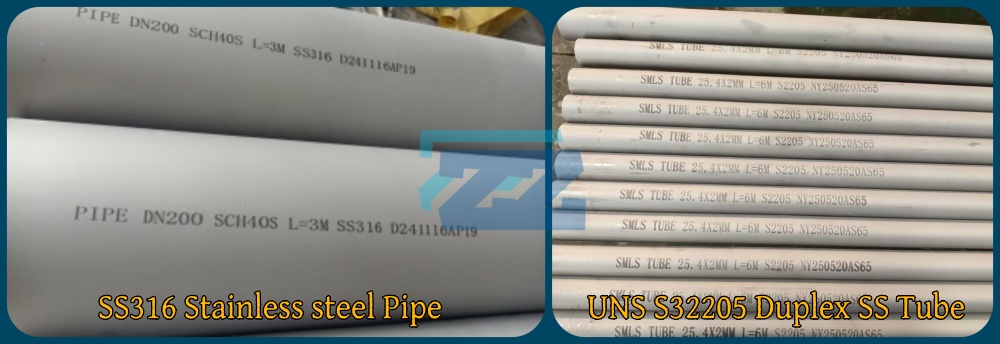
Choosing between SS316 and UNS S32205 affects project cost and schedule. Many procurement and design teams default to 316. It feels safe, familiar, and available everywhere. But under chloride-containing, high-velocity, or offshore conditions, 316’s limitations surface quickly. This guide compares SS316 and UNS S32205 pipe on strength, corrosion resistance, stress corrosion cracking, and temperature limits. Use it to match material to service conditions.
Strength: UNS S32205 Offers Higher Yield Than SS316L
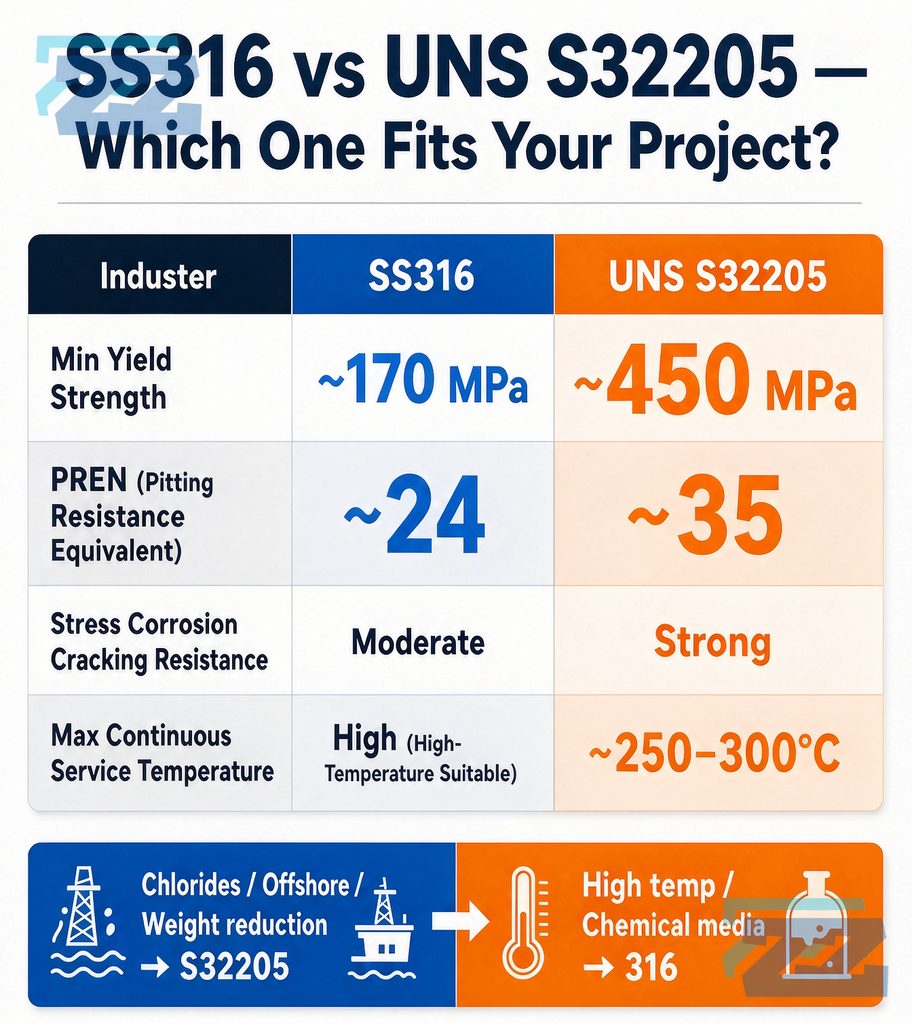
UNS S32205 minimum yield strength: ~450 MPa.
SS316L minimum yield strength: ~170 MPa.
Under the same design conditions, thinner walls are often possible with S32205.
Thinner walls reduce pipe weight and material cost.
Verify minimum wall thickness, corrosion allowance, and stiffness before optimizing.
Corrosion Resistance: PREN Comparison for SS316 and UNS S32205
| Property | SS316L | UNS S32205 |
| Typical PREN | ~24 | ~35 |
| Pitting resistance in chlorides | Moderate | High |
| Crevice corrosion resistance | Moderate | High |
| Seawater systems | Limited | Preferred |
| Produced water handling | Limited | Preferred |
S32205 has a PREN of ~35. SS316L has a PREN of ~24. In chloride environments, seawater systems, and produced water handling, S32205 delivers clearly better pitting and crevice corrosion resistance.
Stress Corrosion Cracking: Chloride Service Favors Duplex
SS316 is susceptible to SCC in chloride-containing, elevated-temperature service. The austenitic-ferritic microstructure of duplex gives UNS S32205 far superior SCC resistance. Select duplex first for chloride-rich, high-temperature service.
Temperature Limits: When SS316 Remains the Safer Choice
UNS S32205 is typically limited to ~250–300°C continuous service. Above this range, sigma phase embrittlement becomes a risk. In high-temperature service, SS316 remains the safer choice. Do not specify duplex by strength alone.
Selection Logic: SS316 or UNS S32205?
| Service Condition | Recommended Material | Reason |
| Chlorides present | UNS S32205 | Higher PREN, better SCC resistance |
| High flow velocity | UNS S32205 | Better erosion-corrosion resistance |
| Offshore / oil & gas | UNS S32205 | Corrosion resistance plus weight reduction |
| Weight reduction target | UNS S32205 | Higher yield allows thinner walls |
| High temperature | SS316 | Avoids sigma phase embrittlement |
| Aggressive chemical media | SS316 | Reliable, well-established service |
| Constrained welding conditions | SS316 | Familiar, proven procedures |
The short selection logic: chlorides, high flow, offshore, oil and gas, weight reduction → look at S32205 first. High temperature, aggressive chemical media, constrained welding conditions → 316 stays reliable.
FAQ: SS316 and UNS S32205 Pipe Selection
Is UNS S32205 always better than SS316?
No. S32205 offers higher strength and better chloride resistance. SS316 remains safer for high-temperature service and constrained welding conditions.
What PREN difference matters in chloride service?
S32205 has a PREN of ~35. SS316L has a PREN of ~24. This gap affects pitting and crevice corrosion performance in seawater and produced water systems.
Can S32205 replace 316 in high-temperature lines?
Not automatically. S32205 is typically limited to ~250–300°C continuous service. Above this range, sigma phase embrittlement becomes a risk.
Which material suits offshore and oil & gas projects?
S32205 is often preferred for chlorides, high flow, and weight reduction. Confirm each line against its specific service conditions.
Do you supply both materials to ASME, ASTM, and EN standards?
Yes. We supply SS316 and UNS S32205 pipe, fittings, and flanges matched to ASME, ASTM, and EN standards.
Message our engineers to match material to your service conditions.