
Pipe couplings are common pipe fittings primarily used to connect two sections of pipe or repair damaged pipes. In piping systems, the selection of pipe couplings directly impacts the sealing integrity, pressure-bearing capacity, and overall service life of the connection. This article will detail the steel pipe coupling types and specifications to help you better select the appropriate product.
Types of Steel Pipe Couplings
Straight Couplings:
As the most fundamental and common coupling type, straight couplings feature identical diameters at both ends. Their smooth inner walls precisely match the pipe’s outer diameter, enabling seamless connection between pipes of the same size for unobstructed medium flow. Their simple structure is typically achieved through one-piece casting or forging. Compatible connection methods include threaded, welded, and compression fittings, allowing flexible selection based on pipeline pressure requirements.
In application scenarios, straight pipe couplings are widely used in low-to-medium pressure conventional piping systems. Material options are diverse: plastic materials (such as PVC, PE) are suitable for civil water supply and drainage; carbon steel is compatible with general industrial piping; stainless steel 304/316 materials can be used in food processing, medical equipment, and other sanitary or mildly corrosive environments.
Reducer Couplings
Reducer couplings connect pipes of differing nominal diameters. Featuring a larger inner diameter at one end and a smaller diameter at the other, they facilitate smooth transitions between pipe sizes. Commonly used to adjust fluid flow rates or adapt to equipment interfaces of varying specifications, they minimize flow resistance at transition points, preventing pressure loss or turbulence caused by abrupt diameter changes.
They are primarily used in systems requiring pipe diameter adjustments, with threaded and welded connections being the main installation methods. For high-pressure applications, forged reducer couplings are often used to ensure structural strength. In low-pressure residential scenarios, injection-molded plastic reducer couplings are commonly employed due to their ease of installation and lower cost.
Full Coupling:
The core advantage of full couplings lies in their uniform wall thickness throughout the entire length, meeting standard pipe wall thickness specifications. Both ends feature complete connection structures capable of withstanding pressures and temperatures equivalent to the pipeline itself. Functioning as an “extension segment” of the pipeline, they can directly replace portions of pipe length while simultaneously connecting two pipeline sections.
Compared to standard couplings, full couplings offer higher pressure ratings, accommodating medium-to-high pressure ranges. They are commonly used in demanding applications such as petrochemical processing, natural gas transmission, and high-pressure steam pipelines.
Half Coupling:
The structural feature of the half coupling (abbreviated as half coupling) is “one end complete, one end simplified”: one end possesses a standard connection structure (such as threaded holes or weld bevels) for tight connection to the pipeline; the other end is a flat or short pipe structure. Its primary function is to create a branch pipe or interface for large pipelines or vessels without cutting or altering the main pipeline structure, making it commonly used for branch connections. Serving as a “connection base” for piping systems, they can be expanded with valves, flanges, and other fittings to enhance pipeline functionality.
Since only one end bears the load, half couplings have a slightly lower pressure rating than full couplings. They are primarily suited for medium-to-low pressure applications, typically connected via welding, with materials matching the equipment or pipeline specifications.
Socket Weld Coupling
The socket weld coupling employs a “socket + insert pipe” connection structure. One end features a socket with a groove, while the other end consists of a short pipe that can be inserted into the pipeline. During installation, the pipe is inserted into the socket until it reaches the bottom, then welded along the socket edge (typically a fillet weld). The welded area forms a sealing ring, effectively preventing medium leakage. Its advantages include superior sealing performance, simplified welding operations with lower technical requirements, and reduced pipeline alignment errors.
Primarily used in medium-to-small diameter, medium-to-high pressure precision pipelines. Due to the gap between the socket bottom and pipe end, it is unsuitable for transporting crystallizing or clogging media.
Threaded Coupling:
A threaded coupling is another type of full coupling. Both ends feature internal threads, connecting to externally threaded pipes through tightening. No welding is required; installation only necessitates tightening with a wrench. In some scenarios, sealing tape or sealant can be used to enhance sealing performance. Disassembly is quick and easy, facilitating pipeline maintenance or modifications. This connection method offers convenient and rapid installation, easy disassembly and replacement, and is suitable for low- to medium-pressure removable pipeline systems.

Carbon Steel Pipe Couplings
Carbon steel pipe couplings are the most common and cost-effective type of pipe coupling. Primarily composed of iron and carbon, they offer excellent strength, hardness, and toughness, meeting the connection requirements for most medium- and low-pressure, non-corrosive piping systems. Due to their outstanding cost-performance ratio, carbon steel pipe couplings are widely used in pipelines transporting ordinary fluids such as water, oil, and gas. However, their primary drawback is poor corrosion resistance, making them unsuitable for humid or highly chemically corrosive environments.
Alloy Steel Pipe couplings
Alloy steel pipe couplings are manufactured by adding alloying elements such as chromium, molybdenum, and vanadium to carbon steel. These additions significantly enhance the couplings’ resistance to high temperatures, high pressures, and wear. Consequently, alloy steel pipe couplings are the preferred choice for demanding industrial environments, such as in petroleum, chemical, and power industries, where they are used in pipeline systems handling high-temperature, high-pressure steam or special media. Their performance surpasses that of carbon steel pipe couplings, though they also carry a relatively higher cost.
Stainless Steel Pipe couplings
Stainless steel pipe couplings are renowned for their exceptional corrosion resistance. Containing at least 10.5% chromium, they form a dense chromium oxide passivation layer that effectively resists various forms of corrosion. Depending on the content of elements like chromium, nickel, and molybdenum, stainless steel pipe couplings are further classified into multiple grades to suit different corrosive environments. Due to their non-toxic, hygienic, and easy-to-clean properties, they are commonly used in highly sanitary applications such as food processing, pharmaceuticals, and drinking water systems. They are also an ideal choice for humid or outdoor environments.
ASME B16.11 Coupling Specification
| Standard | ASME B16.11 |
| Size Range | 1/8”- 4” in Class 9000 |
| Wall Thickness | SCH 10SCH 80SCH 160SCH XXS |
| End Connection | Socket Weld End : Class 3000/ 6000/ 9000Threaded End : Class 2000/ 3000 / 6000 |
| Threads Types | NPTFBSPPBSPBSPTSAENPT |
| Types Of Threaded Coupling | Full CouplingHalf CouplingReducing CouplingStraight couplingThreaded CouplingSocket Weld Coupling |
| Surface Treatment | GalvanizedPolishedAnti-rust OilZinc Plated |
Socket Weld Coupling Dimension
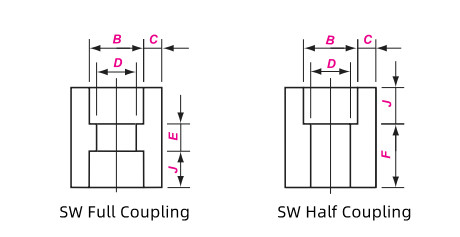
| Nominal Size | Socket Bore Dia. | Bore Dia. of Fittings | Socket Wall Thickness | Depth of Socket | Laying Lengths | Laying Lengths | ||||||||
| DN | NPS | B | D | C | J min | E | F | |||||||
| 3000 | 6000 | 9000 | 3000 | 6000 | 9000 | |||||||||
| ave | min | ave | min | ave | min | |||||||||
| 6 | 1/8 | 10.9 | 6.1 | 3.2 | 3.18 | 3.18 | 3.96 | 3.43 | 9.5 | 6.5 | 16 | |||
| 8 | 1/4 | 14.3 | 8.5 | 5.6 | 3.78 | 3.30 | 4.6 | 4.01 | 9.5 | 6.5 | 16 | |||
| 10 | 3/8 | 17.7 | 11.8 | 8.4 | 4.01 | 3.50 | 5.03 | 4.37 | 9.5 | 6.5 | 17.5 | |||
| 15 | 1/2 | 21.9 | 15 | 11 | 5.6 | 4.67 | 4.09 | 5.97 | 5.18 | 9.53 | 8.18 | 9.5 | 9.5 | 22.5 |
| 20 | 3/4 | 27.3 | 20.2 | 14.8 | 10.3 | 4.9 | 4.27 | 6.96 | 6.04 | 9.78 | 8.56 | 12.5 | 9.5 | 24 |
| 25 | 1 | 34 | 25.9 | 19.9 | 14.4 | 5.69 | 4.98 | 7.92 | 6.93 | 11.38 | 9.96 | 12.5 | 12.5 | 28.5 |
| 32 | 11/4 | 42.8 | 34.3 | 28.7 | 22 | 6.07 | 5.28 | 7.92 | 6.93 | 12.14 | 10.62 | 12.5 | 12.5 | 30 |
| 40 | 11/2 | 48.9 | 40.1 | 33.2 | 27.2 | 6.35 | 5.54 | 8.92 | 7.8 | 12.7 | 11.12 | 12.5 | 12.5 | 32 |
| 50 | 2 | 61.2 | 51.7 | 42.1 | 37.4 | 6.93 | 6.04 | 10.92 | 9.5 | 13.84 | 12.12 | 16 | 19.0 | 30 |
| 65 | 21/2 | 73.9 | 61.2 | 8.76 | 7.62 | 16 | 19.0 | 43 | ||||||
| 80 | 3 | 89.9 | 76.4 | 9.52 | 8.30 | 16 | 19.0 | 44.5 | ||||||
| 100 | 4 | 115.5 | 100.7 | 10.69 | 9.35 | 19 | 19.0 | 48 | ||||||
Threaded Pipe Couplings Dimension
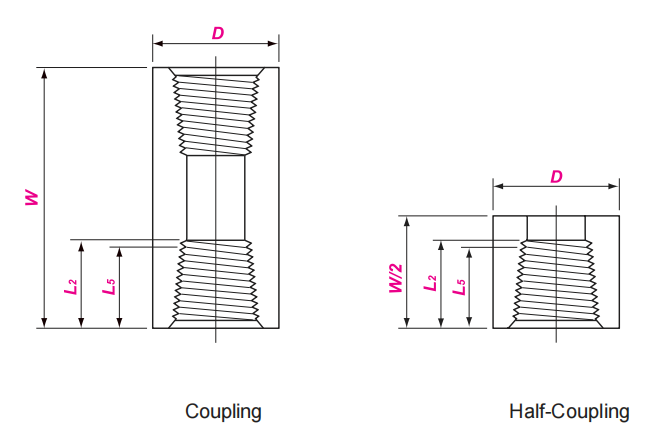
| Nominal Size | End-to-End | Outside Diameter | Length of Thread | |||
| DN | NPS | W | D | L5 min | L2 min | |
| 3000 & 6000 | 3000 | 6000 | ||||
| 6 | 1/8 | 32 | 16 | 22 | 6.4 | 6.7 |
| 8 | 1/4 | 35 | 19 | 25 | 8.1 | 10.2 |
| 10 | 3/8 | 38 | 22 | 32 | 9.1 | 10.4 |
| 15 | 1/2 | 48 | 28 | 38 | 10.9 | 13.6 |
| 20 | 3/4 | 51 | 35 | 44 | 12.7 | 13.9 |
| 25 | 1 | 60 | 44 | 57 | 14.7 | 17.3 |
| 32 | 1 1/4 | 67 | 57 | 64 | 17.0 | 18.0 |
| 40 | 1 1/2 | 79 | 64 | 76 | 17.8 | 18.4 |
| 50 | 2 | 86 | 76 | 92 | 19.0 | 19.2 |
| 65 | 2 1/2 | 92 | 92 | 108 | 23.6 | 28.9 |
| 80 | 3 | 108 | 108 | 127 | 25.9 | 30.5 |
| 100 | 4 | 121 | 140 | 159 | 27.7 | 33.0 |
ASME B16.11 Socket Weld coupling Weight and Volume Chart
ASME B16.11 Socket Weld Fittings Weight and Volume Chart
| Nominal Size | Approximate weight kg | Approximate volume m3 | |||||
| DN | NPS | SCH80/3000 | SCH160/6000 | XXS/9000 | SCH80/3000 | SCH160/6000 | XXS/9000 |
| 6 | 1/8 | 0.05 | 0.06 | – | 0.122*10-3 | 0.129*10-3 | – |
| 8 | 1/4 | 0.06 | 0.07 | – | 0.147*10-3 | 0.162*10-3 | – |
| 10 | 3/8 | 0.08 | 0.10 | – | 0.177*10-3 | 0.187*10-3 | – |
| 15 | 1/2 | 0.13 | 0.16 | 0.29 | 0.238*10-3 | 0.269*10-3 | 0.320*10-3 |
| 20 | 3/4 | 0.20 | 0.28 | 0.47 | 0.316*10-3 | 0.365*10-3 | 0.425*10-3 |
| 25 | 1 | 0.28 | 0.48 | 0.68 | 0.408*10-3 | 0.468*10-3 | 0.560*10-3 |
| 32 | 1-1/4 | 0.48 | 0.65 | 1.08 | 0.497*10-3 | 0.545*10-3 | 0.652*10-3 |
| 40 | 1-1/2 | 0.52 | 0.84 | 1.12 | 0.552*10-3 | 0.661*10-3 | 0.720*10-3 |
| 50 | 2 | 0.95 | 1.65 | 1.95 | 0.904*10-3 | 1.063*10-3 | 1.210*10-3 |
| 65 | 2-1/2 | 1.52 | 2.15 | – | 1.092*10-3 | 1.255*10-3 | – |
| 80 | 3 | 1.75 | 2.40 | – | 1.355*10-3 | 1.470*10-3 | – |
| 100 | 4 | 2.80 | – | – | 1.826*10-3 | – | – |
ASME B16.11 Threaded Coupling Weight and Volume Chart
ASME B16.11 Threaded Fittings Weight and Volume Chart
| Nominal Size | Approximate weight kg | Approximate volume m3 | |||
| DN | NPS | SCH160/3000 | XXS/6000 | SCH160/3000 | XXS/6000 |
| 6 | 1/8 | 0.06 | 0.09 | 0.009*10-3 | 0.015*10-3 |
| 8 | 1/4 | 0.08 | 0.13 | 0.015*10-3 | 0.023*10-3 |
| 10 | 3/8 | 0.11 | 0.24 | 0.021*13-3 | 0.042*10-3 |
| 15 | 1/2 | 0.22 | 0.40 | 0.042*10-3 | 0.075*10-3 |
| 20 | 3/4 | 0.30 | 0.52 | 0.064*10-3 | 0.100*10-3 |
| 25 | 1 | 0.55 | 1.06 | 0.120*10-3 | 0.205*10-3 |
| 32 | 1-1/4 | 0.86 | 1.32 | 0.220*10-3 | 0.265*10-3 |
| 40 | 1-1/2 | 1.26 | 2.20 | 0.327*10-3 | 0.470*10-3 |
| 50 | 2 | 1.65 | 3.37 | 0.508*10-3 | 0.750*10-3 |
| 65 | 2-1/2 | 3.00 | 4.81 | 0.787*10-3 | 1.100*10-3 |
| 80 | 3 | 4.25 | 7.25 | 1.283*10-3 | 1.700*10-3 |
| 100 | 4 | 7.80 | 12.0 | 2.400*10-3 | 3.000*10-3 |