
Fittings, as critical components for connecting and redirecting the flow of pipelines, directly impact the stability and safety of the entire system through their material composition and performance characteristics. 316L stainless steel pipe fittings are a versatile stainless steel material belonging to the austenitic stainless steel category, featuring excellent corrosion resistance, heat resistance, low-temperature strength, and mechanical properties. They do not rust in weak corrosive media such as air, water, and steam. Therefore, 316L stainless steel pipe fittings are widely used in industries such as chemicals, petroleum, food, pharmaceuticals, and marine engineering due to their superior corrosion resistance, low-carbon characteristics, and excellent weldability.
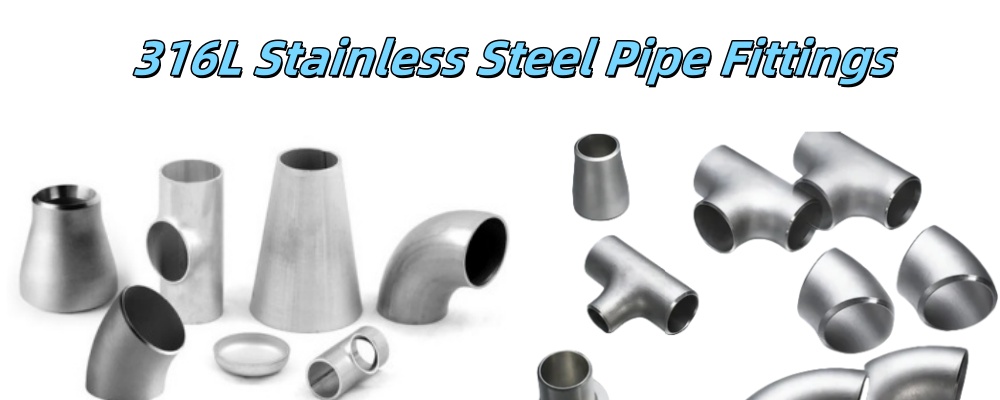
What is 316L stainless steel?
316L is an improved grade of austenitic stainless steel, belonging to the molybdenum-containing stainless steel category. It contains 2.0–2.5% molybdenum in its chemical composition, significantly enhancing resistance to chloride ion corrosion. Compared to 316, 316L has a lower carbon content (≤0.03%), effectively preventing intergranular corrosion after welding or high-temperature processing. It is suitable for welded structural components and high-purity industries.
What does the L stand for in 316L stainless steel?
In 316L stainless steel, the “L” stands for “Low Carbon,” indicating a low carbon content.
This low-carbon version of stainless steel has its carbon content strictly controlled below 0.03%, significantly lower than the 0.08% upper limit of standard 316 stainless steel. This compositional difference offers a critical advantage: during welding, the low carbon content effectively suppresses carbide precipitation, ensuring that the welded area maintains excellent corrosion resistance without requiring additional heat treatment. As a result, 316L is particularly suitable for applications requiring welding and high corrosion resistance, such as chemical processing, marine engineering, and medical devices.
316 Stainless Steel Butt Weld Fittings
Stainless steel butt weld fittings are made of stainless steel and are connected to stainless steel pipes via welding. These fittings include types such as elbows, tees, crosses, and reducers, which are used to change the direction of pipes, create branches, or connect pipes of different diameters.
When connecting pipes, align the welded portion of the fitting with the end of the pipe, then use welding techniques to fuse the metal materials of both components together, forming a secure connection. This welding connection method ensures the sealing and strength of the pipe system, enabling it to withstand higher pressures and temperatures.
| Size Range | 1/2″ – 80″ / DN15 – 2000 |
| Thickness Schedule | SCH 10, 20, 40, STD, XS, 80, 100, 120, 140, 160, XXS |
| Standard | ANSI / ASME B16.9, MSS SP 43 |
| Stainless Steel Grades | ASTM A403 WP304/304L/304H, 316/316L, 310S, 317, 347, 904L |
Stainless Steel 316L Pipe Fittings Chemical Composition
| CHEMICAL | LIMITS | C | Mn | P | S | Si | Ni | Cr |
| ASTM A403 WP316 | MIN | 10.0 | 16.0 | |||||
| MAX | 0.08 | 2.00 | 0.045 | 0.030 | 1.00 | 14.0 | 18.0 | |
| ASTM A403 WP316L | MIN | 10.00 | 16.00 | |||||
| MAX | 0.03 | 2.00 | 0.05 | 0.03 | 1.00 | 14.00 | 18.00 |
Mechanical Properties of 316L Butt Weld Pipe Fittings
| MATERIAL | ASTM A403 WP316 | ASTM A403 WP316L |
| T.S (MPA) | 515 min | 485 min |
| Y.S (MPA) | 205 min | 170 min |
| EL % | 28 min | 28 min |
Stainless Steel 316L Butt weld Fitting Equivalent
| STANDARD | WERKSTOFF NR. | BS | UNS | AFNOR | GOST | JIS | EN |
| 316L | 1.4404 / 1.4435 | 316S11 / 316S13 | S31603 | Z3CND17‐11‐02 / Z3CND18‐14‐03 | 03Ch17N14M3 / 03Ch17N14M2 | SUS 316L | X2CrNiMo17-12-2 / X2CrNiMo18-14-3 |
SS316L Butt Weld Elbow Dimensions
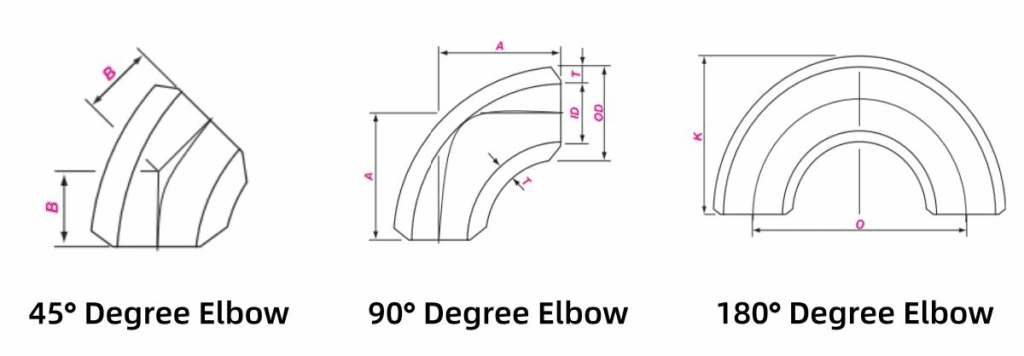
| Nominal Size | Outside Diameter at Bevel | Center to End | Center to Center | Back to Face | ||||
| 90° Elbows | 45° Elbows | 180 Returns | ||||||
| DN | NPS | OD | A | B | O | K | ||
| 3D | 3D | LR | SR | LR | SR | |||
| 15 | 1/2 | 21.3 | 76 | 48 | ||||
| 20 | 3/4 | 26.7 | 57 | 24 | 76 | 51 | ||
| 25 | 1 | 33.4 | 76 | 31 | 76 | 51 | 56 | 41 |
| 32 | 1 1/4 | 42.2 | 95 | 39 | 95 | 64 | 70 | 52 |
| 40 | 1 1/2 | 48.3 | 114 | 47 | 114 | 76 | 83 | 62 |
| 50 | 2 | 60.3 | 152 | 63 | 152 | 102 | 106 | 81 |
| 65 | 2 1/2 | 73.0 | 190 | 79 | 190 | 127 | 132 | 100 |
| 80 | 3 | 88.9 | 229 | 95 | 229 | 152 | 159 | 121 |
| 90 | 3 1/2 | 101.6 | 267 | 111 | 267 | 178 | 184 | 140 |
| 100 | 4 | 114.3 | 305 | 127 | 305 | 203 | 210 | 159 |
| 125 | 5 | 141.3 | 381 | 157 | 381 | 254 | 262 | 197 |
| 150 | 6 | 168.3 | 457 | 189 | 457 | 305 | 313 | 237 |
| 200 | 8 | 219.1 | 610 | 252 | 610 | 406 | 414 | 313 |
| 250 | 10 | 273.0 | 762 | 316 | 508 | 518 | 391 | |
| 300 | 12 | 323.8 | 914 | 378 | 914 | 609 | 619 | 467 |
| 350 | 14 | 355.6 | 1067 | 441 | 1067 | 711 | 711 | 533 |
| 400 | 16 | 406.4 | 1219 | 505 | 1219 | 813 | 813 | 610 |
| 450 | 18 | 457.0 | 1372 | 568 | 1372 | 914 | 914 | 686 |
| 500 | 20 | 508.0 | 1524 | 632 | 1524 | 1016 | 1016 | 762 |
| 550 | 22 | 559.0 | 1676 | 694 | 1676 | 1118 | 1118 | 838 |
| 600 | 24 | 610.0 | 1829 | 757 | 1829 | 1219 | 1219 | 914 |
| 650 | 26 | 660.0 | 1981 | 821 | ||||
| 700 | 28 | 711.0 | 2134 | 883 | ||||
| 750 | 30 | 762.0 | 2286 | 964 | ||||
| 800 | 32 | 813.0 | 2438 | 1010 | ||||
| 850 | 34 | 864.0 | 2591 | 1073 | ||||
| 900 | 36 | 914.0 | 2743 | 1135 | ||||
| 950 | 38 | 965.0 | 2896 | 1200 | ||||
| 1000 | 40 | 1016.0 | 3048 | 1264 | ||||
| 1050 | 42 | 1067.0 | 3200 | 1326 | ||||
| 1100 | 44 | 1118.0 | 3353 | 1389 | ||||
| 1150 | 46 | 1168.0 | 3505 | 1453 | ||||
| 1200 | 48 | 1219.0 | 3658 | 1516 | ||||
316L Stainless Steel Tee & Cross Dimensions
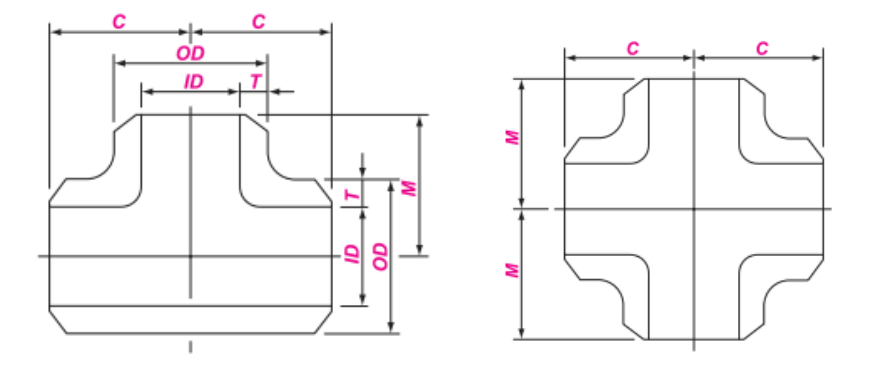
| Nominal Size | Outside Diameter at Bevel | Center to End | ||
| DN | NPS | OD1×OD2 | C | M |
| 15 | 1/2 | 21.3 | 25 | 25 |
| 20 | 3/4 | 26.7 | 29 | 29 |
| 25 | 1 | 33.4 | 38 | 38 |
| 32 | 11/4 | 42.2 | 48 | 48 |
| 40 | 11/2 | 48.3 | 57 | 57 |
| 50 | 2 | 60.3 | 64 | 64 |
| 65 | 21/2 | 73.0 | 76 | 76 |
| 80 | 3 | 88.9 | 86 | 86 |
| 90 | 31/2 | 101.6 | 95 | 95 |
| 100 | 4 | 114.3 | 105 | 105 |
| 125 | 5 | 141.3 | 124 | 124 |
| 150 | 6 | 168.3 | 143 | 143 |
| 200 | 8 | 219.1 | 178 | 178 |
| 250 | 10 | 273.0 | 216 | 216 |
| 300 | 12 | 323.8 | 254 | 254 |
| 350 | 14 | 355.6 | 279 | 279 |
| 400 | 16 | 406.4 | 305 | 305 |
| 450 | 18 | 547.0 | 343 | 343 |
| 500 | 20 | 508.0 | 381 | 381 |
| 550 | 22 | 559.0 | 419 | 419 |
| 600 | 24 | 610.0 | 432 | 432 |
| 650 | 26 | 660.0 | 495 | 495 |
| 700 | 28 | 711.0 | 521 | 521 |
| 750 | 30 | 762.0 | 559 | 559 |
| 800 | 32 | 813.0 | 597 | 597 |
| 850 | 34 | 864.0 | 635 | 635 |
| 900 | 36 | 914.0 | 673 | 673 |
| 950 | 38 | 965.0 | 711 | 711 |
| 1000 | 40 | 1016.0 | 749 | 749 |
| 1050 | 42 | 1067.0 | 762 | 711 |
| 1100 | 44 | 1118.0 | 813 | 762 |
| 1150 | 46 | 1168.0 | 851 | 800 |
| 1200 | 48 | 1219.0 | 889 | 838 |
| 1300 | 52 | 1321.0 | 965 | 914 |
| 1400 | 56 | 1422.0 | 1041 | 965 |
| 1500 | 60 | 1524.0 | 1118 | 1016 |
| 1600 | 64 | 1626.0 | 1194 | 1092 |
| 1700 | 68 | 1727.0 | 1270 | 1168 |
| 1800 | 72 | 1829.0 | 1320 | 1245 |
| 1900 | 76 | 1930.0 | 1422 | 1320 |
| 2000 | 80 | 2032.0 | 1499 | 1397 |
ASTM A403 WP316 Fittings Available Types
Butt Weld 90 Degree Elbow
Butt Weld 45 Degree Elbow
Butt Weld Bend
Butt Weld Tee
Butt Weld Cross
Butt Weld Concentric Reducer
Butt Weld Eccentric Reducer
Butt Weld Cap
Quality Inspection of 316L Stainless Steel Pipe Fittings
Chemical Composition Analysis: Using methods such as spectroscopic analysis and chemical titration, the chemical composition of 316L stainless steel pipe fittings is precisely tested to ensure compliance with relevant standards.
Physical Performance Testing: Physical performance tests such as tensile tests, hardness tests, and impact tests are conducted on 316L stainless steel pipe fittings to assess whether their mechanical properties meet usage requirements.
Non-destructive testing: Non-destructive testing techniques, such as ultrasonic testing, radiographic testing, magnetic particle testing, and penetrant testing, are used to detect internal and surface defects in 316L stainless steel pipe fittings.
Is there a difference between 316 and 316L stainless steel?
The primary difference between 316 stainless steel and 316L stainless steel lies in their carbon content. The “L” stands for “Low Carbon,” and this letter signifies a key performance difference between the two steels.
In simple terms, the carbon content of 316L is strictly controlled to below 0.03%, while the carbon content of standard 316 stainless steel can reach up to 0.08%.
With its extremely low carbon content, 316L maintains excellent corrosion resistance even after welding, without requiring additional heat treatment. Therefore, for applications that involve extensive welding and demand high corrosion resistance, such as in chemical equipment, marine engineering, or medical device manufacturing, 316L is undoubtedly the more reliable and prudent choice.
Application Industries
Oil & Gas Pipeline Systems
Chemical and petrochemical plants
Food and Pharmaceutical Process Piping
Marine & Offshore
Heat Exchangers & Pressure Vessels
Water Treatment & Pure Water Systems
Semiconductor and High Cleanliness Systems
Why Choose ZIZI
Choosing a reputable manufacturer with extensive production experience is key to ensuring you purchase high-quality 316L stainless steel pipe fittings. ZIZI boasts advanced production equipment, a rigorous quality management system, and a professional technical team, ensuring the consistent quality and reliability of our products. Additionally, ZIZI offers comprehensive after-sales service, enabling prompt resolution of any issues that may arise during use. Contact Us
You can get an offer for products in below material forms:
-Pipe and Tube (EN 10216-5, ASTM A213, ASTM A249, A312, A790,)
-Forged Fitting and Flange (ASTM A182 , ASTM A105,ASTM B564 )
-Butt Weld Fittings (ASTM A234, ASTM A403,ASTM A815)
-Round bar , Billet (ASTM A276, ASTM A479)
– Plate, Sheet, Strip(ASTM A240, EN 10028-7, A480)
-Bolting, Nuts(ASTM A193, A194, A320)