
Lap joint stub end is a kind of butt weld pipe fittings, generally is made from the end of the steel pipe by rolling, stamping and other processes into the end of the pipe assembly with a lap edge, in the pipeline system to realize the flange connection. Control and plate flanging using bending, extrusion, molding, machining and other cold or hot processing and methods of molding, the choice of molding methods to confirm that the product is not damaged. Some of the large-diameter flanging also requires welding process. Lap joint stub end of the production standards mainly in line with the United States production standards ANSI/ASME B16.9 and MSS SP-43 production standards. Contact us
Lap Joint Stub End Specification
| Type | Long Pattern (LP) and Short Pattern (SP) |
| Size Range | 1/2” – 24” / DN15 – 600 |
| Thickness Schedule | SCH 10 – SCH 160, XXS |
| China Standard | GB/T12459, GB/T13401, HG/T21635/21631, SH3408/3409 |
| America Standard | ANSI / ASME B16.9 / MSS SP 43 |
| Japan Standard | JIS B2311/2312/2313 |
| Germany Standard | DIN2605/2615/2616/2617 |
| Europe Standard | EN10253 |
Performance Characteristics:
Convenient Connection: by cooperating with loose-set flange and adopting bolt connection, it is convenient to install and dismantle, which facilitates the maintenance and replacement of pipeline.
Good sealing: Utilizing the flange sealing structure, it can effectively prevent medium leakage and guarantee the safe operation of the pipeline system.
Strong adaptability: it can be applied to pipeline systems with a variety of media and temperature conditions, and can be used under different working conditions in petroleum, chemical, natural gas and other industries.
Types of Lap Joint Stub End

Type A
Type A stub ends are used for standard lap joint flanges. The lap thickness at the stub end is greater than or equal to the nominal thickness of the pipe wall. In addition, Type A has an outside corner radius to accept lap flanges. The inside corners are square. The lap usually has a machined serrated face.
Type B
Type B short ends are used as lap joint flanges for standard slip on flanges. The lap thickness of these short ends is greater than or equal to the nominal thickness of the pipe wall. In addition, the outside corner radius of Type B is small enough to accommodate a slip-on flange that can be used as a backup flange. The inside corners are square. The lap usually has a machined serrated face.
Type C
Type C stumps are available for standard lap joint flanges and slip-on flanges. It is flared with a rounded edge at the lap ID. If necessary, the radius can be squared. The lap thickness is 75% of the pipe wall. type C pipe is short enough to accommodate any spare flanges. type C laps are smooth and do not require machining.
You can view the exact specifications on our [Stub End Type A] product detail page.
Long Pattern Stub End and Short Pattern Stub End
1. Long Pattern Stub End
The Long Pattern Stub End usually has a long straight section, which makes it excellent in applications where a long connection length is required or where there are special requirements for pipe support. It provides better stability and reduces the effects of pipe vibration or displacement.
Advantage:
Smoother Fluid Paths: Longer straight sections of pipe help reduce turbulence in the transition to the flanged connection, providing a smoother fluid flow. This is especially important for systems with stringent requirements for fluid resistance or pressure loss.
Better welding conditions: Longer lengths provide more maneuvering space for welding, especially when welding in the field.
Short Pattern Stub Ends are relatively compact, with short straight sections that are advantageous in space-constrained installations, allowing greater flexibility in adapting to pipe connections in confined spaces.
Advantage:
Space-saving: Due to their compact construction, short flanged short sections are very popular in piping layouts where space is limited.
Lighter weight: Shorter lengths mean less material is used, reducing weight and costs.
Wider applicability: In applications with less demanding hydrodynamic requirements, the Short Flap is a more economical and practical choice.
Material & Grades of Buttweld Lap Joint Stub End :
Stainless Steel Buttweld Lap Joint Stub End :
A403 WP304/304L/304H – WP316/316L – WP317 – WP310S – WP321 – WP347 – WP904L
Duplex & Super Duplex Steel Buttweld Lap Joint Stub End :
A815 WPS32205/32750/31803/32760
Carbon Steel Buttweld Lap Joint Stub End :
ASTM A234 WPB / WPC, ASTM 420 WPL 3 / 6 / 9, A860 WPHY 42 / 46 / 52 / 56 / 65 / 70
Alloy Steel Buttweld Lap Joint Stub End :
A234 WP5 / WP9 / WP11 / WP12 / WP22 /WP 91 / WP92
Nickel Alloy Buttweld Lap Joint Stub End :
ASTM B336, ASME SB336, Nickel 200 (UNS No. No2200), Nickel 201 (UNS No. N02201), Monel 400 (UNS No.N04400), Monel 500 (UNS No. N05500), Inconel 800 (UNS No. N08800), Inconel 825 (UNS No. N08825), Inconel600 (UNS No. N06600), Inconel 625 (UNS No. N06625), Inconel 601 (UNS No. N06601), Hastelloy C 276 (UNS No.N10276), Alloy 20 (UNS No. N08020), Titanium (Grade I & II), Cupro-Nickel 70/30, CuNi10Fe1Mn, CuNi30Mn1Fe.
Dimensions of ASME B16.9 Lap Joint Stub End
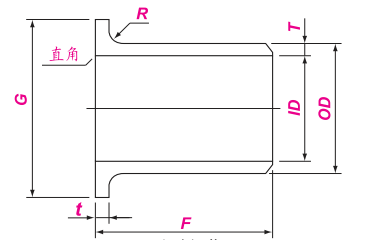
| Nominal Size | OD of Cylinder | Length | Radius of Fillet | Diameter of Lap | ||||
| DN | NPS | OD | F | R | ||||
| Max. | Min. | Long Type | Short Type | A | B max | G | ||
| 15 | 1/2 | 22.8 | 20.5 | 76 | 51 | 3 | 0.8 | 35 |
| 20 | 3/4 | 28.1 | 25.9 | 76 | 51 | 3 | 0.8 | 43 |
| 25 | 1 | 35.0 | 32.6 | 102 | 51 | 3 | 0.8 | 51 |
| 32 | 1 1/4 | 43.6 | 41.4 | 102 | 51 | 5 | 0.8 | 64 |
| 40 | 1 1/2 | 49.9 | 47.5 | 102 | 51 | 6 | 0.8 | 73 |
| 50 | 2 | 62.4 | 59.5 | 152 | 64 | 8 | 0.8 | 92 |
| 65 | 2 1/2 | 75.3 | 72.2 | 152 | 64 | 8 | 0.8 | 105 |
| 80 | 3 | 91.3 | 88.1 | 152 | 64 | 10 | 0.8 | 127 |
| 90 | 3 1/2 | 104.0 | 100.8 | 152 | 76 | 10 | 0.8 | 140 |
| 100 | 4 | 116.7 | 113.5 | 152 | 76 | 11 | 0.8 | 157 |
| 125 | 5 | 144.3 | 140.5 | 203 | 76 | 11 | 1.6 | 186 |
| 150 | 6 | 171.3 | 167.5 | 203 | 89 | 13 | 1.6 | 216 |
| 200 | 8 | 222.1 | 218.3 | 203 | 102 | 13 | 1.6 | 270 |
| 250 | 10 | 277.2 | 272.3 | 254 | 127 | 13 | 1.6 | 324 |
| 300 | 12 | 328.0 | 323.1 | 254 | 152 | 13 | 1.6 | 381 |
| 350 | 14 | 359.9 | 354.8 | 305 | 152 | 13 | 1.6 | 413 |
| 400 | 16 | 411.0 | 405.6 | 305 | 152 | 13 | 1.6 | 470 |
| 450 | 18 | 462.0 | 456.0 | 305 | 152 | 13 | 1.6 | 533 |
| 500 | 20 | 514.0 | 507.0 | 305 | 152 | 13 | 1.6 | 584 |
| 550 | 22 | 565.0 | 558.0 | 305 | 152 | 13 | 1.6 | 641 |
| 600 | 24 | 616.0 | 609.0 | 305 | 152 | 13 | 1.6 | 692 |
Advantages of Stub Ends
Cost-effective: Where expensive, corrosion-resistant materials (e.g. stainless steel, nickel alloys) are used in the piping system, they can be used only in the part of the stub end that comes into contact with the fluid, whereas the more economical carbon steel can be used for the loose-fitting flange. This significantly reduces the cost of the overall flanged connection.
Ease of installation and maintenance: The free rotation of the flanged stub makes alignment of the bolt holes extremely simple, greatly simplifying the installation process. It is also easier to disassemble and reassemble when equipment needs to be inspected or replaced, eliminating the need for cutting or rewelding.
Adaptable: It is easy to connect pipes made of different materials. For example, corrosion-resistant flanged short sections are used for corrosive fluids, while ordinary carbon steel pipes are used for other sections.
Stress Reduction: The flexibility of the loose flange helps to relieve stresses in the piping system due to thermal expansion or vibration, thereby extending the life of the piping system.
Applications
Equipment connections that require frequent disassembly: heat exchangers, vessels, pumps, valves
Corrosive media piping systems: in pipelines handling corrosive fluids such as acids, alkalis, brines, etc.
Oil and gas industry: oil and gas transportation, refinery equipment.
Chemical industry: various chemical production lines.
Power industry: especially in nuclear power plants and other occasions with strict material requirements.
Food and pharmaceutical industry: piping systems with high requirements for hygiene and cleanliness.