
Nickel alloy flanges are mechanical components made of nickel alloy materials used to connect pipes, equipment, and other components. They are tightly connected using fasteners such as bolts to form a secure mechanical connection. They are widely used in industries such as chemical, petrochemical, pharmaceutical, food processing, marine engineering, power, and aerospace, serving functions such as connection, sealing, and support in applications such as connecting different sections of pipe systems and connecting equipment to pipes.
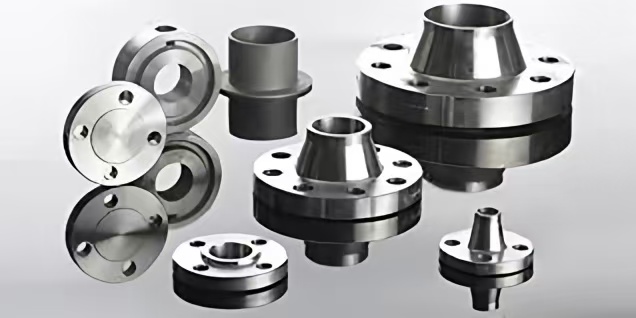
Specification of Nickel Alloy Flanges
| Specifications : | ASTM B564 / ASME SB564 |
| Dimensions : | ANSI/ASME B16.5, B 16.47 Series A & B, B16.48, BS4504, BS 10, EN-1092, DIN, etc. |
| Standard : | ANSI Flanges, ASME Flanges, BS Flanges, DIN Flanges, EN Flanges, etc. |
| Size : | 1/2″NB TO 60″NB |
| Class / Pressure : | 150#, 300#, 600#, 900#, 1500#, 2500#, PN6, PN10, PN16, PN25, PN40, PN64 etc. |
| Flange Face Type : | Flate Face (FF), Raised Face (RF), Ring Type Joint (RTJ) |
| Grades : | Nickel 200, Nickel 201 |
Features and Advantages
Excellent corrosion resistance: Exhibits exceptional resistance to a wide range of chemical media, such as hydrofluoric acid, alkaline solutions, and oxidizing acids, demonstrating outstanding corrosion resistance. It effectively withstands corrosive environments, extends equipment lifespan, and reduces maintenance costs.
Excellent High-Temperature Performance: Nickel alloys inherently possess extremely high heat resistance, maintaining superior mechanical properties and oxidation resistance under high-temperature conditions. They can maintain good strength and stability in working environments above 600°C, ensuring the sealing and safety of pipeline systems.
Excellent weldability: It has good weldability, enabling stable welding with pipes made of different materials, and is less prone to cracks and welding defects. During welding, it is less likely to produce porosity, inclusions, or other issues, ensuring the quality and sealing effectiveness of the weld.
High strength and excellent mechanical properties: It possesses high strength and excellent mechanical properties, including creep resistance, pressure resistance, and impact resistance. In high-temperature, high-pressure pipeline systems or those subjected to physical impacts or rapid temperature changes, it ensures the system’s continuous and stable operation.
Excellent sealing performance: Precision mechanical processing and surface treatment ensure exceptional sealing performance of the flange. By filling uneven areas on the sealing surface with gaskets, effective sealing is achieved, preventing fluid leakage and ensuring safe and stable operation during production processes.
Equivalent Grades of Nickel Alloy 200 / 201 Flanges
| STANDARD | WERKSTOFF NR. | UNS | JIS | BS | GOST | AFNOR | EN |
| Nickel 200 | 2.4066 | N02200 | NW 2200 | NA 11 | НП-2 | N-100M | Ni 99.2 |
| Nickel 201 | 2.4068 | N02201 | NW 2201 | NA 12 | НП-2 | – | LC-Ni 99 |
Nickel Alloy Flanges Chemical Composition
| Grade | C | Mn | Si | S | Cu | Fe | Ni |
| Nickel 200 | 0.15 max | 0.35 max | 0.35 max | 0.01 max | 0.25 max | 0.40 max | 99.0 min |
| Nickel 201 | 0.02 max | 0.35 max | 0.35 max | 0.01 max | 0.25 max | 0.40 max | 99.0 min |
Nickel Alloy Flanges Mechanical Properties
| Element | Density | Melting Point | Tensile Strength | Yield Strength (0.2%Offset) | Elongation |
| Nickel 200 | 8.9 g/cm3 | 1446 °C (2635 °F) | Psi – 67000 , MPa – 462 | Psi – 21500 , MPa – 148 | 45% |
| Nickel 201 | 8.9 g/cm3 | 1446 °C (2635 °F) | Psi – 67000 , MPa – 462 | Psi – 21500 , MPa – 148 | 45% |
Types of Nickel Alloy Flanges
1. Weld Neck Flange (WN)
The flange neck is welded to the pipe, ensuring even stress distribution and strong stress resistance. It is used in high-pressure, high-temperature pipeline systems, such as in the chemical, petrochemical, and power industries.
2. Slip-On Flange (SO)
The pipe is directly inserted into the flange, resulting in fewer welds and easier installation. It is used in low-pressure systems or applications requiring frequent disassembly and reassembly.
3. Blind Flange (BL)
No central hole, used to seal pipe or equipment interfaces. Applied in pipe blocking, pressure testing, or temporary pipe sealing.
4. Socket Weld Flange (SW)
The pipe is inserted into the flange for welding, suitable for small-diameter high-pressure pipes. Applied in industrial pipelines with small diameters and high sealing requirements.
5. Threaded Flange (TH)
Connected to the pipeline via threads, no welding required. Used in special environments or for temporary installations that do not require welding.
6. Lap Joint Flange (LAPJ)
Used with stub ends, allowing free rotation for easy disassembly and assembly. Used in pipeline systems requiring frequent maintenance or inspections.
Class 150 & 300 Nickel Alloy Flange Weight Chart
| Pressure | Size | SO | TH | SW | LAPJ | BL | WN |
| 150LB | 1/2 | 0.45 | 0.45 | 0.91 | 0.45 | 0.91 | 0.91 |
| 3/4 | 0.68 | 0.68 | 0.91 | 0.68 | 0.91 | 0.91 | |
| 1 | 0.91 | 0.91 | 0.91 | 0.91 | 0.91 | 1.14 | |
| 1 1/4 | 1.14 | 1.14 | 1.14 | 1.14 | 1.36 | 1.14 | |
| 1 1/2 | 1.36 | 1.36 | 1.36 | 1.36 | 1.58 | 1.81 | |
| 2 | 2.18 | 2.27 | 2.27 | 2.27 | 2.39 | 2.72 | |
| 2 1/2 | 3.45 | 3.63 | 3.18 | 3.63 | 4.07 | 4.54 | |
| 3 | 4.01 | 4.54 | 3.63 | 4.09 | 4.92 | 5.22 | |
| 3 1/2 | 4.99 | 5.45 | 4.99 | 4.99 | 5.90 | 5.45 | |
| 4 | 5.63 | 5.90 | 5.90 | 5.45 | 7.72 | 7.49 | |
| 5 | 6.74 | 6.81 | 6.81 | 5.90 | 9.08 | 9.53 | |
| 6 | 7.90 | 8.85 | 8.63 | 8.17 | 12.26 | 11.80 | |
| 8 | 12.90 | 13.62 | 13.62 | 12.71 | 21.34 | 19.07 | |
| 10 | 17.60 | 18.61 | 19.52 | 16.34 | 30.42 | 24.52 | |
| 12 | 27.69 | 29.51 | 29.06 | 27.24 | 45.00 | 39.95 | |
| 14 | 37.68 | 38.59 | 38.59 | 38.50 | 63.11 | 51.76 | |
| 16 | 48.12 | 42.22 | 48.22 | 47.22 | 84.90 | 64.47 | |
| 18 | 49.49 | 54.48 | 54.48 | 66.28 | 98.52 | 74.90 | |
| 20 | 67.19 | 70.37 | 70.37 | 72.19 | 128.48 | 89.44 | |
| 24 | 92.62 | 95.34 | 95.34 | 88.53 | 188.41 | 121.67 | |
| 300LB | 1/2 | 0.68 | 0.68 | 1.36 | 0.68 | 0.91 | 0.91 |
| 3/4 | 1.14 | 1.14 | 1.36 | 1.14 | 1.16 | 1.36 | |
| 1 | 1.36 | 1.36 | 1.36 | 1.36 | 1.82 | 1.82 | |
| 1 1/4 | 2.04 | 2.04 | 1.82 | 2.04 | 2.72 | 2.27 | |
| 1 1/2 | 2.95 | 2.95 | 2.72 | 2.95 | 3.18 | 3.18 | |
| 2 | 3.18 | 3.18 | 3.18 | 3.18 | 3.63 | 3.63 | |
| 2 1/2 | 4.54 | 4.54 | 4.54 | 4.54 | 5.45 | 5.45 | |
| 3 | 5.90 | 6.36 | 5.90 | 6.58 | 7.26 | 8.17 | |
| 3 1/2 | 7.20 | 7.26 | 7.72 | 7.26 | 9.53 | 9.10 | |
| 4 | 10.67 | 10.90 | 9.99 | 10.90 | 12.71 | 12.03 | |
| 5 | 13.17 | 14.07 | – | 11.80 | 16.80 | 16.34 | |
| 6 | 16.34 | 16.34 | – | 17.25 | 21.79 | 20.43 | |
| 8 | 25.42 | 25.42 | – | 24.97 | 35.87 | 31.33 | |
| 10 | 34.96 | 36.32 | – | 39.95 | 55.39 | 45.40 | |
| 12 | 51.30 | 49.94 | – | 63.11 | 83.48 | 64.47 | |
| 14 | 72.19 | 74.46 | – | 83.54 | 109.41 | 93.52 | |
| 16 | 95.34 | 99.88 | – | 106.24 | 143.01 | 113.05 | |
| 18 | 114.86 | 127.12 | – | 138.40 | 187.96 | 138.92 | |
| 20 | 139.38 | 147.55 | – | 170.25 | 233.81 | 167.53 | |
| 24 | 222.46 | 222.46 | – | 240.62 | 363.20 | 235.63 |
Application Areas
Due to their outstanding performance, nickel alloy flanges play an important role in the following industries:
Petrochemical: Used to transport corrosive chemicals, high-temperature and high-pressure gases and liquids.
Marine Engineering: Used in ships, offshore drilling platforms, etc., to resist corrosion from seawater.
Aerospace: Used in the manufacture of high-temperature, high-pressure engine and pipeline components.
Nuclear Industry: Used in nuclear reactors and related equipment to ensure safe operation in harsh environments.
Pharmaceutical and Food Industries: Used in production lines requiring high purity and contamination-free conditions, resisting corrosion from cleaning agents and disinfectants.
How to Select Nickel Alloy Flanges
Selecting the appropriate nickel alloy flange requires comprehensive consideration of the following factors:
Medium Type: First, determine whether the medium being transported in the pipeline is acidic, alkaline, or other corrosive substances, as this determines the specific corrosion resistance required for the flange.
Operating Temperature and Pressure: Select the alloy grade capable of withstanding the corresponding thermal loads and mechanical stresses based on the pipeline’s maximum operating temperature and pressure.
Cost budget: Different types of nickel alloys vary significantly in cost. Select the most cost-effective material while ensuring performance requirements are met.
Standards and specifications: Ensure the selected flanges comply with relevant industry standards, such as ASME or DIN, to guarantee compatibility and safety with the pipeline system.