
Heat Treatment of Steel & Its Application in ASTM Standard Stainless Steel Pipe Fittings
Steel heat treatment involves precisely controlled heating, holding, and cooling cycles to modify the internal microstructure and achieve targeted mechanical properties. In pipeline systems, proper heat treatment is critical—it directly impacts the safety, corrosion resistance, and service life of pipe fittings.
This article reviews the four fundamental heat treatment processes, the quench-and-temper method, key considerations for stainless steel grades, and the specific technical requirements outlined in ASTM A403 and ASTM A815.
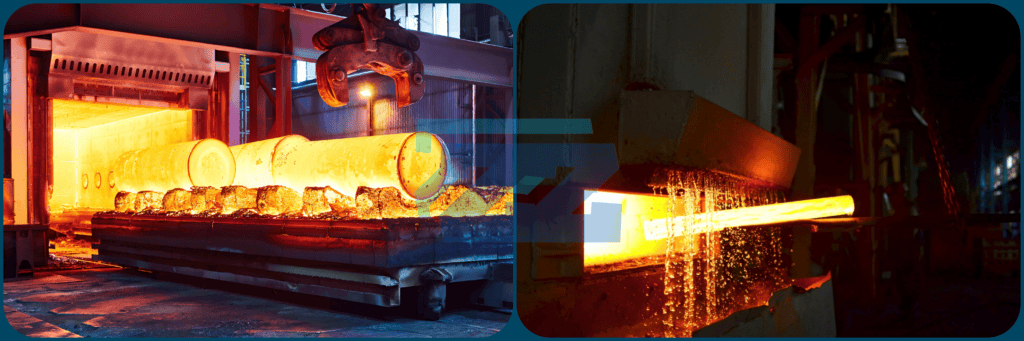
Four Basic Heat Treatment Processes
All four processes follow the same sequence—heat, hold, and controlled cool—but differ in cooling rate, producing distinctly different material behaviors.
Annealing (Slow Furnace Cooling)
Steel is heated above its critical temperature and cooled gradually inside the furnace.
Purpose: Relieves internal stresses, softens the material, refines grain structure, and improves machinability.
Example: For ferritic stainless steel, annealing at 750–850°C removes cold-work and weld-induced stresses while restoring corrosion resistance.
Normalizing (Air Cooling)
Steel is fully austenitized and then cooled in still air.
Purpose: Produces finer grains and more uniform properties than annealing. It is a cost-effective final treatment for low-demand components and helps eliminate network cementite.
Quenching (Rapid Cooling; Requires Subsequent Tempering)
Rapid cooling from high temperature generates hard, brittle martensite with high residual stress.
– Water quenching: Fastest cooling, deep hardness, low cost, but high risk of distortion and cracking. Suited for simple carbon-steel thick-wall parts.
– Oil quenching: Milder cooling, less distortion, ideal for alloy steel, precision parts, and thin-walled complex shapes.
Example: Martensitic stainless steels (e.g., 420, 440C) are quenched at 920–1060°C in oil or air to achieve high strength.
Tempering (Mandatory After Quenching)
Reheating quenched steel below the critical temperature relieves internal stresses and balances hardness with toughness.
– Low-temperature (150–250°C): Maintains high hardness and wear resistance—used for cutting tools, bearings, and wear parts.
– Medium-temperature (350–500°C): Enhances elasticity—applied to springs and stamping dies.
– High-temperature (500–650°C): Combined with quenching (known as quenching and tempering) for heavy-load structural parts such as crankshafts and connecting rods.
Quenching and Tempering (Q&T) Treatment
This combined process—quenching followed by high-temperature tempering—produces tempered sorbite, a microstructure offering an excellent balance of strength, ductility, and toughness. It is ideal for components subject to tension, bending, impact, and fatigue.
As-quenched steel is hard but brittle and cannot be used directly.
High-temperature tempering decomposes unstable martensite into stable tempered sorbite and eliminates residual stresses.
Temperature selection based on target properties:
High toughness: 650–700°C
Standard strength-toughness balance: 550–650°C
High strength: 500–600°C
Material selection: 45# steel is suitable for thin sections under 25 mm; alloy steels like 40Cr and 42CrMo are preferred for large cross-section components.
Heat Treatment for Different Stainless Steel Families
Austenitic (e.g., 304, 316):
The primary process is solution annealing at 1000–1150°C, followed by rapid water quenching to ensure uniform austenite and maximum corrosion resistance. For welded or cold-worked fittings, stress-relief annealing at 300–500°C is recommended.
Martensitic:
Requires quenching and tempering to tailor hardness and toughness.
Ferritic:
No phase transformation occurs; only annealing is used for stress relief.
Duplex Stainless Steel:
Demands precise temperature control. Improper heating can precipitate harmful intermetallic phases, reducing both corrosion resistance and toughness.
ASTM Heat Treatment Specifications for Stainless Steel Butt-Weld Fittings
ASTM A403 (Austenitic Stainless Steel Forged Fittings)
All fittings must be supplied in the fully heat-treated condition. Welding must be completed before heat treatment.
Fittings machined from pre-solution-annealed blanks do not require secondary annealing.
Minimum solution annealing temperatures and rapid water cooling are mandatory for all grades.
Where no temperature range is specified, the single listed minimum temperature applies.
Heat treatment parameters may vary with service temperature; consult manufacturers for custom processes.
ASTM A403 Heat Treatment
| Grade WP | Grade CR | UNS Designation | Solution Anneal Temperature,min °F[℃] | Quench Media |
| WP304 | CR304 | S30400 | 1900 [1040] | Water or other rapid cool |
| WP304L | CR304L | S30403 | 1900 [1040] | Water or other rapid cool |
| WP304H | CR304H | S30409 | 1900 [1040] | Water or other rapid cool |
| WP304N | CR304N | S30451 | 1900 [1040] | Water or other rapid cool |
| WP304LN | CR304LN | S30453 | 1900 [1040] | Water or other rapid cool |
| WP309 | CR309 | S30900 | 1900 [1040] | Water or other rapid cool |
| WP310S | CR310S | S31008 | 1900 [1040] | Water or other rapid cool |
| WP310H | CR310H | S31009 | 1900 [1040] | Water or other rapid cool |
| WPS31254 | CR31254 | S31254 | 2100 [1150] | Water or other rapid cool |
| WPS31266 | CRS31266 | S31266 | 2100 [1150] | Water or other rapid cool |
| WP316 | CR316 | S31600 | 1900 [1040] | Water or other rapid cool |
| WP316L | CR316L | S31603 | 1900 [1040] | Water or other rapid cool |
| WP316H | CR316H | S31609 | 1900 [1040] | Water or other rapid cool |
| WP316N | CR316N | S31651 | 1900 [1040] | Water or other rapid cool |
| WP316LN | CR316LN | S31653 | 1900 [1040] | Water or other rapid cool |
| WP317 | CR317 | S31700 | 1900 [1040] | Water or other rapid cool |
| WP317L | CA317L | S31703 | 1900 [1040] | Water or other rapid cool |
| WP321 | CR321 | S32100 | 1900 [1040] | Water or other rapid cool |
| WP321H | CR321H | S32109 | 1925 [1050] | Water or other rapid cool |
| WP330 | CR330 | N08330 | 1900 [1040] | Water or other rapid cool |
| WP347 | CR347 | S34700 | 1900 [1040] | Water or other rapid cool |
| WP347H | CR347H | S34709 | 1925[1050] | Water or other rapid cool |
| WP347LN | CR347LN | S34751 | 1900 [1040] | Water or other rapid cool |
| WPS34752 | CRS34752 | S34752 | 1940-2140 [1060-1170] | Water or other rapid cool |
| WP348 | CR348 | S34800 | 1900 [1040] | Water or other rapid cool |
| WP348H | CR348H | S34809 | 1925 [1050] | Water or other rapid cool |
ASTM A815 (Ferritic, Duplex, and Martensitic Stainless Steel Fittings)
Covers WP and CR grades; WP includes seamless (WP-S), radiographically tested welded (WP-W/WX), and ultrasonically tested welded (WP-WU) subtypes.
Ferritic grades: Heat above 649°C, with cooling method determined by grade.
Duplex grades: Require strict high-temperature heating and rapid water quenching; no tempering is needed.
Martensitic S41500: Cool to ≤93°C, then temper at 566–621°C.
Guidance: Post-weld heat treatment (PWHT) at 1093–1127°C for welded fittings; seamless/wrought fittings may use 1066–1099°C.
ASTM A815 Heat Treatment
| Stainless Steel | All WP and CR Grades | Temperature | Cooling | Tempering Temperature |
| Ferritic | All | ≥1200°F[649℃] | As appropriate for grade | Not specified |
| Ferritic/Austenitic | S31803 | 1870-2010 F [1021-1099℃] | Water quench or rapidly cooled by other means | Not required |
| S32101 | 1870F [1021℃] min | Water quench or rapidly cooled by other means | Not required | |
| S32202 | 1870-1975°F [1021-1079℃] | Water quench or rapidly cooled by other means | Not required | |
| S32205 | 1870-2010°F [1021-1099℃] | Water quench | Not required | |
| S32750 | 1880-2060°F [1027-1127℃] | Water quench or rapidly cooled by other means | Not required | |
| S32760 | 2010-2085°F [1099-1141℃] | Water quench or rapidly cooled by other means | Not required | |
| S39274 | 1920-2060°F [1049-1127℃] | Water quench or rapidly cooled by other means | Not required | |
| S32550 | 1950-2060°F [1066-1127℃] | Water quench | Not required | |
| S32950 | Not specified | Not specified | Not required | |
| Martensitic | S41000 | ≥1200°F [649°℃] | Not specified | Not specified |
| S41008 | >1200°F [649℃] | In still air as appropriate for grade | Not specified | |
| S41500 | ≥1750F [954℃] | Air cool to ≤200°F [93℃] prior to any optional intermediate temper and prior to final temper. | 1050-1150°F [566-621℃] |
Conclusion
Annealing, normalizing, quenching, and tempering are the core pillars of steel heat treatment. The quench-and-temper process offers the most balanced mechanical properties for demanding applications. Strict adherence to ASTM A403 and A815 heat treatment protocols ensures that stainless steel pipe fittings achieve reliable, long-term performance in petrochemical and other critical service environments.