
Stainless steel butt weld tees are a common type of pipe fitting in industrial piping systems, primarily used to divide fluid flow into three directions or to converge three fluid streams into one. Butt weld tees have a “T” shape, typically consisting of one inlet and two outlets, and can also be used in reverse. They are connected to pipes via butt-welding, a method that ensures the pipeline system forms a sturdy, seamless unit, thereby minimizing the risk of leaks. Common stainless steel grades include 304, 304L, 316, 316L, 321, and 904L, capable of meeting diverse operational requirements.
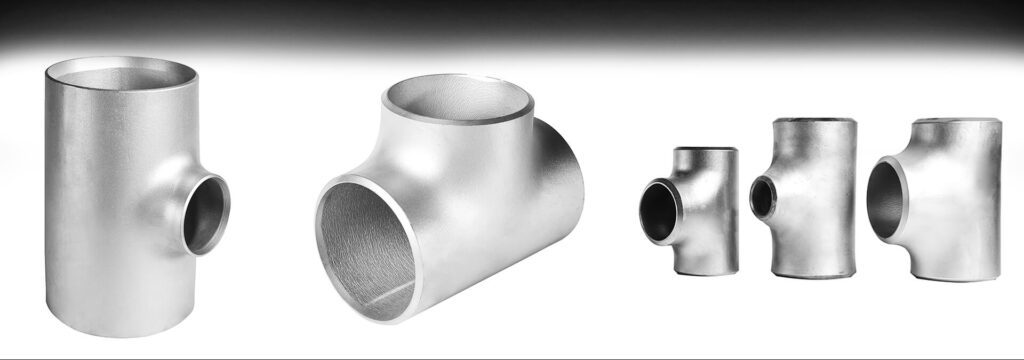
Specification of ASME B16.9 Tee
| Shape Type | Equal Tee and Reducing Tee |
| Size Range | 1/2″ – 80″ / DN15 – 2000 |
| Thickness Schedule | SCH 10 – SCH 160, XXS |
| Standard | GB/T12459, GB/T13401, HG/T21635/21631, SH3408/3409, ANSI / ASME B16.9, MSS SP 43, JIS B2311/2312/2313, DIN2605/2615/2616/2617, EN10253 |
| Carbon Steel | Q235, 20#, 35#, 45#, 20G,Q345B, 16Mn, ASTM A234 WPB/WPC, A420 WPL6 |
| API 5L Grades | ASTM A860 WPHY 42 / 46 / 56 / 60 / 65 |
| Alloy Steel | ASTM A234 WP11 / WP12 / WP 5 / WP9 / WP91 / WP92,15CrMoG, 12Cr1MoVG, 12Cr5Mo, 1Cr5Mo, Cr9Mo, 10CrMo910, 12CrMo4-5 |
| Stainless Steel | ASTM A403 WP304/304L/304H, 316/316L, 310S, 317,347, 904L, A815 S32205, S31803, 32750, 32760 |
Chemical Composition of ASTM A403 Stainless Steel Tee
| CHEMICAL | LIMITS | C | Mn | P | S | Si | Ni | Cr | Mo |
| ASTM A403 WP304 | MIN | 8.0 | 18.0 | ||||||
| MAX | 0.08 | 2.00 | 0.045 | 0.030 | 1.00 | 11.0 | 20.0 | ||
| ASTM A403 WP316 | MIN | 10.0 | 16.0 | 2.00 | |||||
| MAX | 0.08 | 2.00 | 0.045 | 0.030 | 1.00 | 14.0 | 18.0 | 3.00 |
Mechanical Properties of ASTM A403 Butt Weld Tee
| MATERIAL | ASTM A403 WP304 | ASTM A403 WP316 |
| T.S (MPA) | 515 min | 515 min |
| Y.S (MPA) | 205 min | 205 min |
| EL % | 28 min | 28 min |
Advantages of Stainless Steel Butt Weld Tee
1. Exceptional Corrosion Resistance
Stainless steel, particularly grades such as 304 and 316, offers outstanding corrosion resistance. It effectively withstands corrosion from various acids, alkalis, salts, and other chemical substances, ensuring the tee fitting operates reliably in harsh environments for extended periods and prolonging the service life of the piping system.
2. Durable and High-Pressure Rated
The butt-welded connection ensures the tee is seamlessly integrated with the pipeline, eliminating gaps and enabling it to withstand extremely high pressures and temperatures. This makes stainless steel butt-welded tees the preferred choice for high-temperature, high-pressure industries such as petroleum, chemicals, and power generation. Their robust structure resists deformation or fracture.
3. Hygienic and non-toxic, clean and environmentally friendly
The smooth surface of stainless steel prevents bacterial growth and facilitates cleaning. This makes stainless steel butt weld tee an indispensable part of hygiene-critical industries. Such as food processing, pharmaceutical manufacturing, and drinking water treatment.
4. Easy installation and simple maintenance
Although butt welding requires professional welding skills, its one-time installation feature reduces maintenance costs associated with loosening or leaks in the long term. Proper installation ensures the long-term stable operation of the pipeline system.
Classification of Butt Weld Tee
45°Lateral: Also known as a Y-shaped tee is a special pipe fitting in which the branch pipe forms a 45° angle with the main pipe. Compared to traditional right-angle tees, this reduces fluid resistance and pressure loss, resulting in a smoother fluid transition. They are commonly used in piping systems with high requirements for flow rate and pressure. It is widely used in industries such as chemical, petroleum, pharmaceutical, environmental protection, and water treatment.
Equal tee: All three ports have the same nominal diameter, meaning the main pipe and branch pipes have the same diameter. It is suitable for situations where the flow rates of the main pipe and branch pipes are the same, ensuring relatively balanced fluid velocity across all pipes. It is commonly used in piping systems requiring symmetrical branching, such as certain symmetrically arranged equipment connection pipes.
Reducing tees: These three ports have different nominal diameters, with the main pipe larger than the branch pipe. These tees are suitable for pipe systems that combine branching and merging, and require a change in pipe diameter. They are widely used in oil and gas pipeline systems.
Dimension of ASME B16.9 Tee
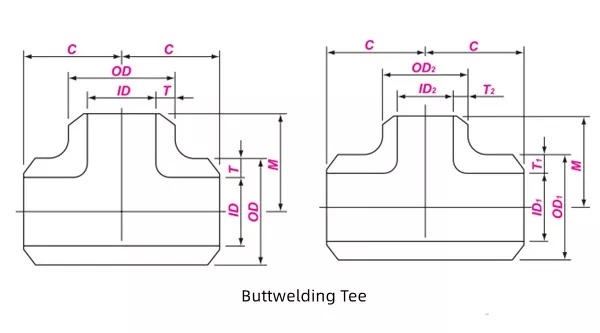
| NPS | O.D. | Center to End | Center to End |
| D | C | M | |
| 1/2 | 21.3 | 25 | 25 |
| 3/4 | 26.7 | 29 | 29 |
| 1 | 33.4 | 38 | 38 |
| 1.1/4 | 42.2 | 48 | 48 |
| 1.1/2 | 48.3 | 57 | 57 |
| 2 | 60.3 | 64 | 64 |
| 2.1/2 | 73 | 76 | 76 |
| 3 | 88.9 | 86 | 86 |
| 3.1/2 | 101.6 | 95 | 95 |
| 4 | 114.3 | 105 | 105 |
| 5 | 141.3 | 124 | 124 |
| 6 | 168.3 | 143 | 143 |
| 8 | 219.1 | 178 | 178 |
| 10 | 273 | 216 | 216 |
| 12 | 323.8 | 254 | 254 |
| 14 | 355.6 | 279 | 279 |
| 16 | 406.4 | 305 | 305 |
| 18 | 457 | 343 | 343 |
| 20 | 508 | 381 | 381 |
| 22 | 559 | 419 | 419 |
| 24 | 610 | 432 | 432 |
| 26 | 660 | 495 | 495 |
| 28 | 711 | 521 | 521 |
| 30 | 762 | 559 | 559 |
| 32 | 813 | 597 | 597 |
| 34 | 864 | 635 | 635 |
| 36 | 914 | 673 | 673 |
| 38 | 965 | 711 | 711 |
| 40 | 1016 | 749 | 749 |
| 42 | 1067 | 762 | 711 |
| 44 | 1118 | 813 | 762 |
| 46 | 1168 | 851 | 800 |
| 48 | 1219 | 889 | 838 |
Weight Chart of Butt Weld Tee
| DN | NPS | SCH20 | SCH30 | STD | SCH40 | SCH60 | XS | SCH80 | SCH100 | SCH120 | SCH140 | SCH160 | XXS |
| 15 | 1/2 | – | 0.15 | 0.16 | 0.16 | – | 0.20 | 0.20 | – | – | – | 0.25 | 0.35 |
| 20 | 3/4 | – | 0.18 | 0.20 | 0.20 | – | 0.30 | 0.30 | – | – | – | 0.35 | 0.45 |
| 25 | 1 | – | 0.27 | 0.28 | 0.28 | – | 0.45 | 0.45 | – | – | – | 0.54 | 0.77 |
| 32 | 1 1/4 | – | 0.46 | 0.55 | 0.55 | – | 0.70 | 0.70 | – | – | – | 0.91 | 1.26 |
| 40 | 1 1/2 | – | 0.68 | 0.78 | 0.78 | – | 1.25 | 1.25 | – | – | – | 1.39 | 1.83 |
| 50 | 2 | – | 0.96 | 1.17 | 1.17 | – | 1.61 | 1.61 | – | – | – | 2.39 | 2.89 |
| 65 | 2 1/2 | – | 2.06 | 2.21 | 2.21 | – | 2.92 | 2.92 | – | – | – | 3.81 | 5.21 |
| 80 | 3 | – | 2.87 | 3.23 | 3.23 | – | 4.42 | 4.42 | – | – | – | 6.17 | 8.01 |
| 90 | 3 1/2 | – | 3.65 | 4.33 | 4.33 | – | 5.95 | 5.95 | – | – | – | – | – |
| 100 | 4 | – | 4.56 | 5.68 | 5.68 | – | 7.88 | 7.88 | – | 10.0 | – | 11.8 | 14.5 |
| 125 | 5 | – | – | 9.08 | 9.08 | – | 12.9 | 12.9 | – | 16.8 | – | 20.5 | 24.0 |
| 150 | 6 | – | – | 13.6 | 13.6 | – | 20.5 | 20.5 | – | 26.1 | – | 32.5 | 38.1 |
| 200 | 8 | 17.5 | 22.0 | 25.5 | 25.5 | 31.8 | 38.7 | 38.7 | 45.4 | 54.1 | 60.4 | 66.6 | 64.6 |
| 250 | 10 | 28.0 | 37.1 | 44.8 | 44.8 | 59.2 | 59.2 | 69.7 | 83.3 | 96.6 | 113 | 125 | 113 |
| 300 | 12 | 42.6 | 55.7 | 63.1 | 68.1 | 93.0 | 83.2 | 112 | 137 | 160 | 178 | 204 | 160 |
| 350 | 14 | 64.5 | 76.3 | 76.3 | 88.7 | 119 | 101 | 148 | 183 | 211 | 238 | 264 | – |
| 400 | 16 | 78.2 | 95.7 | 95.7 | 126 | 164 | 126 | 191 | 252 | 294 | 342 | 375 | – |
| 450 | 18 | 102 | 141 | 121 | 179 | 237 | 160 | 269 | 357 | 419 | 471 | 529 | – |
| 500 | 20 | 168 | 198 | 150 | 235 | 317 | 190 | 365 | 489 | 566 | 651 | 724 | – |
| 550 | 22 | 185 | 241 | 182 | – | 414 | 241 | 482 | 636 | 743 | 846 | 947 | – |
| 600 | 24 | 222 | 305 | 205 | 340 | 516 | 272 | 589 | 796 | 930 | 1046 | 1174 | – |
Applications of Stainless Steel Butt Weld Tee
Petroleum and Natural Gas Industry: Used in oil and gas transmission pipelines for diversion and convergence, withstanding high-pressure fluids.
Chemical Industry: Used in various chemical fluid transmission pipelines to resist highly corrosive substances.
Food and Pharmaceutical Industry: Used as sanitary-grade pipeline connectors to ensure sterile and safe production processes.
Power and Energy Industry: Used in pipelines for the transportation of steam, water, and other fluids, capable of withstanding high-temperature and high-pressure environments.
Shipbuilding and Marine Engineering: Maintains long-term reliability in highly corrosive environments such as seawater and salt fog.
How to Choose the Right Stainless Steel Butt Weld Tee?
Material Grade: Select the appropriate stainless steel grade based on the corrosiveness of the pipeline’s media. Commonly used grades include 304, 316, or others.
Size and Wall Thickness: Determine the appropriate tee size and wall thickness based on the nominal pipe diameter and design pressure to ensure safety and serviceability.
Standard Compliance: When purchasing, ensure that the product complies with relevant standards, such as ASME B16.9.