
In the installation and maintenance of piping systems, the selection of connecting components directly impacts the system’s stability, safety, and service life. As an important type of piping connector, the union pipe fittings, with its unique structure and excellent performance, has found widespread application in piping projects across various industries. This article will take you on an in-depth exploration of the union coupling, revealing why it has become the ideal choice for piping connections.
What is a union ?
A union, also known as a union joint, is a component used for removable connections between pipes. It typically consists of three parts: a male end, a female end, and a gasket. The male and female ends are connected to the two pipes to be joined, achieving a tight seal through threaded connections, while the gasket serves as a seal to prevent leakage of the medium inside the pipes.
Compared to traditional welding or flange connections, the most significant feature of union is their removability. This feature makes pipeline installation, maintenance, and replacement more convenient, eliminating the need for destructive operations on the pipeline, significantly improving work efficiency, and reducing maintenance costs.

MSS SP-83 Pipe Union Specification
| Size: | 1/8″ to 3″ / DN6 to DN80 |
| Pressure: | 3000 LB, 6000 LB, 9000 LB |
| Connection: | Socket Weld and Threaded Union |
| Thread Type: | Female and Male NPT, BSPP and BSPT |
| Alloy Steel: | ASTM A182 F1, F5, F9, F11, F12, F22, F91 |
| Carbon Steel: | ASTM A105, A350 LF2/LF3, A694 F52, F60, F65, F70 |
| Stainless Steel: | ASTM A182 F304, F316, F317, F310, F321 |
| Duplex Stainless Steel: | ASTM A182 F51, F53, F55 |
Structural Advantages of Union
Excellent Sealing Performance: The gasket is the key to ensuring the sealing performance of union. High-quality gaskets fit tightly to the male and female ends, effectively preventing medium leakage and ensuring the safe operation of the pipeline system.
Easy Installation and Removal: When maintenance or component replacement is required, simply disassemble the union, complete the operation, and then retighten it, saving time and effort.
High adaptability: Union couplings can accommodate connections between pipes of different diameters and materials. Whether it is metal or plastic piping, as long as the thread specifications match, union can be used for connection.
Material & Grades of Forged Unions:
Carbon Steel Threaded Flanges :
Carcon Steel: ASTM A105 / A105N,ASTM A350 LF2 / LF3, A694 F42 / 46 / 52 / 56 / 65 / 70
Alloy Steel Threaded / Screwed Flanges :
ASTM / ASME A/SA 182 & A 387 F1, F5, F9, F11, F12, F22, F91
Stainless Steel Threaded Flanges :
ASTM A 182, A 240 F 304, 304L, 304H, 316, 316L, 316Ti, 310, 310S, 321, 321H, 317, 347, 347H, 904L
Duplex & Super Duplex Steel Threaded Flanges :
ASTM / ASME A/SA 182 F 44, F 45, F51, F 53, F 55, F 60, F 61
Copper Alloy Steel Threaded Flanges :
ASTM SB 61 , SB62 , SB151 , SB152 UNS No. C 70600 (Cu-Ni 90/10), C 71500 (Cu-Ni 70/30), UNS No. C 10100, 10200, 10300, 10800, 12000, 12200
Nickel Alloy Threaded Flanges :
ASTM SB564, SB160, SB472, SB162 Nickel 200 (UNS No. N02200), Nickel 201 (UNS No. N02201), Monel 400 (UNS No. N04400), Monel 500 (UNS No. N05500), Inconel 800 (UNS No. N08800), Inconel 825 (UNS No. N08825), Inconel 600 (UNS No. N06600), Inconel 625 (UNS No. N06625), Inconel 601 (UNS No. N06601), Hastelloy C 276 (UNS No.N10276), Alloy 20 (UNS No. N08020)
Types of Unions
Socket welding involves inserting a steel pipe into a socket hole for welding, hence the term socket weld union. A socket coupling consists of a socket, a spigot, and a socket groove, with the distinctive feature of a socket groove on the spigot, and the spigot and socket located at opposite ends. Socket unions can be widely applied to pipes of various diameters and are also suitable for water meters and valves. Due to the socket structure, pipe joints reduce costs and offer extremely convenient installation, use, and maintenance, while also providing excellent leak prevention capabilities, making them highly promising in the market.
Threaded Union:
Threaded unions are the most common type of joint, characterized by using a threaded connection method for pipe connections. They primarily consist of three parts: a male end with external threads, a female end with internal threads, and a nut. By rotating the nut, the sealing surfaces of the male and female ends can be tightly aligned, thereby achieving connection and sealing. Thread forms can include BSP, NPT, G, etc., and the connection is further secured using a locking nut and a seal ring. Suitable for small-diameter pipes, threaded connections achieve pipe sealing. They are easy to install and commonly used in water pipes, gas pipes, and other applications.
Class 3000 Socket Weld Union Dimension
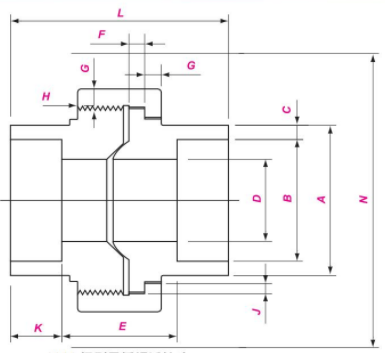
| Nominal Size | Pipe End | Socket Bore Dia. | Socket Wall | Water Way Bore | Laying Length | THRD Per Inch | Depth of Socket | Length Assem | Clear Assem. Nut | |
| DN | NPS | A | B | C min | D | E | H | Kmin | L nom | N |
| 6 | 1/8 | 21.8 | 10.9 | 3.2 | 6.1 | 20.7 | 16 | 9.7 | 41.4 | 51 |
| 8 | 1/4 | 21.8 | 14.3 | 3.3 | 8.5 | 20.7 | 16 | 9.7 | 41.4 | 51 |
| 10 | 3/8 | 25.9 | 17.7 | 3.5 | 11.8 | 23.8 | 14 | 9.7 | 46 | 56 |
| 15 | 1/2 | 31.2 | 21.9 | 4.1 | 15.0 | 23.8 | 14 | 9.7 | 49 | 59 |
| 20 | 3/4 | 37.1 | 27.3 | 4.3 | 20.2 | 28.6 | 11 | 12.7 | 56.9 | 66 |
| 25 | 1 | 45.5 | 34.0 | 5 | 25.9 | 30.2 | 11 | 12.7 | 62 | 79 |
| 32 | 11/4 | 54.9 | 42.8 | 5.3 | 34.3 | 36.6 | 10 | 12.7 | 71.1 | 94 |
| 40 | 11/2 | 61.5 | 48.9 | 5.5 | 40.1 | 38.1 | 10 | 12.7 | 76.5 | 112 |
| 50 | 2 | 75.2 | 61.2 | 6 | 51.7 | 41.4 | 10 | 15.7 | 86.1 | 132 |
| 65 | 21/2 | 91.7 | 73.9 | 7.7 | 61.2 | 56.9 | 8 | 15.7 | 102.4 | 150 |
| 80 | 3 | 109.2 | 89.9 | 8.3 | 76.4 | 58.7 | 8 | 15.7 | 109 | 176 |
CLASS 3000 Threaded Union Dimensions
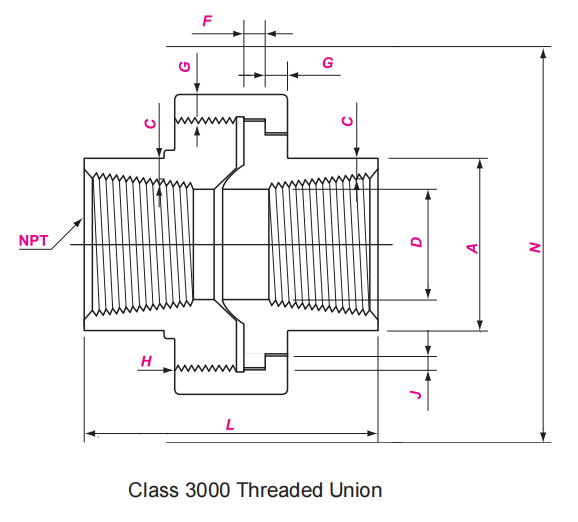
| Nominal Size | Pipe End | Wall | Bone | Male Flange | Nut | THRD Per Inch | Bearing | Length Assem | Clear Assem Nut | |
| DN | NPS | Amin | Cmin | D | Fmin | Gmin | H | Jmin | Lnom | N |
| 6 | 1/8 | 14.7 | 2.4 | 8.46.4 | 3.2 | 3.2 | 16 | 1.2 | 41.4 | 51 |
| 8 | 1/4 | 19.1 | 3.0 | 11.19.4 | 3.2 | 3.2 | 16 | 1.2 | 41.4 | 51 |
| 10 | 3/8 | 22.9 | 3.2 | 14.313.5 | 3.4 | 3.4 | 14 | 1.4 | 46.0 | 56 |
| 15 | 1/2 | 27.7 | 3.7 | 17.917.1 | 3.7 | 3.7 | 14 | 1.5 | 49.0 | 59 |
| 20 | 3/4 | 33.5 | 3.9 | 23.021.4 | 4.1 | 4.1 | 11 | 1.7 | 56.9 | 66 |
| 25 | 1 | 41.4 | 4.5 | 29.027.7 | 4.6 | 4.4 | 11 | 1.9 | 62.0 | 79 |
| 32 | 11/4 | 50.5 | 4.9 | 37.735.4 | 5.3 | 5.2 | 10 | 2.1 | 71.1 | 94 |
| 40 | 11/2 | 57.2 | 5.1 | 43.541.2 | 5.8 | 5.6 | 10 | 2.3 | 76.5 | 112 |
| 50 | 2 | 70.1 | 5.5 | 55.652.1 | 6.6 | 6.4 | 10 | 2.7 | 86.1 | 132 |
| 65 | 21/2 | 85.3 | 7.0 | 66.364.3 | 7.5 | 7.1 | 8 | 3.1 | 102.4 | 150 |
| 80 | 3 | 102.4 | 7.6 | 82.677.3 | 8.3 | 8.0 | 8 | 3.5 | 109.0 | 176 |
Union Pipe Fittings Applications
Water treatment systems
Petrochemical pipelines
Heating, ventilation, and air conditioning (HVAC) systems
Pharmaceutical and food industry piping
Laboratory and research piping systems
How to Choose the Right Union Pipe Fitting?
Working medium and temperature: Determine the type of fluid and temperature, and select the appropriate material.
Working pressure: Ensure that the pressure rating of the union fitting exceeds the working pressure of the system.
Pipe size: Match the outer diameter, inner diameter, and thread specifications of the pipe.
Installation and Maintenance of Union Fittings
Installation: Before installation, clean the threads of the pipe and union fitting to remove debris and burrs. During installation, connect the male and female ends to the pipe separately, ensuring the tightening force is appropriate to avoid over-tightening or under-tightening. Additionally, ensure the gasket is properly installed to provide effective sealing.
Maintenance: Regularly inspect the union quick-connect fitting for leaks, loosening, or other issues. If the gasket is found to be aged or damaged, it should be replaced promptly. For pipeline systems that are not in use for extended periods, the quick-connect fitting should be disassembled, cleaned, and lubricated regularly to prevent thread rusting and seizing.