
Incoloy 825 is a nickel-iron-chromium alloy with primary alloying elements including Mo, Cu, and Ti. The composition of this alloy is listed in Table 1. This alloy was designed to exhibit outstanding corrosion resistance in numerous corrosive environments. Sufficient nickel content provides resistance to stress corrosion cracking. The combination of Ni, Mo, and Cu imparts exceptional corrosion resistance to this alloy, particularly in sulfuric and phosphoric acid environments.
Due to its outstanding acid resistance and high-temperature stability, Incoloy 825 is widely used in chemical processing, oil and gas, offshore engineering, and environmental protection equipment, and is considered one of the most reliable corrosion-resistant alloys available.
Reference Standard Material of Alloy 825
Incoloy Alloy 825 is a nickel-iron-chromium alloy widely used in the chemical, oil and gas, and offshore industries. Its production and inspection generally follow the following international standards:
Rod, Bar, Wire and Forging Stock: BS 3076NA16, ASTM B 425, ASTM B 564, ASME SB 425, ASME SB 564, ASME Code Case N-572, DIN 17752, DIN 17753, DIN 17754, VdTÜV 432, ISO 9723, ISO 9724, ISO 9725.
Plate, Sheet and Strip: BS 3072NA16, BS 3073NA16, ASTM B 424, ASTM B 906, ASME SB 424, ASME SB 906, DIN 17750, VdTÜV 432, ISO 6208.
Pipe and Tube: BS 3074NA16, ASTM B 163, ASTM B 423, ASTM B 704, ASTM B 705, ASTM B 751, ASTM B 775, ASTM B 829, ASME SB 163, ASME SB 423, ASME SB 704, ASME SB 705, ASME SB 751, ASME SB 775, ASME SB 829, ASME Code Case 1936, DIN 17751, VdTÜV 432, ISO 6207.
Others: ASTM B 366, ASME SB 366, DIN 17744
Chemical Composition of Incoly 825, Nickel Alloy 825 and UNS N08825
The chemical composition of Incoloy 825 primarily includes elements such as nickel (Ni), chromium (Cr), molybdenum (Mo), and iron (Fe). Its typical composition is: Ni (38-46%), Cr (19.5-23.5%), Mo (2.5-3.5%), Fe (22%). This composition ratio enables the material to maintain high strength and excellent corrosion resistance even in high-temperature environments (up to 900°C).
| CHEMICAL | LIMITS | C | Mn | Al | S | Si | Ni | Cr | Mo | Fe | Ti | Cu |
| Incoloy 825 | MIN | 38.00 | 19.50 | 2.50 | 22.00 | 0.600 | 1.50 | |||||
| MAX | 0.05 | 1.00 | 0.200 | 0.030 | 0.50 | 46.00 | 23.50 | 3.50 | 1.200 | 3.00 |
N08825 – Mechanical Properties
| Incoloy | Density | Melting Point | Tensile Strength | Yield Strength (0.2%Offset) | Elongation |
| 825 | 8.14 g/cm3 | 1400 °C (2550 °F) | 586Mpa (85 Ksi) | 241Mpa (35Ksi) | 30% |
Nickel Alloy 825 – Equivalent Grade Designations
| STANDARD | UNS | WERKSTOFF NR. | AFNOR | EN | JIS | BS | GOST | OR |
| Incoloy 825 | N08825 | 2.4858 | NFE30C20DUM | NiCr21Mo | NCF 825 | NA 16 | ЭП703 | XH38BT |
Incoloy 825 Characteristics
1. Excellent resistance to stress corrosion cracking
2. Good resistance to pitting and crevice corrosion
3. Superior oxidation resistance and non-oxidizing hot acid resistance
4. Excellent mechanical properties at room temperature and up to 550°C
5. Certified for manufacturing pressure vessels at temperatures up to 450°C
Hot and Cold Forming
Incoloy 825 has a hot working temperature range of 1600 to 2150°F (870 to 1180°C). Final hot forming should be performed between 1600 and 1800°F (870 to 980°C). After hot working, air cooling or faster cooling methods may be employed. Large-section components are highly sensitive to cooling rates after hot working. Consequently, intergranular corrosion may readily occur in certain environments. Corrosion resistance can be restored through stabilization annealing. If the alloy requires welding or further heat treatment followed by exposure to environments prone to intergranular corrosion, stabilization annealing should disregard cooling rates starting from the hot working temperature. Although the strain hardening rate is somewhat lower than that of standard austenitic stainless steels, it remains significantly high. Forming equipment should be reinforced to compensate for the increased yield strength during deformation.
Incoloy 825 Welding
Incoloy 825 is suitable for welding to itself or to other metals using any conventional welding process, such as tungsten inert gas welding, plasma arc welding, manual metal arc welding, gas metal arc welding, and gas metal arc welding. Among these, pulsed arc welding is the preferred method. When using manual metal arc welding, a multi-component shielding gas mixture (Ar+He+H₂+CO₂) is recommended.
Incoloy 825 must be welded in the annealed condition, with all contaminants, dust, and markings thoroughly cleaned using a stainless steel wire brush. When welding the root of the weld, extreme care must be exercised (using 99.99% argon) to achieve optimal root weld quality, ensuring no oxides form after root welding. Any discoloration in the heat-affected zone must be removed with a stainless steel brush while the weld area is still hot.
Corrosion Resistance of Incoloy 825
Alloy 825 is a versatile engineering alloy exhibiting high resistance to corrosion by acids and alkali metals in both oxidizing and reducing environments. Its high nickel content provides effective resistance to stress corrosion cracking. It demonstrates excellent corrosion resistance in various media, including sulfuric acid, phosphoric acid, nitric acid, organic acids, and alkali metals such as sodium hydroxide, potassium hydroxide, and hydrochloric acid solutions. The alloy’s superior comprehensive performance is particularly evident in nuclear burnup dissolvers handling diverse corrosive media—such as sulfuric acid, nitric acid, and sodium hydroxide—within a single vessel.
Incoloy 825 Alloy Products
1. Pipes & Tubes
– Seamless Pipe & Tube
– Welded Pipe & Tube
Commonly used in heat exchangers, chemical pipelines, and desalination equipment
2. Plates, Sheets & Strips
Wide thickness range, suitable for pressure vessels and chemical equipment linings
3. Bars & Forgings
Used for fasteners, valves, and shaft components
4. Flanges
Weld neck flanges, slip-on flanges, blind flanges,socket weld flange ,threaded flange,lap joint flange
Compliant with ASME/ANSI B16.5, B16.47 standards
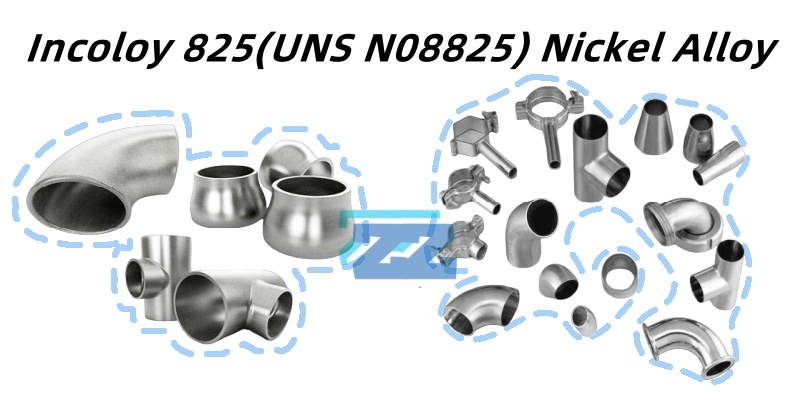
5. Pipe Fittings
– Butt weld fittings (elbows, tees, reducers, heads) — Compliant with ASME B16.9
– Forged Fittings (Socket Weld, Threaded) — Compliant with ASME B16.11
Suitable for petrochemical and highly corrosive piping systems
6. Welding Materials
Incoloy 825 Welding Wire / Welding Rods
Used for welding to 825 alloy or other corrosion-resistant materials
Incoloy 825 Applications
1. Heating tubes, vessels, baskets, and chains in sulfuric acid pickling plants.
2. Seawater-cooled heat exchangers, marine product piping systems, and piping in acidic gas environments.
3. Heat exchangers, evaporators, scrubbers, and immersion tubes in phosphoric acid production.
4. Air heat exchangers in petroleum refining
5. Food processing
6. Chemical processing
7. Flame-retardant alloys for high-pressure oxygen applications
Incoloy 825 VS Inconel 625 (UNS 08825 VS UNS N06625)
Incoloy 825 and Inconel 625, though both nickel-based alloys, exhibit distinct core characteristics and application scenarios: Incoloy 825 features a nickel-iron-chromium matrix with added molybdenum and copper, emphasizing performance in moderately corrosive environments at lower temperatures. It excels in chemical applications such as sulfuric acid pipelines, demonstrating outstanding corrosion resistance in chloride and sulfuric acid environments. It also offers favorable machinability and relatively competitive cost.
Inconel 625 contains a higher nickel content (≥58%) along with substantial amounts of chromium, molybdenum, and niobium. It offers superior high-temperature strength and exceptional resistance to extreme corrosion, making it suitable for high-end applications like aerospace engine components and deep-sea oil and gas extraction equipment. While it delivers superior performance, its cost and machining difficulty are higher than Incoloy 825. Compared to Inconel 625, Incoloy 825 is more suitable for foundational applications in conventional industrial corrosion environments, while Inconel 625 targets precision components operating under higher temperatures and more demanding conditions.