
ASME B16.5 threaded flange is one of the most practical and widely used flanges in small-bore and low-pressure piping systems. It connects pipes and equipment through internal threads instead of welding, making installation fast and convenient. This article covers the standard details, thread types, sealing faces, weight chart for reference, and applications of ASME B16.5 threaded flanges to support your engineering selection and procurement.
ASME B16.5 Standard
ASME B16.5 is an international standard that specifies pipe flanges and flanged fittings for industrial piping systems. It defines nominal sizes, pressure-temperature ratings, dimensions, tolerances, materials, marking and testing requirements.
ASME B16.5 flanges are widely used in oil and gas, petrochemical, chemical, power generation, water treatment and general industrial applications. The standard ensures interchangeability, safety and stability for flanged connections. Threaded flanges under ASME B16.5 are usually available in pressure classes including Class 150, Class 300 and Class 600 etc, with size ranges mainly from NPS 1/2” to NPS 4”.
Threaded Flange – ASME B16.5
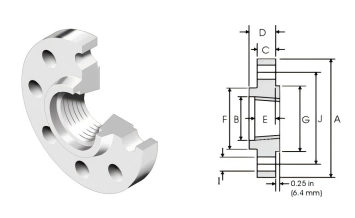
ASME B16.5 threaded flange is a flange with internal threads machined in the bore. It can be directly screwed onto external threaded pipes without welding. This design makes it ideal for applications where welding is difficult, dangerous or not permitted.
Compared with weld neck, slip-on and socket weld flanges, threaded flanges provide faster assembly and disassembly. They are commonly used in small-size piping systems that require quick installation or frequent maintenance. Although they are not designed for high-temperature or high-stress conditions, they perform reliably in many non-critical utility lines.
Characteristics of Threaded Flange
Threaded flanges under ASME B16.5 have distinct structural and functional characteristics:
- No welding required during installation
- Easy and fast assembly and disassembly
- Suitable for small-diameter piping systems
- Good for areas where hot work is restricted
- Lower installation cost compared with welded flanges
- Limited use in high-temperature, high-pressure or vibrating conditions
- Generally used in NPS 1/2” to NPS 4” sizes
- Compatible with various threaded pipe ends
These characteristics make threaded flanges a preferred choice in many light industrial and utility applications.
Thread Types – NPT/BSPT/BSPP
NPT (ASME B1.20.1) is the thread type specified in ASME B16.5 for threaded flanges. It is a tapered thread that creates a pressure-tight seal when tightened, making it the universal choice for North American and global industrial systems. All standard ASME B16.5 threaded flanges are manufactured with NPT threads.
BSPT (British Standard Pipe Taper) – Custom Option
BSPT is a tapered thread used in British and Commonwealth markets. It is not part of the ASME B16.5 standard but is available as a custom thread for regional compatibility.
BSPP (British Standard Pipe Parallel) – Custom Option
BSPP is a parallel thread that requires a gasket or O ring for sealing. It is used in hydraulic, pneumatic, and some European systems and is offered as a non-standard custom thread for ASME B16.5 flanges.
Sealing Faces of ASME B16.5 Threaded Flange
The sealing face of a threaded flange directly affects leakage prevention and compatibility with gaskets. Common sealing face types under ASME B16.5 include:
Raised Face (RF)
Raised Face is the most popular sealing face for threaded flanges. It provides good sealing with most gasket types and fits general industrial applications.
Flat Face (FF)
Flat Face is used mainly in low-pressure systems and is often matched with cast iron valves or equipment to avoid damage during assembly.
Ring Type Joint (RTJ)
RTJ is used in high-pressure and high-temperature conditions, though less common for standard threaded flanges.
To know more about flange sealing faces, please click.
Weight Reference for Carbon Steel Threaded Flange
| NPS | 150LB | 300LB | 400LB | 600LB | 900LB | 1500LB | 2500LB |
| 1/2 | 0.45 | 0.68 | 0.91 | 0.91 | 2.72 | 2.72 | 3.18 |
| 3/4 | 0.68 | 1.14 | 1.36 | 1.36 | 2.72 | 2.72 | 4.09 |
| 1 | 0.91 | 1.36 | 1.59 | 1.59 | 3.41 | 3.41 | 5.45 |
| 1 1/4 | 1.14 | 2.04 | 2.04 | 2.04 | 4.54 | 4.54 | 8.17 |
| 1 1/2 | 1.36 | 2.95 | 2.95 | 2.95 | 6.36 | 6.36 | 11.35 |
| 2 | 2.27 | 3.18 | 3.63 | 3.63 | 9.99 | 9.99 | 17.25 |
| 2 1/2 | 3.63 | 4.54 | 5.45 | 5.45 | 14.07 | 16.34 | 24.97 |
| 3 | 4.54 | 6.36 | 6.81 | 6.81 | 16.34 | 21.79 | 37.68 |
| 3 1/2 | 5.45 | 7.26 | 9.53 | 9.53 | / | / | / |
| 4 | 5.9 | 10.9 | 10.9 | 14.98 | 24.06 | 33.14 | 57.66 |
| 5 | 6.81 | 14.07 | 14.07 | 28.6 | 37.68 | 59.93 | 95.34 |
| 6 | 8.85 | 16.34 | 17.71 | 36.32 | 49.03 | 74.46 | 146.64 |
| 8 | 13.62 | 25.42 | 28.6 | 44.04 | 78.09 | 117.13 | 220.19 |
| 10 | 18.61 | 36.32 | 41.31 | 80.36 | 111.23 | 197.94 | 419.95 |
| 12 | 29.51 | 49.94 | 58.57 | 97.61 | 148 | 302.82 | 590.2 |
| 14 | 38.59 | 74.46 | 86.71 | 117.59 | 172.52 | / | / |
| 16 | 42.22 | 99.88 | 114.86 | 166.16 | 208.39 | / | / |
| 18 | 54.48 | 127.12 | 140.74 | 216.1 | 293.74 | / | / |
| 20 | 70.37 | 147.55 | 171.61 | 277.85 | 359.57 | / | / |
| 24 | 95.34 | 222.46 | 244.71 | 397.7 | 671.92 | / | / |
Why Choose ASME B16.5 Threaded Flange?
There are many practical reasons to choose ASME B16.5 threaded flanges:
- No welding needed, which saves time and labor costs
- Allowed in areas where welding or hot work is prohibited
- Easy installation and maintenance
- Suitable for small-bore pipes and low-pressure systems
- Interchangeable with other ASME B16.5 flanges
- Wide availability of materials and sizes
- Ideal for temporary or removable piping connections
For projects that prioritize speed, safety and convenience, threaded flanges are an excellent solution.
Where to Apply Threaded Flange?
ASME B16.5 threaded flanges are widely used in many industries and systems:
- Compressed air piping
- Water supply and utility lines
- Chemical processing for small pipes
- Petroleum refining auxiliary systems
- Fire protection systems
- Pneumatic and hydraulic circuits
- Facilities where welding is restricted
- Maintenance and temporary piping connections
They are especially suitable for low-pressure, small-diameter and non-critical applications.