
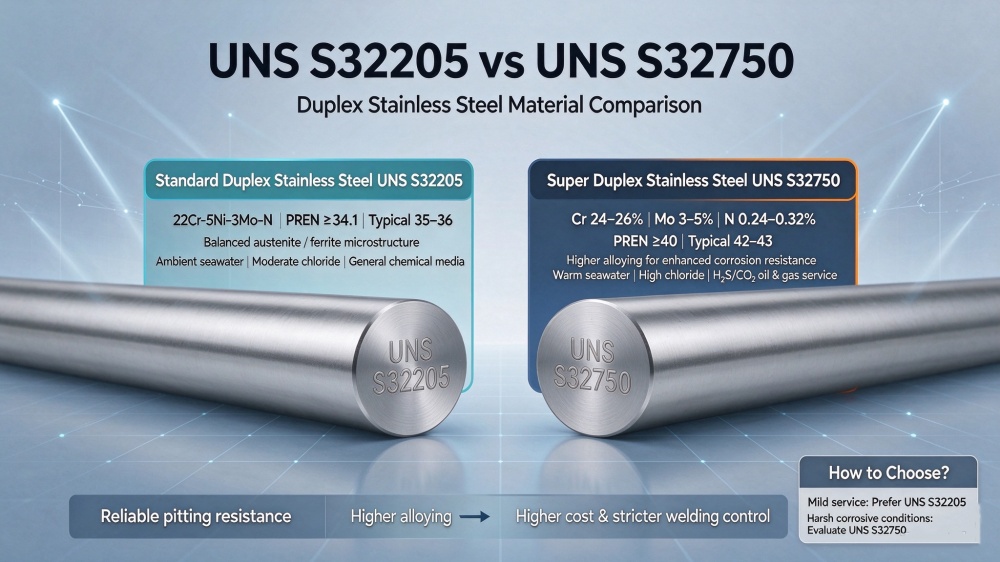
UNS S32205 (2205) and UNS S32750 (2507) are the two most representative duplex stainless steel grades. Both belong to the duplex family. They sit at different levels. S32205 is the standard duplex grade. S32750 is a super duplex grade. Alloy content sets them apart in corrosion resistance, mechanical strength, welding and cost. This article compares UNS S32205 and UNS S32750, with key data, standard cross-references and selection boundaries for engineering design.
Material Positioning: Standard Duplex S32205 vs Super Duplex S32750
Standard Duplex UNS S32205
UNS S32205 is close to UNS S31803 in chemistry. Both belong to the 22Cr-5Ni-3Mo-N family. S32205 sets higher minimums for chromium, molybdenum and nitrogen. This raises the minimum pitting resistance equivalent number (PREN) to 34.1 or above. Typical values fall in the 35–36 range. The practical benefit: reliable pitting resistance in seawater, chloride process media and sour oil and gas service. Buyers no longer depend on suppliers controlling chemistry at the top of the range. A balanced austenite-ferrite structure gives high yield strength and good stress corrosion cracking resistance. Typical service covers ambient seawater, moderate chloride environments and general chemical media.
Super Duplex UNS S32750
UNS S32750 carries higher alloy content. Chromium is about 24%–26%, molybdenum 3%–5%, nitrogen about 0.24%–0.32%. PREN is at least 40, typically 42–43. This supports hot seawater, high chloride concentrations and H2S/CO2 oil and gas service. Material cost and welding control demands rise accordingly.
Complex specs giving you a headache? Send us your original inquiry and we’ll handle it—fastest quote guaranteed.
Chemistry and Corrosion Resistance Compared
Chemical Composition
Performance differences start with chemistry. The table below compares key elements and PREN.
| Item | UNS S32205 (2205) | UNS S32750 (2507) |
| Grade family | Standard duplex | Super duplex |
| Chromium | 22.0%–23.0% | Approx. 24%–26% |
| Molybdenum | 3.0%–3.5% | 3%–5% |
| Nitrogen | 0.14%–0.20% | 0.24%–0.32% |
| PREN | ≥34.1 (typical 35–36) | ≥40 (typical 42–43) |
S32750 is higher in all three key elements. The PREN gap is about 7–8 points. This gap directly affects localized corrosion resistance. Data follows ASTM A240/A182 composition limits. Ranges may vary slightly between standard editions. Always confirm the edition named in the purchase contract.
Request certified MTC samples for S32205 and S32750 to verify chemistry.
Pitting Resistance and Critical Pitting Temperature
Critical pitting temperature (CPT) measures pitting resistance in chloride environments. In 6% FeCl3 solution, S32205 shows a CPT of about 35°C. S32750 reaches about 65°C. The gap is roughly 30°C. In high-temperature chloride media, S32205 may face pitting risk while S32750 keeps a wide margin. For seawater cooling systems and offshore platform piping with temperature swings, this difference often decides the grade. CPT values vary with test standard and solution conditions. Confirm values against the project specification.
Mechanical Properties Compared
Strength Data
High strength is a key reason duplex grades replace austenitic stainless steel. The table compares mechanical properties.
| Property | UNS S32205 (2205) | UNS S32750 (2507) |
| Min. yield strength | ≥450 MPa | ≥550 MPa |
| Min. tensile strength | ≥655 MPa | ≥800 MPa |
| Elongation | ≥25% | ≥15% |
| Hardness (HBW) | ≤290 | ≤300 |
S32750 yield strength is about 22% higher than S32205. Tensile strength is about 28% higher. For pressure piping and offshore structures with weight targets, S32750 allows thinner walls. Unit price is higher, but total material cost may narrow the gap.
What Strength Means for Design
Higher strength does not always cut wall thickness. For stiffness-controlled structures, a higher grade may bring no gain. For strength-controlled pressure parts, the S32750 advantage is clear. Run the design calculation against the applicable code. Do not select on strength data alone.
Send your design pressure and wall thickness targets for a grade and weight review.
Standards Cross-Reference and Purchasing Points
Grade Designations by Product Form
Designations change with standard system and product form. The UNS number is global. The product designation follows the standard. Confirm both at drawing review and purchasing.
| Product form | S32205 designation | S32750 designation |
| Flanges / forgings | ASTM A182 F60 | ASTM A182 F53 |
| Plate | ASTM A240 S32205 | ASTM A240 S32750 |
| Tube (seamless/welded) | ASTM A789 S32205 | ASTM A789 S32750 |
| Pipe (seamless/welded) | ASTM A790 S32205 | ASTM A790 S32750 |
| Butt-weld fittings | ASTM A815 WPS32205 | ASTM A815 WPS32750 |
| EN equivalent | EN 1.4462 | EN 1.4410 |
Lock F60 or F53 in your purchase order. Ask us for a compliant quotation now.
Two Purchasing Checkpoints
First, F60 and F51 are not freely interchangeable. S32205 (F60) fully meets S31803 (F51) and may be dual-certified. The reverse does not hold. If the drawing specifies S32205, delivery of S31803/F51 is a downgrade. It may be rejected at inspection in offshore or sour service. The same rule applies to S32750: lock F53 in the purchase documents.
Second, control certificates and PMI. Pressure parts should come with EN 10204 3.1 MTC and full heat traceability. For critical service, add PMI spot checks on receipt. Verify Cr, Mo and Ni fall within the specified grade window. This prevents lower grades from entering the line.
Processing, Welding and Temperature Limits
Welding Heat Input Control
Both grades are duplex. Welding must control heat input and interpass temperature. This suppresses harmful intermetallic phases such as sigma phase. S32205 commonly uses ER2209 filler. Interpass temperature should stay below 150°C. S32750 demands tighter control due to higher alloy content. Typical heat input is 0.5–2.5 kJ/mm. Interpass temperature also stays below 150°C. Welding procedure qualification is more demanding.
Service Temperature Limits
Temperature limits are a key boundary for pressure components. Under ASME B16 Case 13, S32205 is limited to 316°C (600°F) in B16.5 flanges, B16.47 flanges and B16.34 valves. Only standard pressure-temperature ratings apply. S32750 is recommended for long-term service up to 280°C, with short-term excursions to 300°C. Above these limits, sigma phase embrittlement risk rises. Applications beyond the limits need case-by-case engineering review. Do not apply standard ratings directly.
Processing and Cost
S32205 has mature processing and welding practice, broad supply coverage and shorter lead times. S32750 costs about 30%–50% more. Available sizes and processing experience are more limited. Factor this into project schedule and budget.
Selection Guidance
When to Choose S32205
Choose S32205 for ambient seawater, moderate chloride environments or cost-sensitive projects. Minimum yield strength is ≥450 MPa, about 2.6 times that of 316L (≥170 MPa). It performs reliably in routine corrosive service and offers balanced value. Typical uses include offshore oil and gas process lines, heat exchangers cooled by chlorinated water, and seawater desalination pretreatment piping. Note the limits. In stagnant crevices, under deposits or at low flow velocity, duplex grades still face crevice corrosion risk. Base selection on chloride concentration, temperature, pH and crevice geometry.
When to Choose S32750
Choose S32750 for higher temperatures (seawater above 40–50°C), very high chloride levels, or harsh media such as H2S/CO2 oil and gas service. S32205 corrosion margin may fall short. Typical uses include offshore platform seawater systems, high-pressure water injection lines, flue gas desulfurization systems and high-pressure RO seawater piping. In sour H2S service, S32750 outperforms 22Cr duplex. It still must follow ISO 15156 / NACE MR 0103 limits. For offshore piping with strict weight targets, its strength supports optimized wall thickness.
Frequently Asked Questions (FAQ)
Q1: Can UNS S32205 and UNS S32750 be used interchangeably?
Direct interchange is not recommended. Corrosion resistance and strength differ clearly. In hot, high-chloride service, replacing S32750 with S32205 brings corrosion risk. Replacing S32205 with S32750 exceeds requirements but raises cost. Welding procedure qualification must also be repeated.
Q2: How much better is S32750 corrosion resistance than S32205?
PREN for S32750 is about 42–43. S32205 is about 34–36. The gap is about 7–8 points. In 6% FeCl3 solution, CPT values are about 65°C and 35°C respectively, a gap of about 30°C. Actual performance also depends on medium composition, flow velocity and surface condition.
Q3: How do welding requirements differ between the two grades?
S32205 welding practice is mature with a wider heat input window. ER2209 is the common filler. S32750 needs tighter heat input and interpass temperature control. Typical heat input is 0.5–2.5 kJ/mm. Procedure qualification must confirm parameters and avoid sigma phase and other harmful phases.
Q4: How do I avoid grade downgrade substitution at purchase?
First, lock the UNS number and product designation in purchase documents. S32205 maps to F60. S32750 maps to F53. Do not accept lower grades such as F51. Second, require EN 10204 3.1 MTC with full heat traceability. For critical service, run PMI spot checks on receipt to verify key elements fall within the specified composition window.
Q5: What are the service temperature limits for each grade?
Under ASME B16 Case 13, S32205 is limited to 316°C in B16.5 flange applications, with standard ratings only. S32750 is recommended up to 280°C long-term, with short-term excursions to 300°C. Cases beyond these limits need individual review.
Q6: S32750 costs more per kilogram. Is total cost always higher?
Not necessarily. Where pressure or weight targets apply, S32750 higher strength allows 20%–30% wall thickness reduction. Lower material volume may offset part of the unit price gap. Run the actual design calculation. Do not compare unit price alone.
Talk to our engineers before you finalize the grade. Get a compliant quote today.
In summary, S32205 suits routine chloride service with balanced performance and cost. Watch the F60 versus F51 distinction at purchase. S32750 serves harsher corrosion duty and higher strength needs. Watch the 280°C temperature boundary. Base selection on medium, temperature, chloride concentration and structural requirements. Lock the standard designation. Qualify the welding procedure where needed. Do not decide on grade shorthand or price alone.