
What is a Socket Weld Tee?
A Socket Weld Tee, also known as a socket weld tee fitting, is a high-pressure pipe connection component manufactured using round steel or steel ingots through die-forging and machining on a lathe. It is used in piping systems to achieve a “one-pipe-to-two-branches” configuration. Its core structure includes three ports: one main pipe port and two branch pipe ports, all of which utilize socket weld connections. Unlike ordinary threaded tees or butt-welded tees, the ports of a Socket Weld Tee are designed in a “socket” form, allowing pipes to be directly inserted into the sockets and then secured via welding to form a tight, sealed connection. It is primarily used in high-pressure precision fields such as petrochemicals, power generation, aerospace, and defense industries. Its manufacturing processes include hot pressing, radial compression, and branch pipe stretching, differing from the metal compensation method used in hydraulic forming processes.
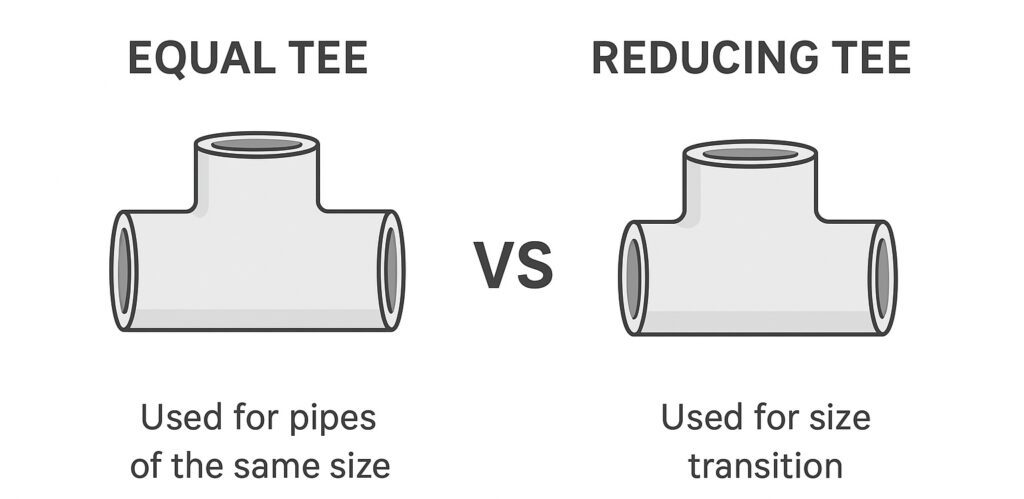
Forged Socket Weld Fittings Tees are categorized into two types based on structure: equal tee and reducing tee. Sizes range from DN6 to DN100, with common sizes being DN15 to DN50. Materials include carbon steel, stainless steel, and alloy steel. Pressure ratings include 3000LB, 6000LB, and SCH80. The product complies with the American Standard ASME B16.11. Contact us
Forged Fitting Socket Weld Tee Specification
| Standard | ASME 16.11, MSS SP-79, MSS SP-95, 83, 95, 97, BS 3799 |
| Size : | 1/8″ NB TO 4″ NB(DN6 – DN100) |
| Class : | 3000LBS, 6000LBS, 9000LBS |
| Type : | Socket Weld Fitting Tee, Socket Weld Equal Tee, Socket Weld Unequal Tee |
Advantages of Socket Weld Tees: Why Are They thePreferred Choice for Industrial Piping?
1. Strong Adaptability to High-Pressure Conditions
The socket weld tee’s socket weld structure can withstand higher working pressures (typically compatible with pressure ratings from Class 150 to Class 2500), far exceeding the pressure limits of threaded tees. Socket weld connections provide excellent structural strength, enabling them to withstand high internal and external pressures, and are commonly used in applications with pressure ratings of Class 3000, 6000, and 9000.
2. Corrosion Resistance
High-quality Socket Weld Tees are typically manufactured from materials such as stainless steel (e.g., 304, 316L), alloy steel, or specialty plastics. Among these, Socket Weld Tees made from 316L stainless steel not only resist corrosion from ordinary water and oil media but also significantly extend the service life of the fittings, reducing long-term maintenance costs.
3. Easy and Efficient Installation
Compared to the complex process of butt-welded tees, which require precise alignment of pipes and multiple welds, the installation of Socket Weld Tees is much simpler: simply insert the pipe into the socket and secure it with a single weld.
4. Wide Range of Applicable Media
Whether it is gas, liquid, or certain powder media, Socket Weld Tees can be reliably adapted.
5. High strength and leak-proof performance:
By welding the pipes and tees together, a robust and completely leak-proof connection is formed. This is critical for systems transporting high-pressure, high-temperature, or hazardous fluids.
6. Smooth inner walls: Although there are weld seams on the exterior, since the pipes are inserted into the socket, the weld seams do not protrude into the pipe interior, ensuring smooth fluid flow within the pipe and minimizing turbulence and pressure drop.
ASME B16.11 Socket Weld Tee Dimensions
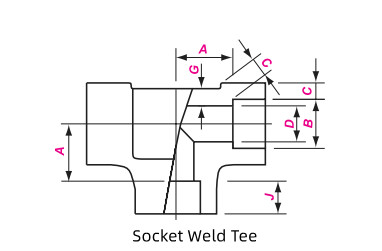
| DN | NPS | B | C | A | G | |||||||||
| 3000 | 6000 | 9000 | 3000 | 6000 | 9000 | 3000 | 6000 | 9000 | ||||||
| 6 | 1/8 | 10.9 | 3.18 | 3.18 | 3.96 | 3.43 | – | – | 11.0 | 11.0 | – | 2.41 | 3.15 | – |
| 8 | 1/4 | 14.3 | 3.78 | 3.30 | 4.60 | 4.01 | – | – | 11.0 | 13.5 | – | 3.02 | 3.68 | – |
| 10 | 3/8 | 17.7 | 4.01 | 3.5 | 5.03 | 4.37 | – | – | 13.5 | 15.5 | – | 3.20 | 4.01 | – |
| 15 | 1/2 | 21.9 | 4.67 | 4.09 | 5.97 | 5.18 | 9.53 | 8.18 | 15.5 | 19 | 25.5 | 3.73 | 4.78 | 7.47 |
| 20 | 3/4 | 27.3 | 4.09 | 4.27 | 6.96 | 6.04 | 9.78 | 8.56 | 19 | 25.5 | 28.5 | 3.91 | 5.56 | 7.82 |
| 25 | 1 | 34.0 | 5.69 | 4.98 | 7.92 | 6.93 | 11.38 | 9.96 | 22.5 | 27.0 | 32.0 | 4.55 | 6.35 | 9.09 |
| 32 | 11/4 | 42.8 | 6.07 | 5.28 | 7.92 | 6.93 | 12.14 | 10.62 | 27.0 | 32.0 | 35.0 | 4.85 | 6.35 | 9.70 |
| 40 | 11/2 | 48.9 | 6.35 | 5.54 | 8.92 | 7.80 | 12.7 | 11.12 | 32.0 | 38.0 | 38.0 | 5.08 | 7.14 | 10.15 |
| 50 | 2 | 61.2 | 6.93 | 6.04 | 10.92 | 9.50 | 13.84 | 12.12 | 38.0 | 41.0 | 54.0 | 5.54 | 8.74 | 11.07 |
| 65 | 21/2 | 73.9 | 8.76 | 7.62 | – | – | – | – | 41.0 | – | – | 7.01 | – | – |
| 80 | 3 | 89.9 | 9.52 | 8.30 | – | – | – | – | 57.0 | – | – | 7.62 | – | – |
| 100 | 4 | 115.5 | 10.69 | 9.35 | – | – | – | – | 66.5 | – | – | 8.56 | – | – |
2) Considering the tolerance of outside diameter of pipe, the diameters of some socket bore can be a little larger than the ones specified in B16.11.
3) When the sizes of the connecting pipes are not conformed to the ones specified in this catalog, the sizes of the connecting pipes shall be provided in the purchase specification.
4) When the fittings are reducing,the structure sizes shall be same as the ones of the straight fittings and B J D shall be machined per the according reducing ends.
5) Fittings can also be manufactured as the mixed connectings of Socket Weld and Threaded.
ASME B16.11 Forged Tee Weight Chart in KG
| DN | NPS | 3000 | 6000 | 9000 |
| 6 | 1/8 | 0.13 | 0.22 | – |
| 8 | 1/4 | 0.14 | 0.25 | – |
| 10 | 3/8 | 0.16 | 0.45 | – |
| 15 | 1/2 | 0.35 | 0.55 | 1.15 |
| 20 | 3/4 | 0.48 | 0.90 | 1.80 |
| 25 | 1 | 0.66 | 1.46 | 2.25 |
| 32 | 1-1/4 | 1.00 | 1.90 | 3.95 |
| 40 | 1-1//2 | 1.40 | 2.80 | 4.87 |
| 50 | 2 | 2.00 | 3.70 | 8.89 |
| 65 | 2-1/2 | 4.10 | – | – |
| 80 | 3 | 5.55 | – | – |
| 100 | 4 | 15.6 | – | – |
Tolerances for Socket Weld Fittings
| Nominal Size | All Fittings | Tees | Reducer Inserts | ||||
| Socket Bore Dia. | Bore Dia. of Fittings | Center to Bottom of Socket | Laying Length | Shank Dia. | Length | ||
| DN | NPS | B | D | A H | A | SD | SL |
| 6~8 | 1/8~1/4 | +0.4 0 | +1.5 0 | ± 1.0 | +1.5 0 | ± 0.25 | 0 -1.5 |
| 10~20 | 3/8~3/4 | +0.4 0 | +1.5 0 | ± 1.5 | +1.5 0 | ± 0.25 | 0 -1.5 |
| 25~40 | 1~11/2 | +0.4 0 | +1.5 0 | ± 2.0 | +2.0 0 | ± 0.25 | 0 -2.0 |
| 50 | 2 | +0.5 0 | +1.5 0 | ± 2.0 | +2.0 0 | ± 0.5 | 0 -2.0 |
| 65~80 | 21/2~3 | +0.5 0 | +3.0 0 | ± 2.5 | +2.5 0 | ± 0.5 | 0 -2.5 |
| 100 | 4 | +0.5 0 | +3.0 0 | ± 2.5 | +2.5 0 | ± 0.7 | 0 -2.5 |
Material & Grades of Forged Fittings Tees
Carbon Steel :
ASTM A105 / A105N,ASTM A350 LF2 / LF3, A694 F42 / 46 / 52 / 56 / 65 / 70
Alloy Steel :
ASTM / ASME A/SA 182 & A 387 F1, F5, F9, F11, F12, F22, F91
Stainless Steel :
ASTM A 182, A 240 F 304, 304L, 304H, 316, 316L, 316Ti, 310, 310S, 321, 321H, 317, 347, 347H, 904L
Duplex & Super Duplex Steel :
ASTM / ASME A/SA 182 F 44, F 45, F51, F 53, F 55, F 60, F 61
Copper Alloy Steel :
ASTM SB 61 , SB62 , SB151 , SB152 UNS No. C 70600 (Cu-Ni 90/10), C 71500 (Cu-Ni 70/30), UNS No. C 10100, 10200, 10300, 10800, 12000, 12200
Nickel Alloy :
ASTM SB564, SB160, SB472, SB162 Nickel 200 (UNS No. N02200), Nickel 201 (UNS No. N02201), Monel 400 (UNS No. N04400), Monel 500 (UNS No. N05500), Inconel 800 (UNS No. N08800), Inconel 825 (UNS No. N08825), Inconel 600 (UNS No. N06600), Inconel 625 (UNS No. N06625), Inconel 601 (UNS No. N06601), Hastelloy C 276 (UNS No.N10276), Alloy 20 (UNS No. N08020)
Types of Socket Weld Tee – Comparison
| Feature | Equal Tee (Straight Tee) | Reducing Tee (Unequal Tee) |
| Definition | All three outlets have the same diameter. | Branch outlet has a smaller diameter than the main pipe. |
| Flow Distribution | Divides or combines flow into three equal-sized directions. | Divides or combines flow where branch requires different pipe size. |
| Application | Used when all connecting pipes are of the same size. | Used when the branch connection requires a different size for flow reduction or transition. |
| Design | Simple, symmetrical shape. | Asymmetrical, with a smaller branch end. |
| Common Usage | General piping systems, balanced flow distribution. | Piping systems requiring size transition, fluid control, or reduced flow rate. |
Application Areas
Oil and Gas Transportation
Chemical and Petrochemical Plants
Power and Boiler Systems
Shipbuilding and Marine Engineering
High-Pressure Hydraulic and Steam Systems
Conclusion
The Socket Weld Tee, with its advantages of high-pressure resistance, corrosion resistance, easy installation, and wide applicability, has become an indispensable key component in industrial piping systems. Whether in high-pressure, high-temperature industries such as petrochemicals and power generation, or in fields with stringent hygiene and corrosion resistance requirements such as food and pharmaceuticals and water treatment, selecting the appropriate Socket Weld Tee can significantly enhance the stability and service life of the piping system.
When purchasing Socket Weld Tees, it is recommended to prioritize products manufactured by reputable manufacturers that comply with international/domestic standards, and to select the appropriate type based on the characteristics of the medium and operating conditions. During installation, strict adherence to specifications is essential to ensure the quality of the connections. In the future, with advancements in material technology and intelligent systems, Socket Weld Tees will play an increasingly important role in more industrial applications, providing stronger support for the efficient and safe operation of pipeline systems.