
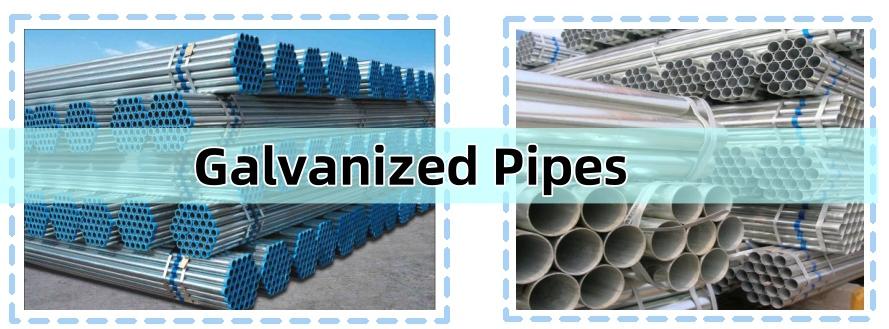
Galvanized pipes are steel pipe with a layer of hot dip galvanized or electro galvanized on the surface of welded pipe. Galvanizing increases the corrosion resistance of the steel pipe and extends its service life. It also significantly improves the corrosion resistance of the steel pipe and extends its service life. Galvanized pipes can be divided into many types according to different classification standards, each type showing unique advantages in specific applications. Galvanized pipes are widely used in oil well pipes and oil pipelines in the petroleum industry, oil heaters in chemical coking equipment, condensate coolers, coal distillation wash oil exchangers, and trestle piles and supports in mines. Contact us
Hot-dip Galvanized Pipes
Hot-dip galvanizing pipes are made by chemically reacting molten metal with the iron matrix to form an alloy layer, so that the matrix and the coating are tightly bonded. The steel pipe is first pickled to remove the iron oxide scale on the surface of the steel pipe. After pickling, it is cleaned in an ammonium chloride or zinc chloride aqueous solution or a mixed aqueous solution of ammonium chloride and zinc chloride, and then sent to a hot-dip plating tank. Hot-dip galvanizing has the advantages of uniform coating, strong adhesion, and long service life. The hot-dip galvanized pipe matrix undergoes a complex physical and chemical reaction with the molten plating solution to form a tightly structured corrosion-resistant zinc-iron alloy layer. The alloy layer is fused with the pure zinc layer and the steel pipe matrix, and has strong corrosion resistance.
Hot Galvanized Pipes Production Steps
Pre-treatment stage
Alkali washing: removes oil, lubricants and other organic impurities from the surface of the steel pipe, usually using an alkaline solution for treatment. This step is to ensure the subsequent pickling effect and zinc layer adhesion. Remove residues of degreasing solution.
Rust removal by pickling : The pipe is immersed in a pickling bath to remove inorganic impurities such as surface rust and oxidized skin. Pickling is a critical step to ensure a good bond between the zinc layer and the steel matrix. Remove the residue of the pickling solution and prevent the acid from being carried into the auxiliary plating bath.
Auxiliary plating treatment: The pickled steel pipe is immersed in an auxiliary plating solution consisting of ammonium chloride and zinc chloride to form a uniform protective film. This film prevents secondary oxidation of the steel pipe before drying and entering the zinc solution, and increases the wettability of the zinc solution on the surface of the steel pipe and promotes the reactive bonding of the zinc layer with the steel matrix.
Drying: The steel pipe after the auxiliary plating treatment is dried to remove the surface moisture to avoid moisture being carried into the zinc solution to trigger splashing and zinc layer defects.
Hot-dip galvanizing stage
Hot-dip galvanizing: The dried steel pipe is completely immersed in a molten zinc solution at a temperature of about 450°C. Iron and zinc undergo a metallurgical reaction, resulting in the formation of an iron-zinc alloy layer on the surface of the steel pipe and a pure zinc layer on the outside. The time and temperature of zinc dipping affects the thickness and organization of the coating.
Galvanizing: After the steel pipe is taken out of the zinc liquid, it is leached or blown to remove excess zinc inside and outside the pipe to make the coating uniform and smooth.
Post-treatment stage
Cooling: The galvanized steel pipe is cooled naturally or water-cooled to room temperature to allow the zinc layer to crystallize and solidify.
Passivation: Some products need to be immersed in a chromate solution to form a passivation film on the surface of the zinc layer to further enhance corrosion resistance.
Inspection and finishing: The appearance, coating thickness and adhesion of the galvanized pipe are inspected to ensure that the product meets the standards.
Electro Galvanized Pipe
Electro galvanized zinc has a very small amount of zinc coating, only 10-50g/m2, and its own corrosion resistance is much worse than that of hot galvanized pipe. In this method, a layer of zinc is electroplated on the surface of steel pipe by electrochemical principle. The thickness of the electroplated zinc layer is relatively thin and the surface is smooth and even, but the corrosion resistance is not as good as hot dip galvanizing.
Production steps of Electro Galvanized Pipe
Pre-treatment
Degreasing and degreasing: Use chemical or electrochemical methods to remove oil, dust, etc. from the steel surface to ensure zinc layer adhesion.
Pickling and rust removal: Minor corrosion can be treated by mechanical grinding, while severe corrosion requires pickling. Then rinse with water and neutralize the residual acid.
Water washing and neutralization: After pickling, water washing should be carried out to neutralize the residual acid.
Zinc Electroplating (Electrolytic Reaction)
The treated steel pipe is used as the cathode and placed into an electrolytic solution containing zinc salts. By direct current, zinc ions are reduced and deposited on the surface of the steel pipe to form a uniform zinc plating layer. Current density, plating time, electrolyte composition and temperature all affect the quality and thickness of the coating.
Post-treatment stage
Cleaning and drying: After galvanizing, the electrolyte remaining on the surface of the steel pipe is rinsed with water and then dried to remove moisture.
Passivation treatment: Form a protective film by chromate passivation to make up for the defect of thin zinc layer and enhance the corrosion resistance.
Inspection: Check the appearance of the zinc layer for smoothness and pinholes, and use a thickness gauge to check whether the thickness is up to standard.
Selection of Galvanizing Production Process
The choice of which galvanizing process to use depends on the specific usage requirements.
Hot-dip galvanizing is widely used in projects that require long-term corrosion protection. Such as fire protection, water supply and drainage, and gas, because of its thick coating, strong adhesion, and good corrosion resistance.
Electro-galvanizing, on the other hand, is suitable for applications that require a high level of appearance, uniform coating thickness, and relatively mild corrosive environments.
Advantages of Galvanized Pipe
Corrosion Resistance:
The zinc layer effectively isolates the steel from the outside environment, providing electrochemical protection and significantly extending the life of the pipe.
Cost-effective:
Galvanized pipe offers better economics in many applications than more expensive corrosion protection materials such as stainless steel pipe.
Easy to install:
Galvanized pipe can be connected in a variety of ways, such as threaded connections, welding, etc., making installation relatively easy.
Good durability:
The galvanized layer is hard and not easily damaged, and can withstand certain mechanical shocks.
Disadvantages of Galvanized Pipe
Easy to scale inside:
With the prolongation of the use of time, the galvanized pipe is easy to produce rust and scale inside, affecting water quality and flow.
Welding performance:
galvanized layer in the welding will produce zinc fumes, harmful to the welder’s body, and may affect the quality of the weld, the need for special welding process.
Unsuitable for certain media:
Galvanized pipes may not be suitable for the transport of drinking water, certain corrosive chemicals or high temperature and pressure media as the zinc coating may react with the medium or fail at high temperatures.
Potential environmental impact:
The galvanizing process, if not handled properly, may produce waste liquids and slag, which may have an impact on the environment.
How Long Do Galvanized Pipes Last?
The service life of galvanized pipe depends on many factors, such as environmental conditions, the thickness and quality of the zinc coating, water quality, and the presence of physical damage. Generally speaking, in a dry and less corrosive suburban, a high-quality hot-dip galvanized pipe can last 50 years or more. Some sources even indicate 60 years or more under ideal conditions. However, in more corrosive environments, the service life of galvanized pipe will be significantly shortened and may be only 20 to 30 years or less.
Differences Between Hot-dip Galvanizing and Electro-galvanizing
| Aspect | Hot-dip Galvanizing | Electro-galvanizing (Cold Galvanizing) |
| Process Principle | Steel is immersed in molten zinc (~450°C), forming a zinc-iron alloy layer | Zinc is deposited on the steel surface via electrolysis at room temperature |
| Zinc Coating Thickness | Thick, typically 35–85 μm | Thin, usually 5–15 μm |
| Adhesion Strength | Strong, metallurgically bonded to the substrate | Weaker adhesion, more prone to peeling |
| Corrosion Resistance | Excellent, suitable for outdoor and harsh environments | Moderate, best for indoor or dry environments |
| Surface Appearance | Rougher, matte or spangled finish | Smooth, bright, and more aesthetically pleasing |
| Service Life | 20–70+ years depending on conditions | 5–15 years |
| Cost of Processing | Higher, due to high-temperature zinc bath | Lower, suitable for mass production at low cost |
| Common Applications | Steel structures, outdoor piping, fences, power towers | Hardware, appliances, automotive parts, small components |
| Environmental Impact | Relatively eco-friendly, minimal waste liquid | Involves chemical solutions, requires proper waste treatment |
| Weldability | Not ideal for welding (zinc must be removed first) | Easier to weld due to thinner coating |
Is galvanized pipe ok for water?
The general consensus is that it is not recommended for new potable water piping installations. Especially after prolonged periods of use, and that its impact on water quality cannot be ignored. In the early days, galvanized pipe was widely used in potable water systems. However, over time, the galvanized layer corrodes and flakes off, leading to the following problems:
Water contamination: The corrosion of the zinc layer exposes the steel inside, triggering rust.
Reduced water flow and clogging: Internal rust and scale can build up, resulting in smaller pipe diameters, reduced water flow, and even complete clogging.
Reduced pipe life and leaks: Severe internal corrosion can lead to thinning of the pipe walls, eventually leading to leaks or pipe bursts.
You can get an offer for products in below material forms:
-Pipe and Tube (EN 10216-5, ASTM A213, ASTM A249, A312, A790,)
-Forged Fitting and Flange (ASTM A182 , ASTM A105,ASTM B564 )
–Butt Weld Fittings (ASTM A234, ASTM A403,ASTM A815)
-Round bar , Billet (ASTM A276, ASTM A479)
– Plate, Sheet, Strip(ASTM A240, EN 10028-7, A480)
-Bolting, Nuts(ASTM A193, A194, A320)